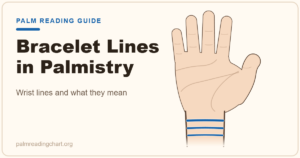
Bracelet lines in palmistry are the horizontal creases across the wrist, just below the base of the palm. Traditional readers treat them as themes of vitality, comfort and prosperity, and every one of the thirteen guides we read uses the word bracelet for them. Below you will see where the lines sit, how to find and count them, and how the guides read clear, faint, wavy, chained and broken ones. . . .
Travel Lines on Palm: Where They Sit and What They Mean
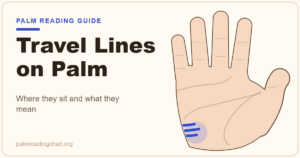
Travel lines on palm are short creases usually placed along the outer side of the hand, in the stretch between the little finger and the wrist. Palmists traditionally read them as journeys, moves and changes of scene, and every one of the nine guides we read uses the name travel line. This guide shows where the lines sit, how to spot them on your own hand and how to tell them from folds and . . .
Intuition Line Palm Reading: Where It Is and What It Means
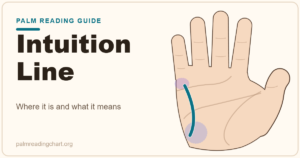
The intuition line is a curved mark on the outer edge of the palm. Most guides place it between the pad below the little finger and the pad at the heel of the hand. Palmists traditionally read it as a sign of gut feeling, sensitivity and vivid inner imagery. All ten guides we read link it to intuition, and eight describe it as rare, uncommon or missing from most hands. This guide locates the line . . .
Fingers in Palmistry: What Each Finger and Thumb Mean
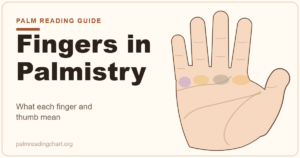
Fingers in palmistry are read as five small signposts on one hand: the thumb, the index finger, the middle finger, the ring finger and the little finger. Guides traditionally tie each one to a theme, then look at its length, its tip, its spacing and how it bends. Most begin with the planet names, so the first step is knowing which finger is which. This guide covers what each finger and the thumb . . .
Double Life Line Palm Reading: Meaning of the Sister Line
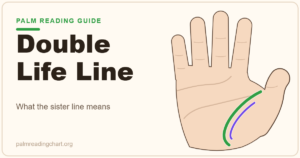
A double life line is a second line that runs beside the main life line around the base of the thumb. Palmists traditionally read it as extra support or a reserve of energy. Seven of the nine guides we read call it a sister line. This guide shows where the second line sits and how to tell it from a fork or a skin fold. It also sets out what full, partial, faint and wide versions are said to mean. . . .
Palm Marks: Meaning of Star, Cross, Triangle and Island
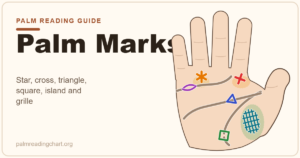
Palm marks are small shapes that sit on a line, between lines or on a mount: a star, a cross, a triangle, a square, an island or a grille. Palmistry guides traditionally read each one as a note added to the line or mount underneath it, not as a verdict of its own. Many apparent marks turn out to be ordinary creases, so the first skill is knowing what counts. This guide shows how to spot each of . . .
Girdle of Venus Palm: Meaning, Location and Types
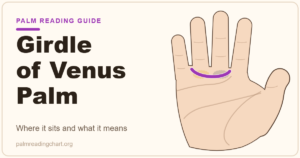
The girdle of Venus is a curved line high on the palm, above the heart line and just below the base of the fingers. Palmistry guides usually link it with strong feeling and a keen eye for beauty. Many palms have no such line at all, and most sites that discuss this treat having none as normal. This guide shows where to look, the main types, what palmistry sites say each one means, and how to tell . . .
Hand Shapes in Palmistry: Earth, Air, Fire and Water Hands
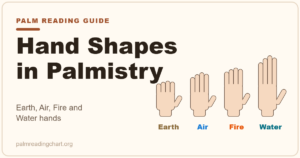
Hand shapes in palmistry are four commonly used types named Earth, Air, Fire and Water. Guides sort a hand by comparing two things. The first is how long the palm is next to how wide it is. The second is how long the fingers are next to the palm. This guide shows how to check your own hand in three steps and what tradition says about each type. Read all of this as tradition rather than science. . . .
- 1
- 2
- 3
- 4
- Older Posts