The trident sign on palm is a mark with three prongs, shaped like the trishul, the spear linked with the god Shiva. Palm guides traditionally treat it as a lucky mark that strengthens the mount or line it touches, and many list it among the rare ones.
This guide covers the outline, the spots where pages place the sign and the readings tied to each spot. It also shows how to tell the sign from a plain fork or a star. We read twelve pages from ten sites, and every count here is a count of pages. Most pages call a trident favorable, yet they disagree on its outline and say little about hands. Palmistry has no scientific backing, and Wikipedia describes it as a pseudoscience, so take every reading as folklore. The drawings show a right palm from the front, so flip them if you read your left palm.
Table of Contents
What Is the Trident Sign on Palm?
A trident sign is a small mark on the palm with three prongs, like a spear with three points. Five pages link it to Shiva, whose three-pronged spear is the trishul, and seven pages use the word trishul. Two tie it to Vedic readings. One page says the three prongs stand for victory, wisdom and the protection of resources.
One idea comes up again and again: the mark adds strength to the place where it sits. Four pages say it lifts the mount or line it touches, and at least two add that it also helps the neighboring mount. Four pages say it works in any position.
What a Trident Sign Looks Like
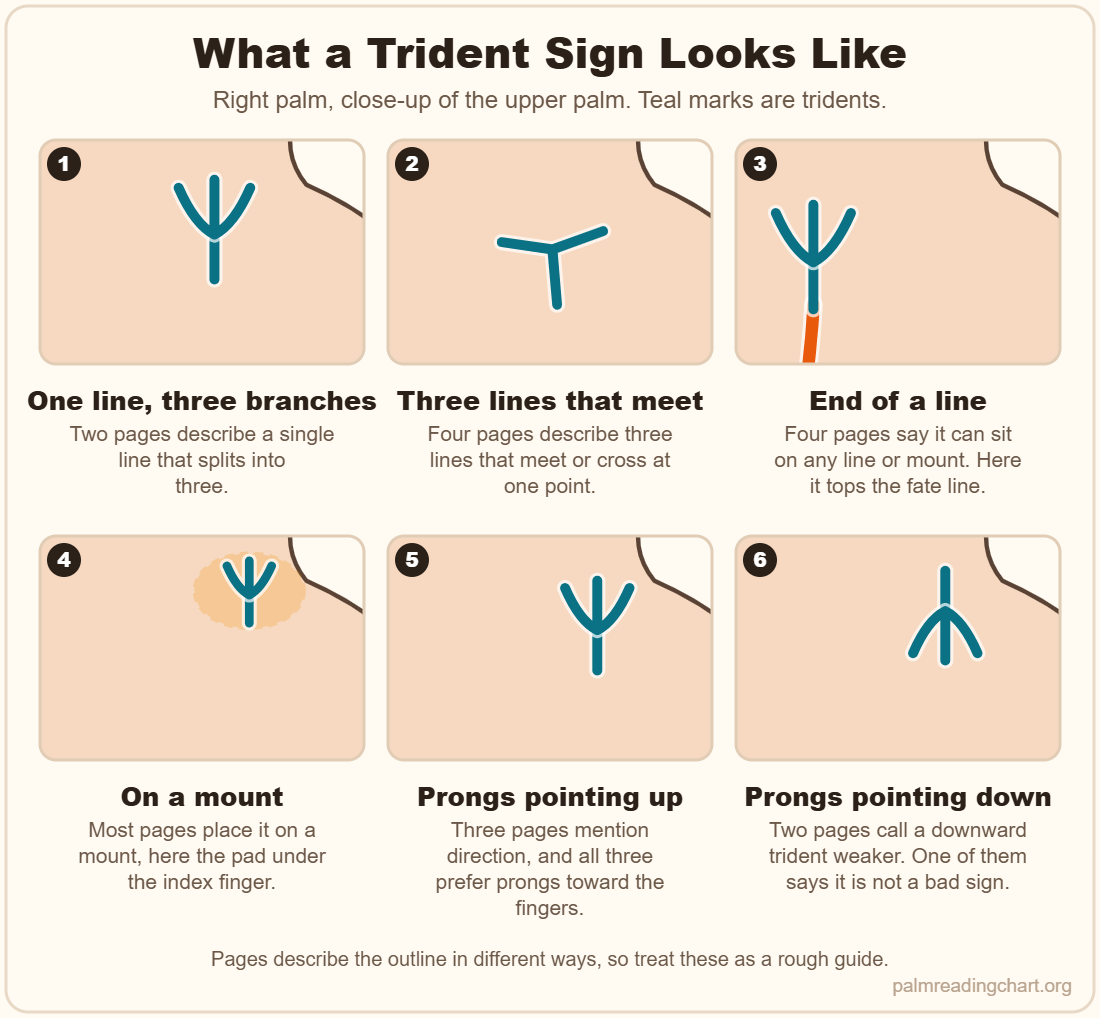
Descriptions of the shape vary, so Figure 1 sketches the main forms that pages mention. Six pages give no outline beyond the word trident, and three of those only say whether the prongs point up or down.
One Line, Three Branches
Two pages describe a single line that divides into three, like a trident with a stem. One says the line splits into three upward lines, and the other says the mark resembles three forks branching out. That form matches the name best, so it is the one we draw first.
Three Lines That Meet
Four pages describe three lines that meet or cross at one point. Three of them name the heart, head and life lines as the three, and the fourth says only that three distinct lines intersect in a set pattern. In our view this is a loose description, since the heart, head and life lines do not usually meet in one spot.
Prongs Up or Down
Three pages mention direction, and all three prefer prongs that point up toward the fingers. Two of them call a downward trident less effective or less prosperous, and one adds that it is not a bad sign. The third page ties a downward trident to delays, a reading we leave out.
Size and Clarity
Only one page sets a clarity rule. It asks for deep, clear lines and says faint scratches from dry skin do not count. No page gives a minimum size. We would note a mark you can barely see in good light, but we would not build a long reading on it.
Where Is the Trident Sign on the Palm?
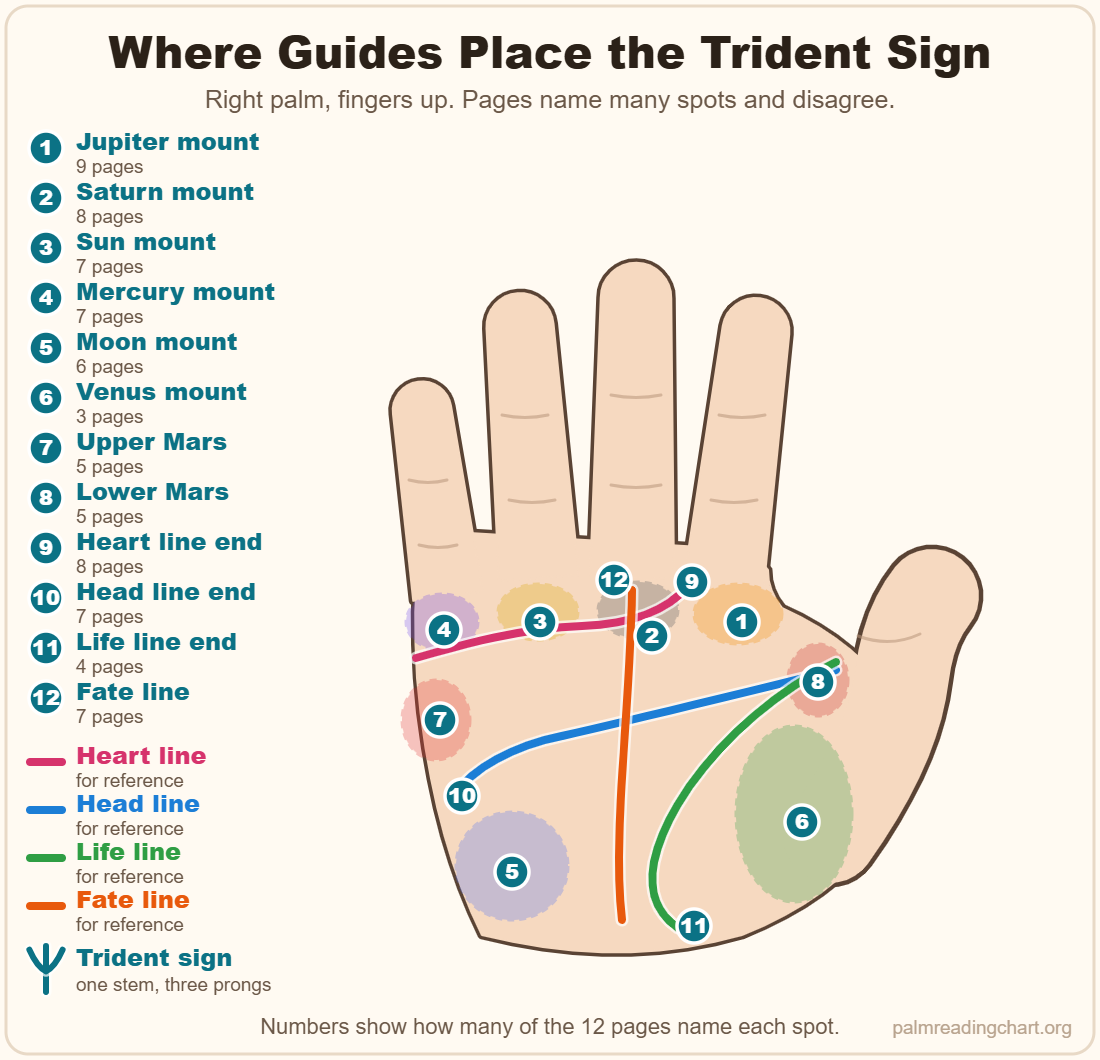
Pages name a dozen spots, and four pages say a trident can sit on any line or mount. Figure 2 shows, spot by spot, how many of the twelve pages name it. The mounts of the palm guide shows where each pad sits. Pages label some pads in different ways, such as the two Mars pads and the Moon pad, so the drawing follows the map in that guide.
Pads and Mounts
Nine pages name Jupiter, the pad beneath the index finger, more than any other spot. Eight name Saturn, beneath the middle finger. Seven pages name the sun mount under the ring finger, and seven name Mercury under the little finger. One of those seven calls the pad Buddha Parvat, which we read as Mercury. The Moon pad, across from the thumb near the wrist, comes up in six pages, and Venus, the swell at the base of the thumb, in three. Five pages name each Mars pad.
At the Ends of the Lines
Eight pages place a trident at the end of the heart line. Seven name the end of the head line, and seven name the fate line, most of them at its end. Four pages name the end of the life line. Our guides to the heart line, head line, life line and fate line show where each one usually ends. Two pages also name the sun line, the thin line that rises toward the ring finger.
How to Spot a Trident Sign on Your Palm
No page gives a step-by-step way to look for one, so this routine is our own.
- Sit by a window in soft daylight and open the palm without stretching it flat.
- Scan the pads under the fingers first, then follow each main line to its end.
- Count the prongs. A trident has three, which is one more than a fork and fewer than a tassel.
- Check that the prongs are lines of their own. Open and close the hand and see whether the mark keeps its shape.
- Study the other hand too, and write down what you see. Our which hand to read guide explains the rule we follow.
- Draw or photograph the mark before you read about it, so wishful thinking does not reshape it.
Trident Sign or Look-Alike?
Many small marks resemble a trident, and Figure 3 sets a trident beside five of them. Most of these look-alikes are our own picks, not topics the pages cover. Only the first counts. A plain fork has two prongs, and the head line guide linked earlier covers forks at the end of a line. A tassel has many fine branches. One page says faint dry-skin scratches do not count.
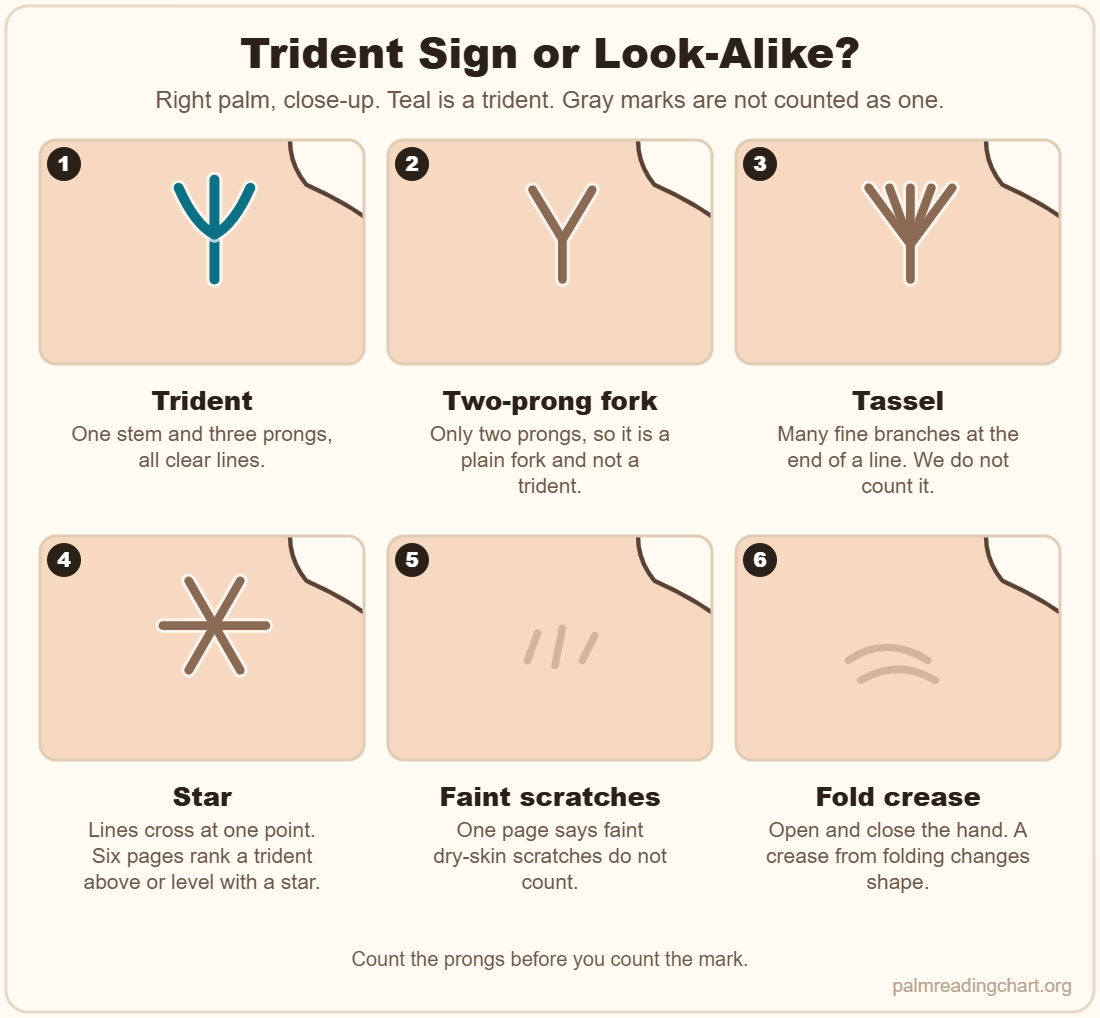
Six pages compare a trident with a star. Two say a trident on the sun mount equals a star there, and four say it outshines one. Our palm marks guide explains how a star differs.
What the Trident Sign Means in Palmistry
Meanings depend on the spot, so the headings below group them by theme. Each reading is what pages say, not something a trident does.
Success, Wealth and Recognition
Six pages read a trident on the fate line as a sign of success or wealth, and two of them add divine protection. A seventh says a trident on the fortune line keeps luck steady through problems. Seven pages read a trident on the sun mount as creativity, recognition or fame, and two read a trident on the sun line the same way. Two pages tie a trident on Jupiter to wealth or status, and two tie a trident that reaches the Saturn pad to property.
Leadership and Ambition
Jupiter’s pad draws this theme most often. Most of the nine pages naming it speak of leadership, ambition or recognition, and four add spiritual growth. One page calls Jupiter the most auspicious spot for a trident.
Discipline and Wisdom
Four of the eight pages that name Saturn speak of discipline or practical sense, and five speak of wisdom or call the bearer wise. One page adds simplicity and generosity, and another a post of high rank.
Communication and Creativity
Mercury’s pad, beneath the little finger, goes with communication or business in all seven pages that name it. Two of them add wealth, promotion or charm, and two add artistic skill. The sun mount draws creative themes, as noted above.
Love and Emotion
Three pages read a trident on the Venus pad as love and empathy. Four pages speak of strong feeling or a loving nature at the end of the heart line. Three of them add a gentle note to choose a partner with care. Two other pages call a trident at the end of the heart line fortunate and stable, especially when it ends beneath Jupiter.
Intuition and Imagination
All six pages that name the Moon pad speak of imagination, creativity or intuition. Four pages link the end of the head line with intuition or imagination. Two others say a head line that forks toward the Moon and Mercury pads suits a career in communication.
Courage, Energy and Travel
Five pages name each Mars pad, and they read them in different ways: courage, self-control, determination, sport or a gain after long effort. Three pages read a trident that ends the life line as energy and a taste for adventure, with travel possible if money allows.
Readings We Leave Out
Three pages attach worries to a spot, to a downward mark or to a line across a trident. We leave those readings out, since a few lines on the skin cannot support claims about health, family or luck.
Trident Sign Meaning by Location
This table sums up the spots from Figure 2 and the usual reading at each one.
| Location | Usual reading | Pages |
|---|---|---|
| Jupiter mount (index finger) | Leadership, ambition, recognition and status | 9 pages |
| Saturn mount (middle finger) | Discipline, practical sense and wisdom | 8 pages |
| Sun mount (ring finger) | Creativity, recognition and fame | 7 pages |
| Mercury mount (little finger) | Communication, business and charm | 7 pages |
| Moon mount (outer palm, near the wrist) | Imagination, creativity and intuition | 6 pages |
| Venus mount (base of the thumb) | Love, empathy and a comfortable life | 3 pages |
| Upper Mars | Self-control, courage or sport; pages differ | 5 pages |
| Lower Mars | Determination, courage or a gain after long effort; pages differ | 5 pages |
| End of the heart line | Strong feeling and loving nature; two call it fortunate | 8 pages |
| End of the head line | Intuition, imagination and creative ideas | 7 pages |
| End of the life line | Energy and a taste for travel, per three of the four | 4 pages |
| Fate line, mostly at its end | Success, wealth and protection | 7 pages |
How Rare Is the Trident Sign?
Eight pages call it rare, very rare or not found on every hand, and one of them lists it among five rare signs. One blog calls it a very common symbol because it is easy to see. No page gives a count or cites a study, so treat the word rare as a figure of speech.
Which Hand Shows the Trident?
Pages say little about hands. One singles out the right palm for luck and sensitivity, and another cites a general rule that your dominant hand reflects present career and wealth. The rest say nothing. If a trident shows on only one palm, note it and leave it at that.
Where the Pages Disagree
Most pages agree on the core claim: a trident is a favorable mark. They split on the outline, on the Mars pads, on how rare it is and on whether direction matters. Six of the twelve pages add some caution, from a note on choosing a partner to a worry tied to one spot.
Money plays a part too. At least four of the twelve pages sell readings, astrologer chats or other services, and a fifth links to its apps. One blog states its meanings as fact and sells reports by email, so weigh its promises of luck accordingly.
What the Trident Sign Cannot Tell You
Three tiny lines on the skin cannot decide your career, your income or your love life. If you find a trident, let it prompt you to look at your hand closely. Make real choices with facts and with advice from people who know your situation.
Having no trident costs nothing. One page says that lacking the mark is no disappointment, because life is what you make of it.
Trident Sign on Palm: Common Questions
What is the trident sign on palm?
It is a three-pronged mark, like the trishul. Palm guides traditionally call it lucky and say it adds strength to the mount or line where it sits.
Where is the trident sign on the palm?
Pages name the mounts beneath the fingers, the Moon, Venus and Mars pads, and the heart, head, life and fate lines. Jupiter’s pad is named most, by nine of the twelve pages.
Is the trident sign on palm lucky?
Most pages read it as lucky. A few attach worries to certain spots or to a downward mark, which this guide leaves out.
Is a trident on the palm rare?
Eight pages call it rare or say not everyone has one, but none gives a count. One blog calls it very common.
Does it matter if the trident points down?
Three pages mention direction and all three prefer prongs that point up. One of them says a downward trident is not a bad sign.
Conclusion
The trident sign on palm is a three-pronged mark that palm guides traditionally read as a lucky sign of strength, success and protection. Look for it in daylight, count the prongs and rule out a fork, a tassel and a star. Compare your other palm before you draw any meaning from it. One page lists the fish sign beside the trident among five rare signs. The mystic cross and the ring of Solomon are two more small marks we cover. For a walk through the lines in order, start with our beginner guide to reading your palm. Keep the labeled palm chart open to check each line and pad.
Leave a Reply