Sun line palm reading looks at a vertical line that rises toward the ring finger. Palmists also call it the Apollo line or the line of success. Most guides link it to recognition and creative fulfillment, and many warn against reading it as a promise of fame or money.
This guide covers where the sun line sits, the places it most often starts, what its markings mean and why having no sun line is common. Every drawing shows a right palm.
Treat everything below as tradition, not fact. Wikipedia’s entry on palmistry says the practice is widely regarded as a pseudoscience, so no line can predict your fame, your work or your income.
Table of Contents
What Is the Sun Line in Palmistry?
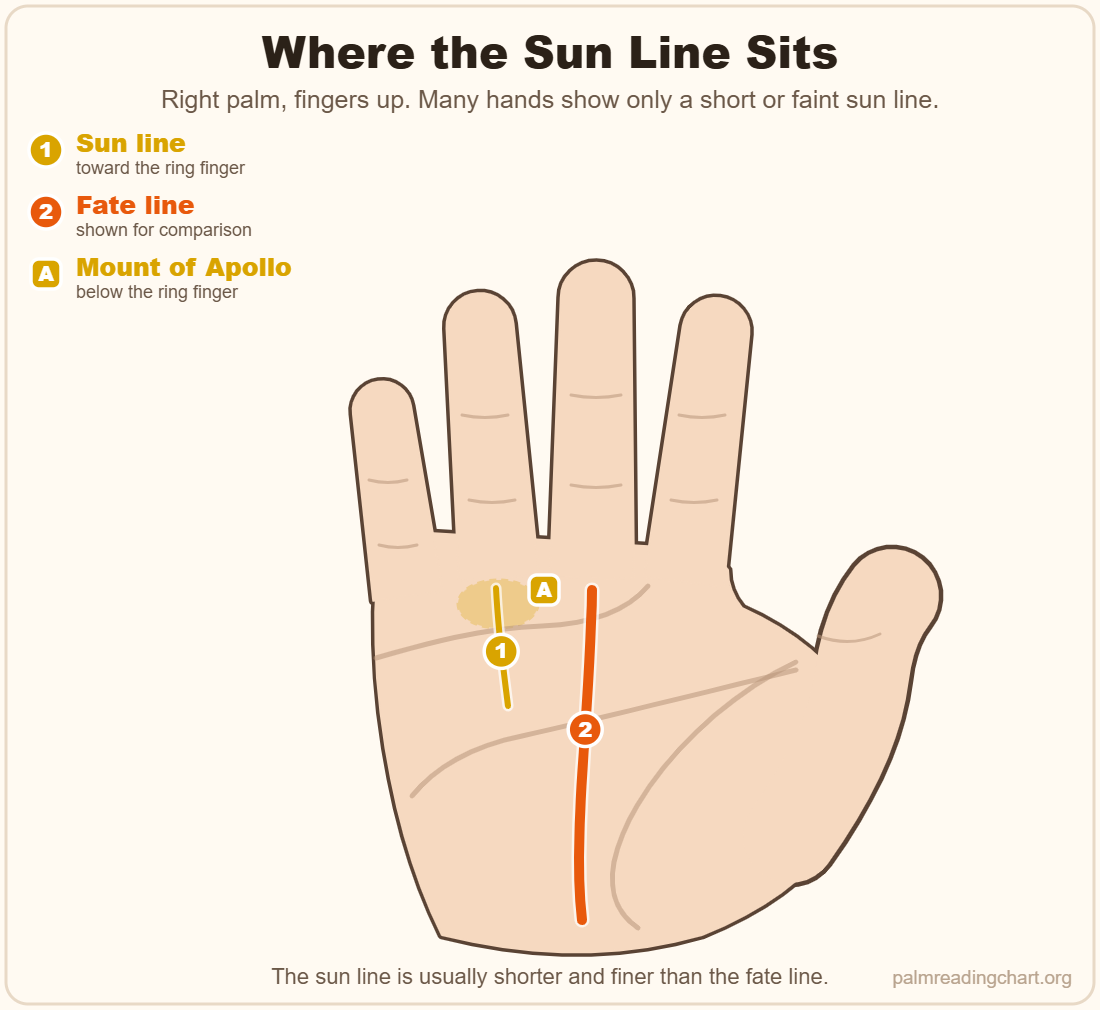
The sun line is a vertical line on the upper palm. It rises toward the base of the ring finger and ends on the Mount of Apollo. Guides use the names sun line, Apollo line and line of success for the same line. One guide says the palmist Cheiro used the name line of the Sun, and another lists the Hindu name Surya Rekha.
Where the sun line sits
Near the ring finger, it usually sits on the little-finger side of the fate line, often in the upper third of the palm. It is usually shorter and finer than the fate line, so it is easy to miss. The Mount of Apollo is the pad under the ring finger, and our palm reading chart shows it next to the other mounts.
What the sun line means
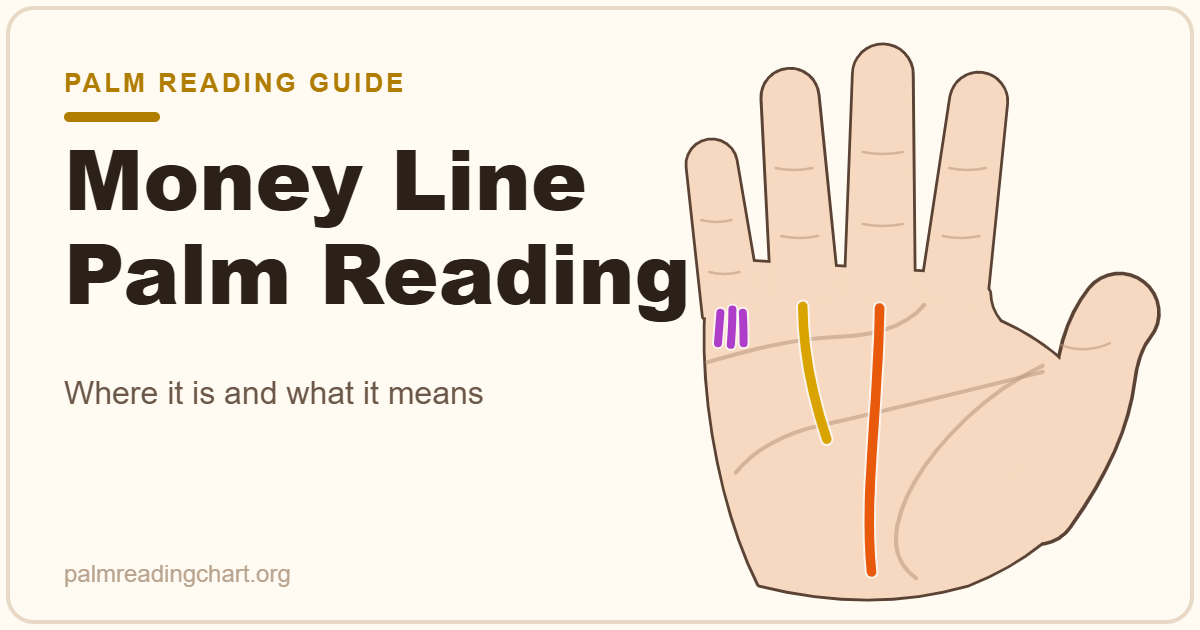
Guides tie the sun line to recognition, creative expression and a sense of fulfillment. Many guides say it describes the kind of recognition more than the amount. One guide says the label line of success oversells its link with money, and our money line palm reading guide sorts out the marks that guides do link with money.
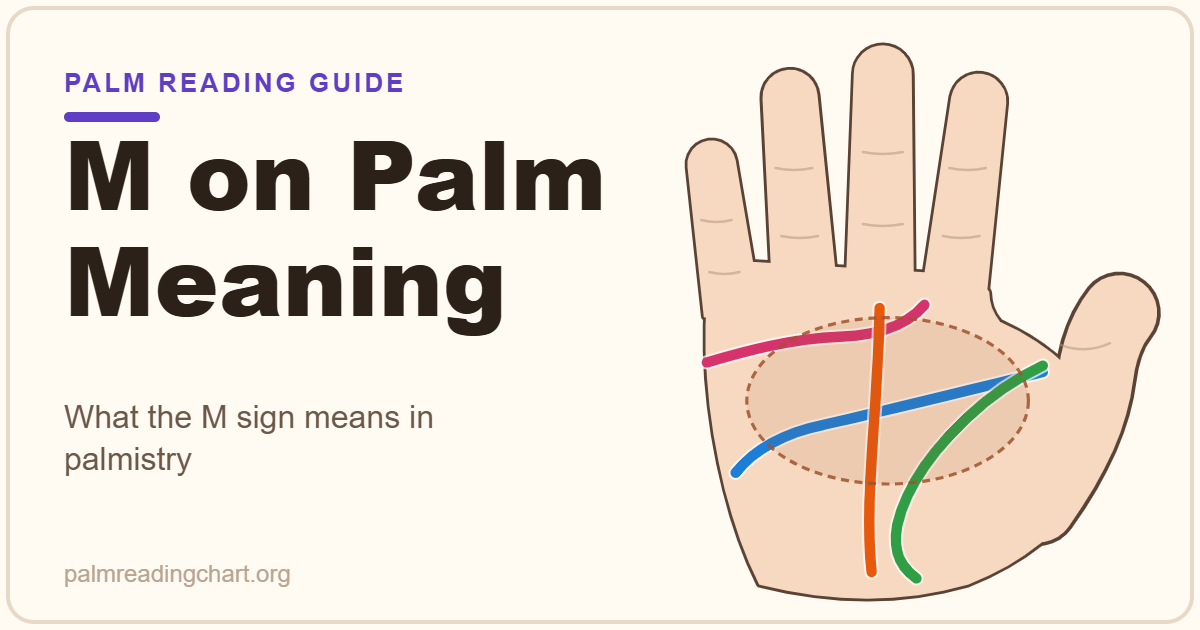
The fate line often runs close by, and guides tie that one to career direction. Our fate line guide covers it in full.
Sun Line Palm Reading: Where It Starts
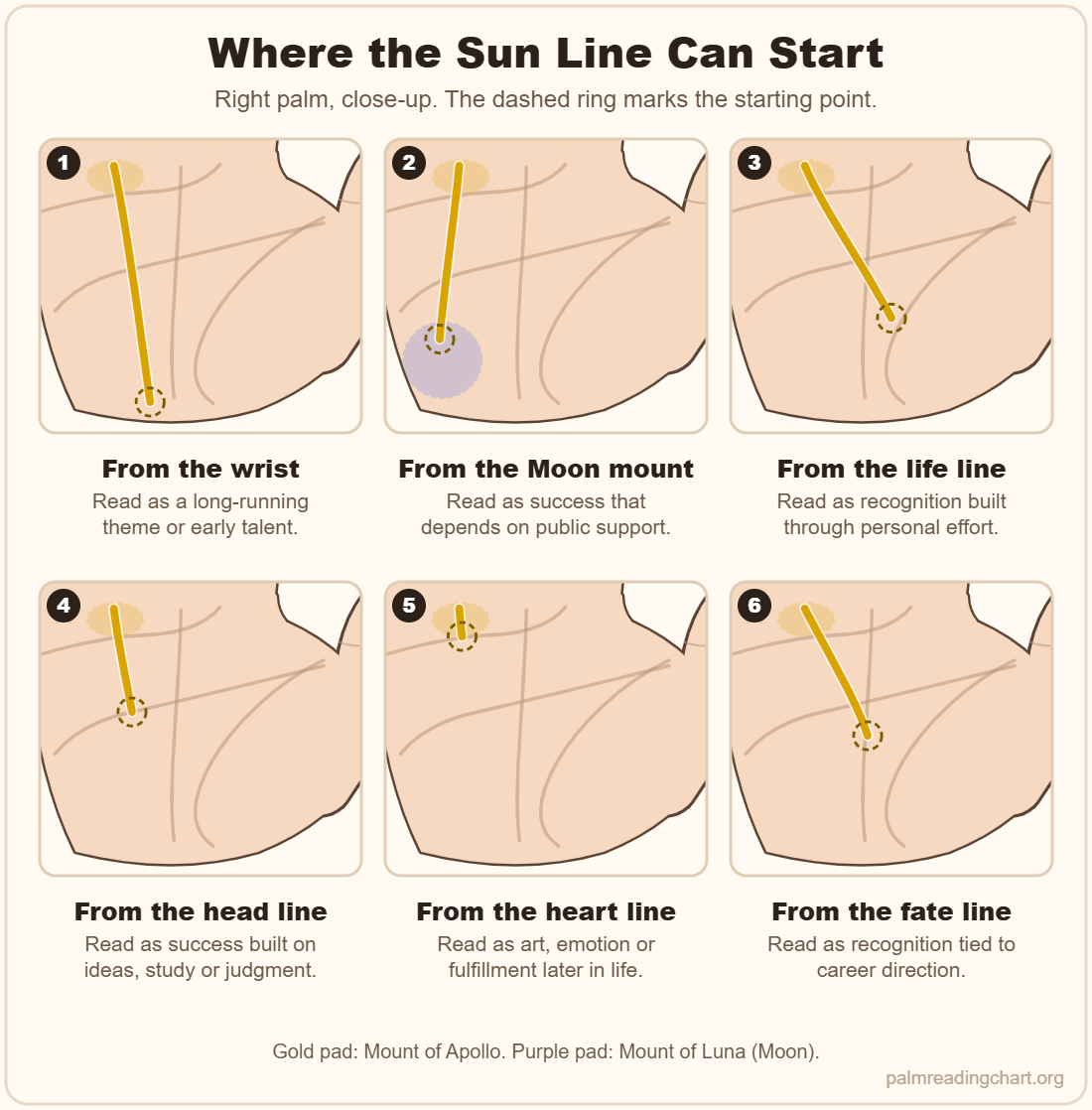
Guides describe several starting points, and six come up most often. Each gets a slightly different reading, and sources do not agree on a single one. In every case the line then rises toward the ring finger.
| Start point | Where it begins | Traditional reading |
|---|---|---|
| Wrist | At the base of the palm, then up its full length | A long-running theme or an early talent (several guides) |
| Mount of Luna (Moon) | The outer heel of the palm | Success that depends on public support and imagination (several guides) |
| Life line | The arc around the base of the thumb | Recognition earned through personal effort (some guides) |
| Head line | The line that crosses the middle of the palm | Success built on ideas, study or judgment (several guides) |
| Heart line | The line across the upper palm | Art, emotion or fulfillment later in life (several guides) |
| Fate line | The central line that rises up the palm | Recognition tied to career direction (a few guides) |
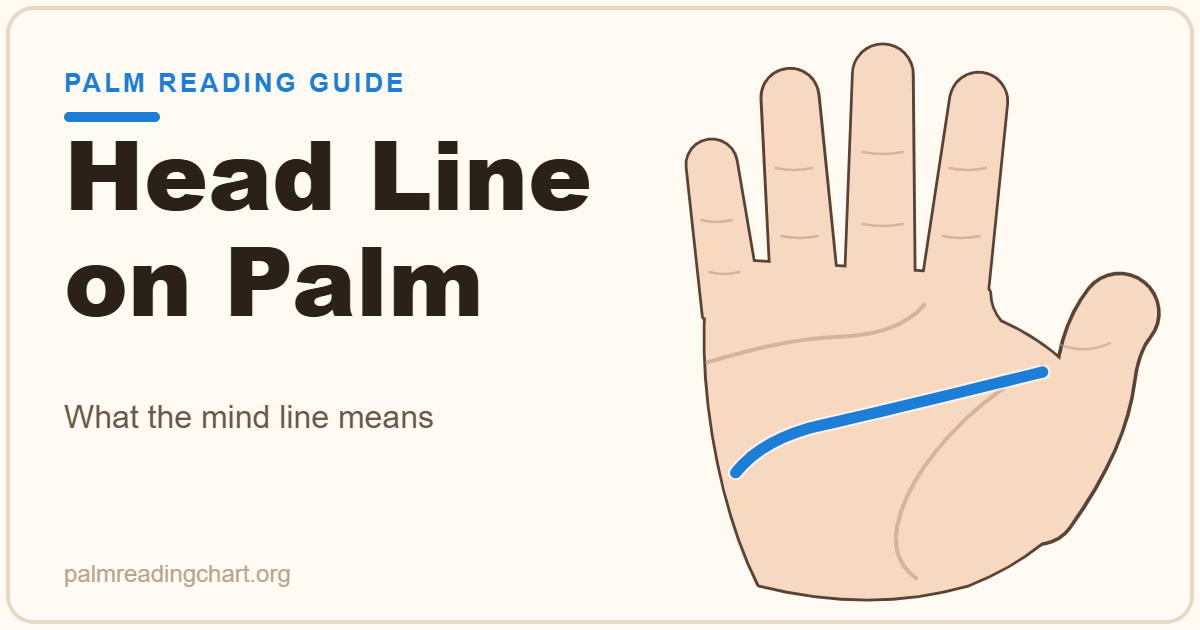
A sun line that starts at the wrist, the Moon mount or the life line crosses other lines on its way up. For the lines that it can spring from, see our guides to the life line, the head line and the heart line.
Sun Line Variations and Markings
Guides judge a sun line by how clear it is, how long it runs and which marks sit on it. These readings are traditional, and guides sometimes disagree.
Depth and length
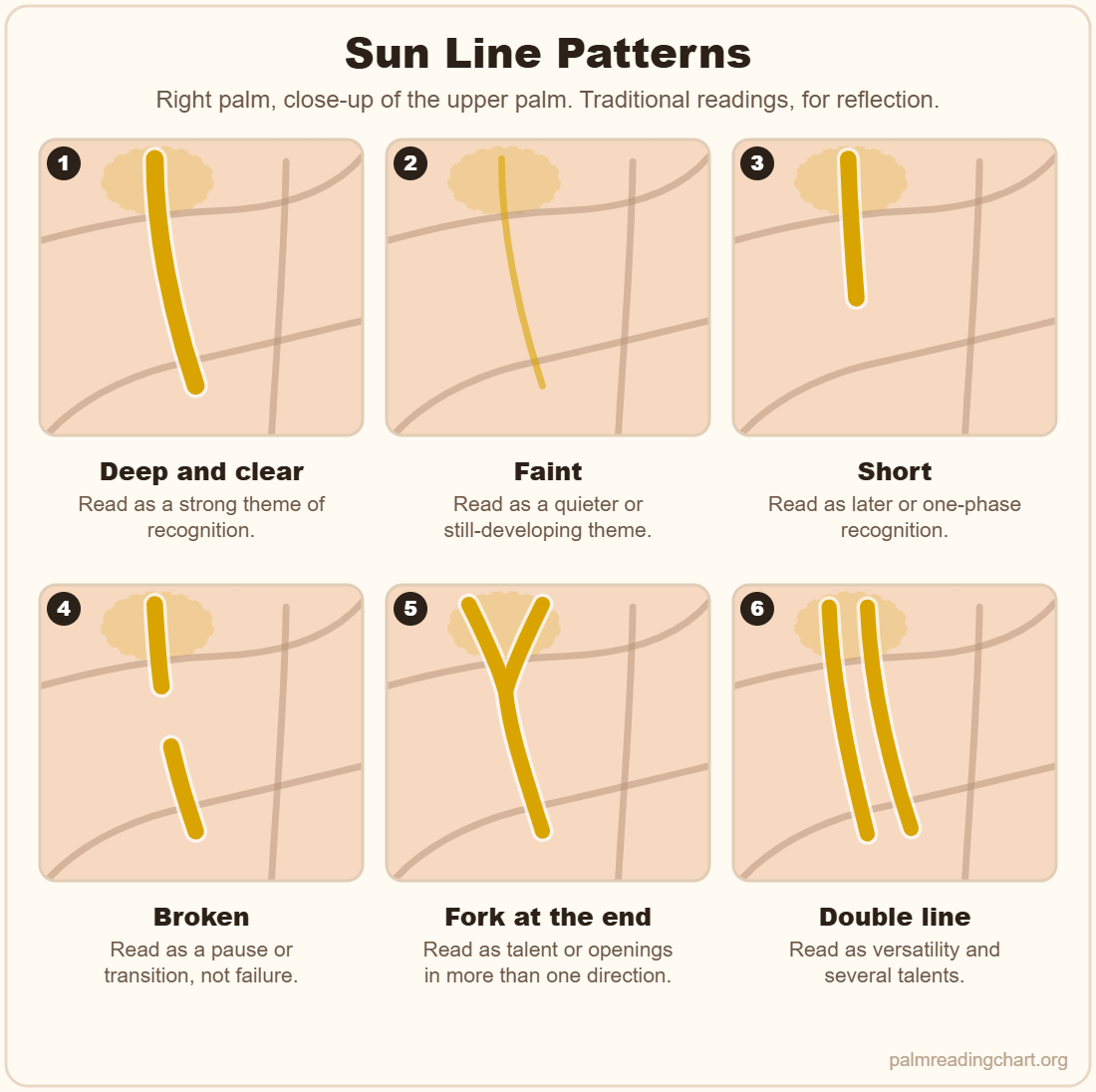
Guides read a deep, clear line as a strong theme of recognition. A faint line is read as quieter, more private or still developing, not as a missing one. A long line suggests a sustained theme. A short line, or one that shows only in the upper palm, is read as recognition that comes later or in one phase of life.
Breaks, forks and double lines
A break is read as a pause, a transition or a setback. Guides add that the line may resume afterward, so a break is not proof of failure. A fork at the end suggests talent or openings in more than one direction. Two lines side by side suggest versatility, with talent in more than one area.
Marks on the line
Marks are small signs on or beside the line. Many guides read a star as a sudden breakthrough or moment of notice. Two guides call it rare, and one warns that it is easy to over-read, so there is no need to hunt for one.
| Mark | What it looks like | Traditional reading |
|---|---|---|
| Island | A small oval in the line | A pressured stretch of work or public life; older texts are harsher, and one guide says modern readers are milder |
| Star | A small cluster of crossing lines | A sudden moment of notice or breakthrough; guides call it rare |
| Cross | Two short lines that cross on the sun line | A challenge or obstacle (several guides); a few sources read it more harshly, and this guide does not treat it as certain failure |
| Square | A small box around part of the line | Protection through a hard stretch (some guides) |
What an Absent Sun Line Means
Most guides treat a missing sun line as common and not as a failure. Guides say many hands have a short or faint line, or none at all, and the other lines still show the rest of the picture. Two guides take a harsher view of a missing sun line. This guide leaves that view out, since it reads as a prediction of failure.
It helps to look at the fate line first. One guide reads a clear fate line with no sun line beside it as steady direction without much spotlight. Some guides add that a sun line can shift or appear later, and one ties this to work gaining notice.
Which Hand to Read for the Sun Line
Several guides read your writing hand as present recognition and creative expression, and your other hand as inborn potential. Another guide says to read both hands and compare them. Our post on which hand to read explains the comparison.
How to Find Your Sun Line in 5 Steps
- Rest your hand palm up in soft daylight, with your fingers relaxed.
- Find your ring finger, then look down the palm below it for a vertical line.
- Check the little-finger side of the fate line, since the sun line often sits there.
- Follow the line downward to see where it starts, from the wrist, the Moon mount or one of the lines.
- Look at your other hand and note any differences.
Guides call a short or faint line common, so tilting your hand under a lamp can help.
What the Sun Line Cannot Tell You
Many guides say the sun line does not predict fame or wealth. It describes the quality of recognition, not how much you will receive or when. Palmists often say lines can change over time, and none of them can promise a career outcome. Please do not base a work or money decision on a line in your palm.
Sun Line Palm Reading FAQ
What is the sun line in palm reading?
It is a vertical line that rises toward the ring finger. Guides tie it to recognition, creative expression and fulfillment.
Where is the sun line on the hand?
Near the ring finger it usually sits on the little-finger side of the fate line and ends on the Mount of Apollo. It is often short and fine.
Does no sun line mean I will not be successful?
Most guides say no. They call a missing sun line common and not a sign of failure, as the section on an absent sun line explains.
Is the sun line the same as the Apollo line?
Yes. Guides use sun line, Apollo line and line of success for the same line, and the Mount of Apollo lies at its upper end.
Does the sun line mean fame or money?
Not by itself. Many guides say it points to recognition and creative fulfillment, and they do not read it as a promise of fame or income.
Can the sun line change?
Some guides say it can shift or appear later, and one ties this to work gaining notice. Palmists often say lines in general can change over a lifetime.
Conclusion
Sun line palm reading comes down to one vertical line toward the ring finger. A few details matter: where it starts, how clear it is and which marks sit on it. Compare both hands, remember that most guides call a faint line or none common, and treat every reading as symbolism. To see how all the lines fit together, open our guide to the main palm lines.


Leave a Reply