The fate line in hand is a vertical crease that runs up the palm toward the middle finger. Palmistry guides also call it the Saturn line, destiny line, career line or luck line, and Indian palmistry names it Bhagya Rekha.
Palmists traditionally read it as a picture of direction: how your sense of purpose forms, where it shifts and who or what shapes your path. It is not read as a fixed destiny. Because scientists treat palmistry as a pseudoscience, take everything below as symbolism for reflection, not as a forecast.
This guide shows where to find the line, what each start and end point is said to mean, how depth and shape change the reading, and what it can mean when a palm has no fate line. Every drawing shows a right palm. On a left hand, everything is mirrored.
Table of Contents
What Is the Fate Line?
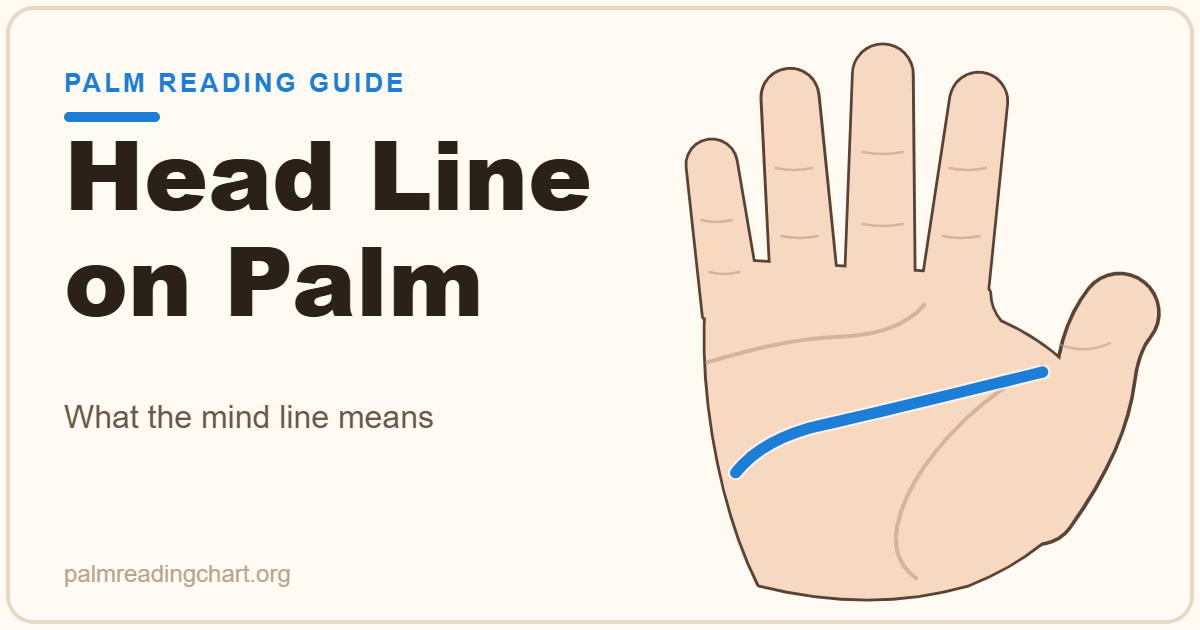
The fate line is the main line that runs up the center of the palm instead of across it. Most guides list four main lines: the heart, head, life and fate lines. Our palm lines guide shows all four on one hand.
Two guides say it changes more than the other main lines, and several say it can fade, deepen or shift over the years. One guide suggests looking again every few years.
Many palms show no fate line at all. Several guides call that normal, and most read a missing line as a self-directed path, not a missing purpose. The questions near the end of this page return to that point.
Where Is the Fate Line on Your Palm?
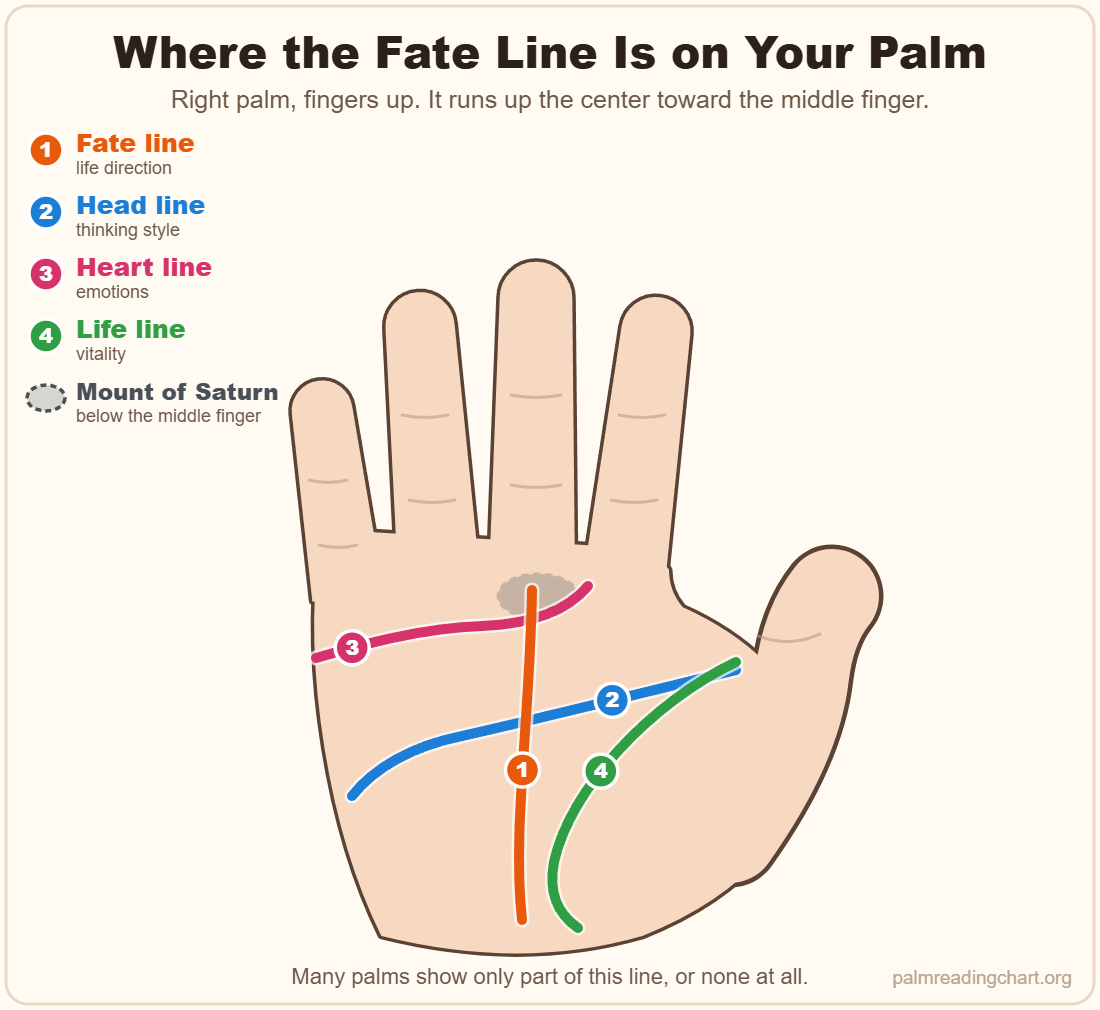
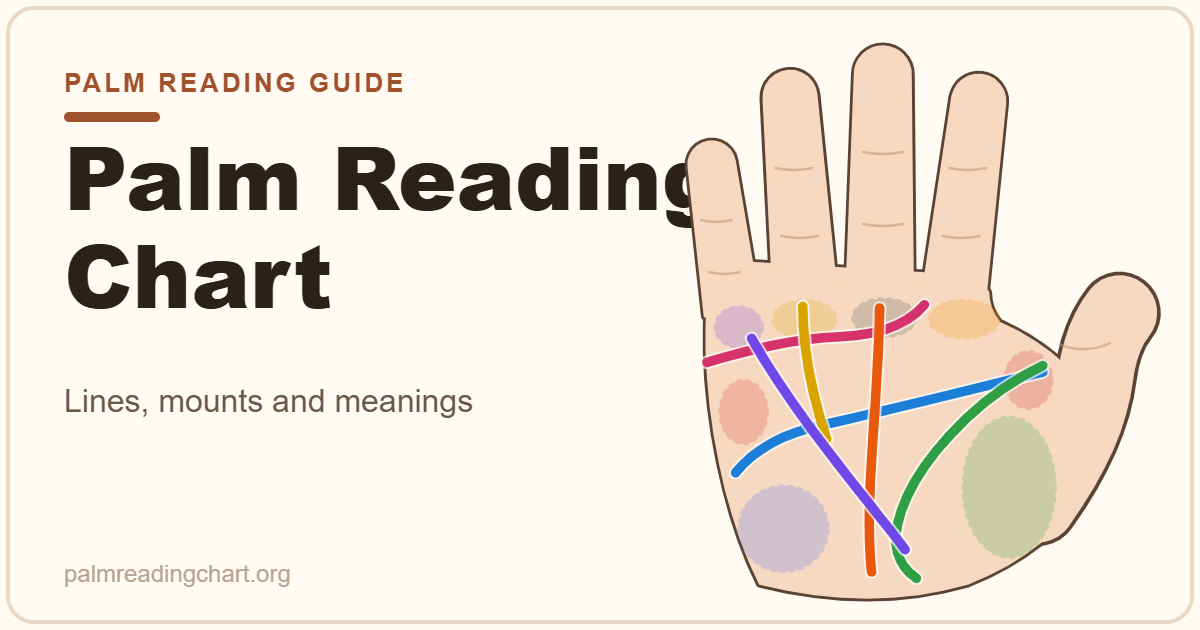
Look at the center of your palm. The fate line runs from the wrist side up toward the base of the middle finger, which sits above the Mount of Saturn. Guides say it may begin anywhere from the wrist up to the heart line, and many hands show only part of it.
To find it, hold your palm open in bright light and follow a straight path up from the center of the wrist toward the middle finger. Tilt the hand so the crease catches the light. A full-length line crosses the head line and the heart line on the way up.
Fate Line in Hand: Start Points and Their Meanings
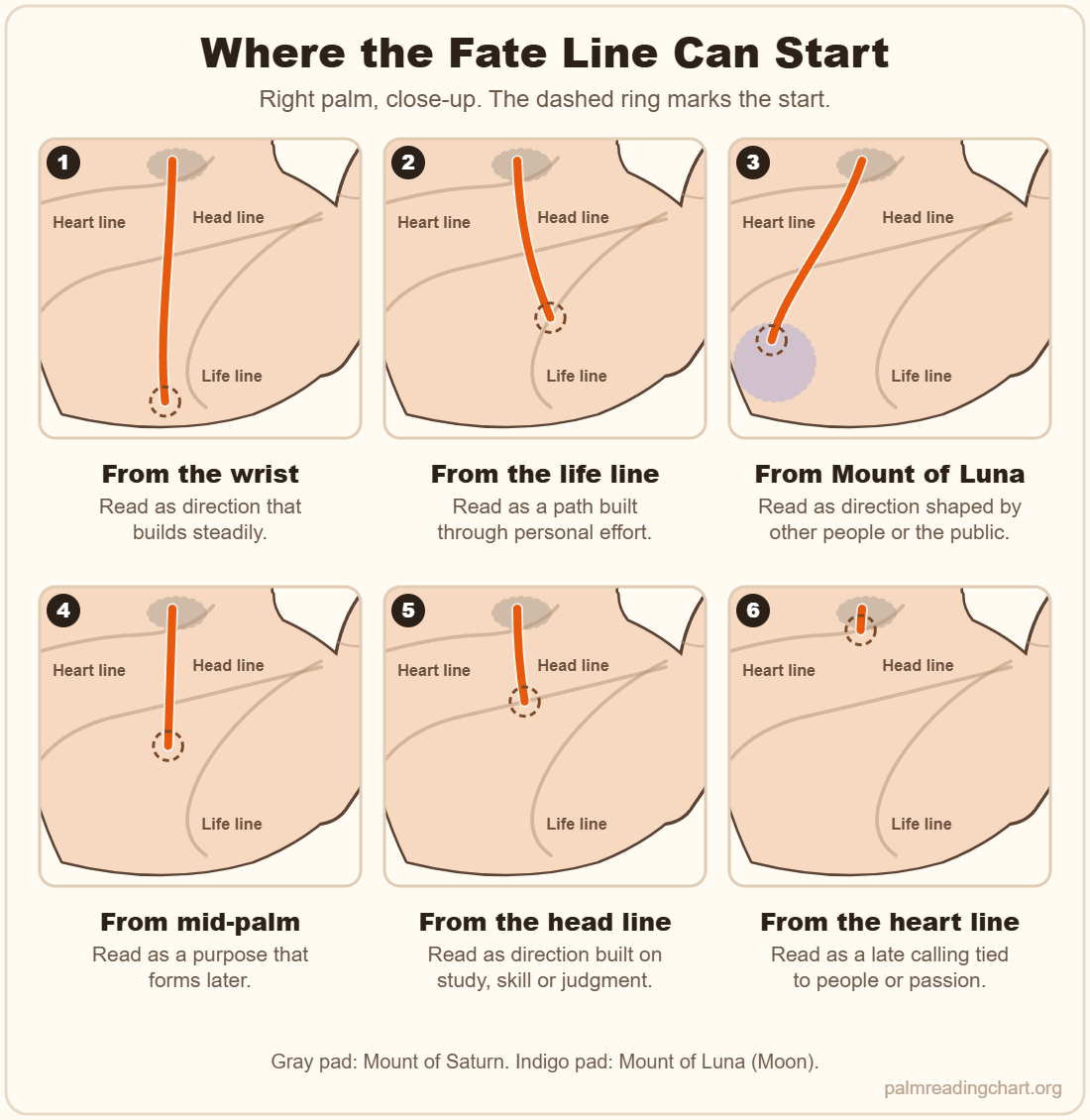
Guides read the starting point as the source of your sense of direction. The drawing and table below cover the six starting points that guides describe most. Readings differ between sources, so the last column notes how many guides agree.
| Start point | Traditional reading | How guides compare |
|---|---|---|
| 1. From the wrist | Direction that shows up early and builds steadily | Several guides |
| 2. From the life line | A path built through personal effort | Most guides; some add that family or upbringing shapes it |
| 3. From the Mount of Luna (Moon) | Direction shaped by the public, other people or creative work | Most guides |
| 4. From the middle of the palm | A purpose that forms later, or a self-made drive | Some guides |
| 5. From the head line | Direction that forms through study, skill or judgment | Most guides |
| 6. From the heart line | A calling that arrives later in life, linked with people or passion | Some guides |
Three guides also describe a line that rises from the Mount of Venus, the pad at the base of the thumb. They read it as family support behind the path.
Where the Fate Line Can End
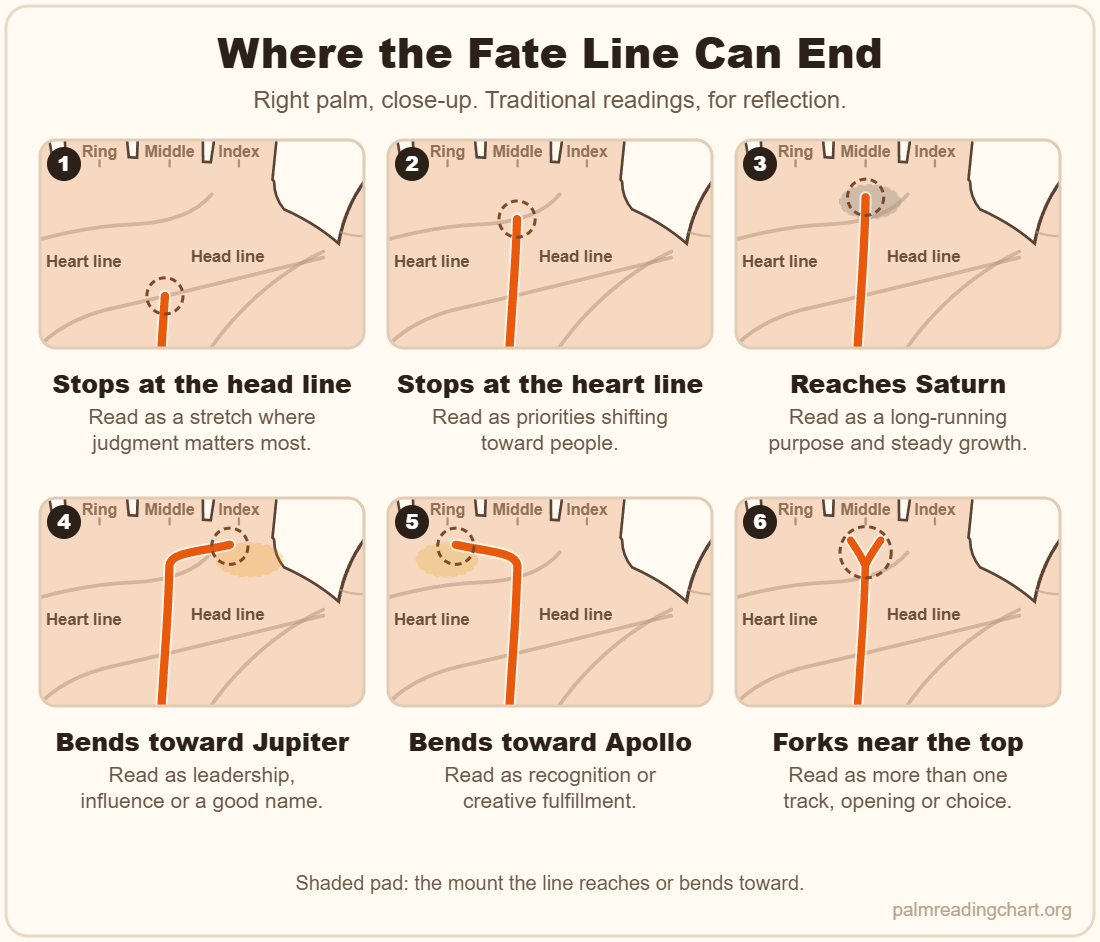
Guides read the end point too. A line that reaches the Mount of Saturn is the usual picture, but guides also describe lines that stop early or bend toward a neighboring finger.
| End point | Traditional reading | How guides compare |
|---|---|---|
| 1. Stops at the head line | A stretch where judgment and careful choices matter most | Several guides |
| 2. Stops at the heart line | Priorities shifting toward people, with feelings weighing on career choices | Several guides |
| 3. Reaches the Mount of Saturn | A long-running purpose and steady growth | Several guides |
| 4. Bends toward Jupiter (index finger) | Leadership, influence or a good reputation | Several guides |
| 5. Bends toward Apollo (ring finger) | Recognition or creative fulfillment | Some guides |
| 6. Forks near the top | More than one track, opening or choice | Several guides |
One guide also lists a line that ends toward Mercury, under the little finger, as a business-minded direction. Our guide to the mounts of the palm shows where each of these pads sits.
Timing Along the Line
Several guides read the fate line like a timeline from bottom to top. The wrist covers the early years. The crossing with the head line sits near age 35, the crossing with the heart line near 50 to 55, and the climb toward Saturn covers the later years. The age marks differ from guide to guide, and some call them symbolic. Use them to organize your own reflection, not to date events.
Fate Line Types: Depth, Shape and Length
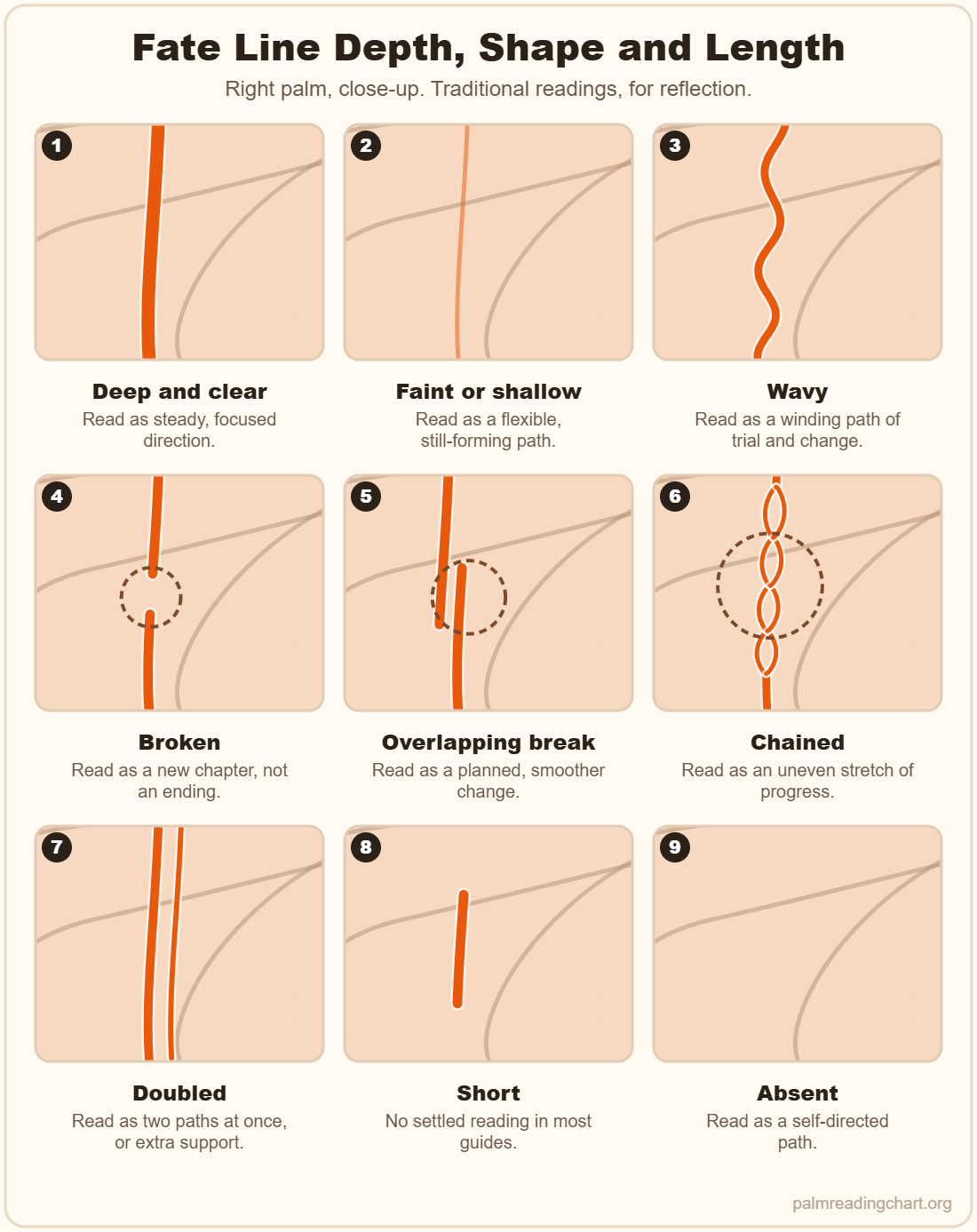
After the start and end, guides look at how the line itself is drawn. The nine patterns below come up in guides, from a deep line to no line at all.
| Pattern | Traditional reading | How guides compare |
|---|---|---|
| 1. Deep and clear | A steady, focused direction with consistent effort | Most guides |
| 2. Faint or shallow | A flexible, still-forming or self-made path; some say it can deepen | Several guides |
| 3. Wavy | A winding path built through trial and change | Some guides |
| 4. Broken | A change of direction or a new chapter, not an ending | Most guides |
| 5. Overlapping break | A planned, smoother change | Several guides |
| 6. Chained | An uneven stretch of progress | Some guides |
| 7. Doubled | Two paths at once, such as two callings or extra support | Most guides |
| 8. Short | No settled reading | Most guides do not cover it on its own |
| 9. Absent | A self-directed path | Most guides |
Two guides stress that a deep line is not a promise of success, since choices and circumstances still count. A break is not read as a failure either. Guides that cover breaks describe a turning point, and the overlapping version is the gentler of the two.
Marks on the Fate Line
Small marks on or beside the line add detail. Several sites attach harsh or fearful meanings to some of them. This guide leaves those out and lists only the milder readings that more than one guide shares.
| Mark | Traditional reading | How guides compare |
|---|---|---|
| Island (small oval) | A temporary stretch of uncertainty or divided attention | Four guides |
| Star | Recognition, or a sudden and memorable turn | Five guides |
| Cross | A hurdle or a sudden turn, not an ending | Four guides |
| Square | Protection or support during a hard stretch | Three guides |
A single mark does not tell the whole story. Look at the whole hand, in good light, and compare both palms.
Which Hand Do You Read the Fate Line On?
Read both hands. The writing hand is traditionally read for the path you are building now, and the other hand for the tendencies you were born with. If you read only one hand, start with the writing hand. Our guide on which hand to read in palm reading explains the rule in full.
Comparing the two hands is the useful part. One guide reads similar lines on both hands as steady alignment with your first direction, and different lines as choices reshaping the path.
Reading the Fate Line With Other Lines
No line stands alone. Where the fate line meets the head line, guides look at how judgment steers direction, and where it meets the heart line, at how feelings do. Two guides read a sun line running beside the fate line as recognition added to direction, and our sun line guide covers that line in full.
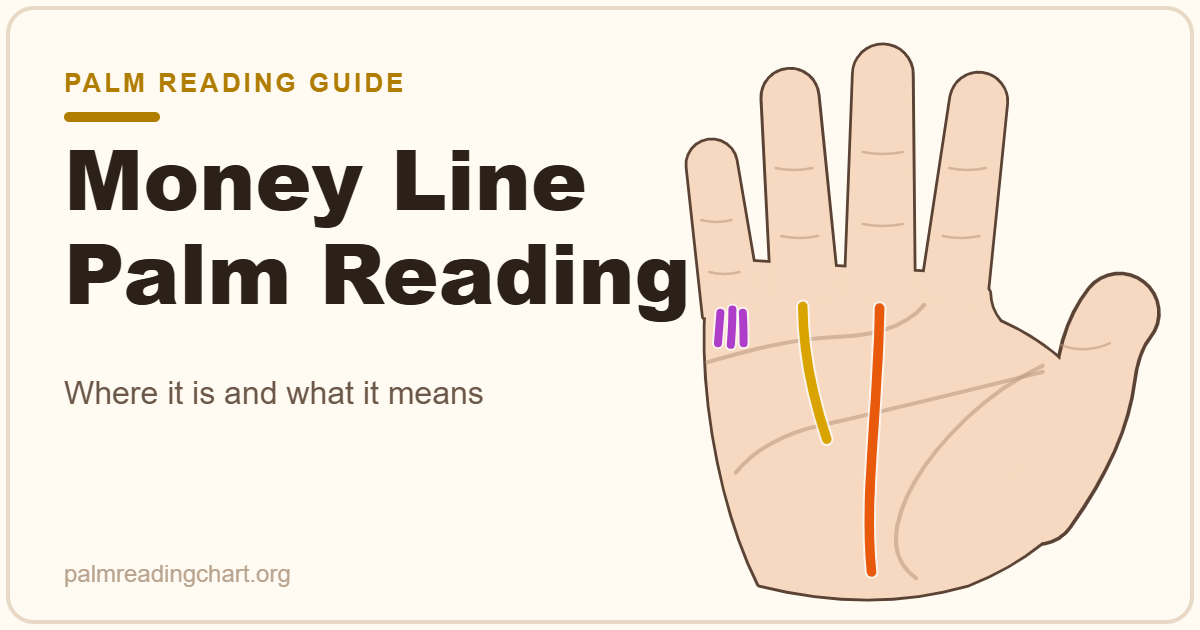
Several guides also look at the fate line when they search for money signs. Our money line guide explains why palmistry has no single money line. Some guides use the fate line as one of the four lines in an M shape, and our M on palm guide notes where sources disagree.
What the Fate Line Cannot Tell You
The fate line does not say which job to take, how much you could earn or what comes next. One guide says the line does not predict events. Lines also look different in different light and shift as hands change. Treat the line as a prompt for thinking about direction, then make your own choices.
Fate Line in Hand: Common Questions
What does it mean if a palm has no fate line?
Most guides read it as a self-directed path with no single track set in advance. Several call a missing line normal, and most say it is not a bad sign.
Is the fate line the same as the Saturn line?
Yes. Most guides use Saturn line, destiny line, career line and luck line for the same vertical crease, and Indian palmistry calls it Bhagya Rekha.
Can the fate line change over time?
Several guides say yes. They describe a line that can deepen, fade or shift as life changes, and one guide suggests looking again every few years. Some call the age marks along the line symbolic, so a change does not confirm any event.
Does a deep fate line mean success?
Not by itself. Most guides read a deep, clear line as steady focus and effort, but two stress that it is not a promise of success.
Does a broken fate line mean something bad?
Most guides read a break as a change of direction or a new chapter, not as failure. An overlapping break is read as a smoother, planned change.
Which hand shows the fate line?
Check both. The writing hand is traditionally read for the line you are drawing now, and the other hand for the one you started with.
Conclusion
The fate line in hand gives guides a way to talk about direction: where it starts, how it runs and where it ends. Guides generally do not treat a missing, faint or broken line as a bad sign, and no single line is a forecast of your future. Compare both hands, read the line together with the others, and keep going with our palm reading chart or the beginner steps in how to read your palm.

Leave a Reply