Marriage lines in palms are small horizontal creases at the pinky-side edge of the palm, just under the little finger, that palmists read as symbols of important relationships. Many guides call them relationship lines or affection lines, and Indian palmistry uses the name Vivah Rekha.
Below you will find where marriage lines sit, how to spot them, and the usual reading of each pattern. The pictures are close-ups of a right palm. A left palm looks like its mirror.
Treat all of it as tradition for reflection. Marriage line palm reading is not a forecast: Palmistry has no scientific support, and no crease can predict whether you will marry, divorce or be happy.
Table of Contents
Where Are the Marriage Lines on Your Palm?
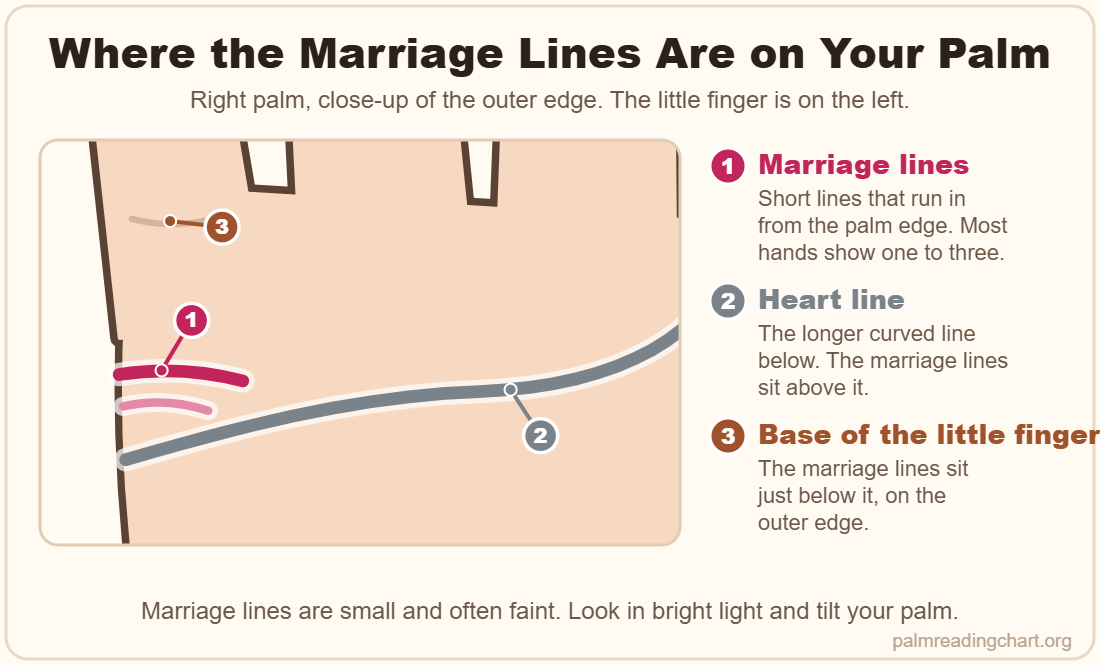
Marriage lines run in from the outer edge of the palm, the side opposite the thumb. They sit above the heart line and below the base of the little finger, in the area palmists link with the Mount of Mercury, the pad of flesh just under that finger. Most are short, and many are faint.
Other names and look-alikes
Besides relationship lines and affection lines, you will see the Indian name Vivah Rekha. Do not mix these short creases up with the heart line, the longer curve just below them, or with the upright lines that some palmists read as child lines.
How to Find Your Marriage Lines in 4 Steps
- Stand by a window or under a bright lamp and open your writing hand with the palm toward you.
- Locate the heart line, the long curved crease near the top of the palm. The marriage lines sit just above it, at the pinky-side edge.
- Curl the hand slightly or tilt it toward the light so the short creases stand out.
- Repeat with your other hand, then compare the two before you read anything.
Pressure, dry skin and bent fingers can all make marks look stronger than they are, so check that a line is still visible when the hand is relaxed. For the major creases around these short lines, see palm lines and what they mean.
What Number, Length and Depth of Marriage Lines Mean
Palmists read several features together. The readings below draw on several palmistry sites and show one common version, so treat them as a starting point, not a rule.
One line, several lines or none
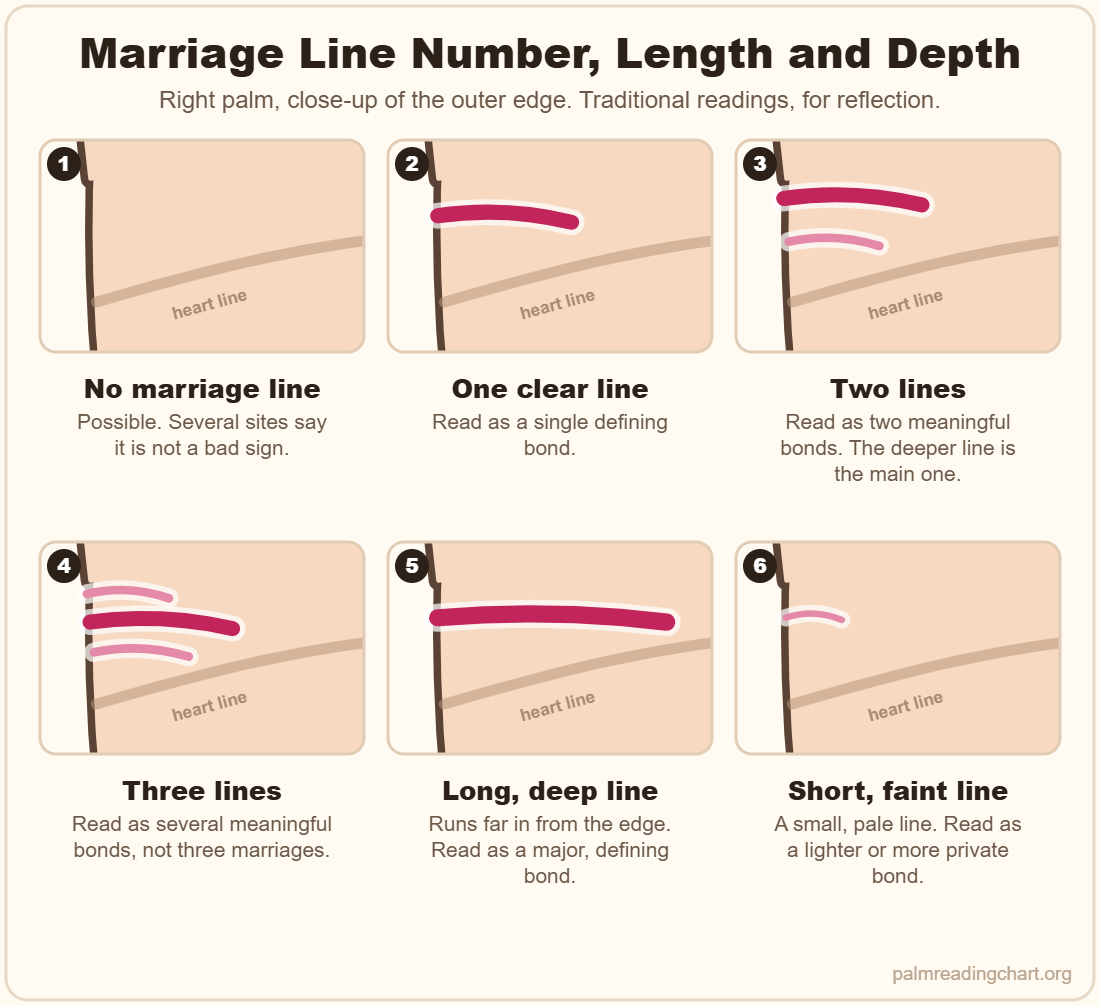
Most palms show between one and three marriage lines. Sites agree on one point: the number is not a count of marriages. Each line stands for a significant bond, which may be a partner, a close relationship or another deep attachment.
One clear line points to a single defining bond. Two or three lines suggest several meaningful bonds, and the longest or deepest one is treated as the most important. Some sites read many fine lines as an open, warm emotional life. It is possible to have no line at all. Several sites say that is not a bad sign and does not mean a life without love, while others read it as a more private approach to partnership.
Long or short marriage line
A long line suggests a major, defining attachment, and some sites add that it hints at a lasting one. A short line suggests a real but smaller bond. One site stresses that length shows the weight of a bond, not how long a marriage lasts, so sources differ here.
Deep or faint marriage line
A deep, clear line suggests a strong emotional presence. A faint line points to a lighter or more private bond, and one site adds that faint lines may deepen as relationships mature. Another site says depth matters more than length, so a short, deep line can carry more weight than a long, faint one.
Rising, Drooping, Forked and Broken Marriage Lines
Shape and marks add detail. Sites overlap on the milder readings and differ on the rest. Several of them call these features turning points rather than verdicts.
Rising or drooping line
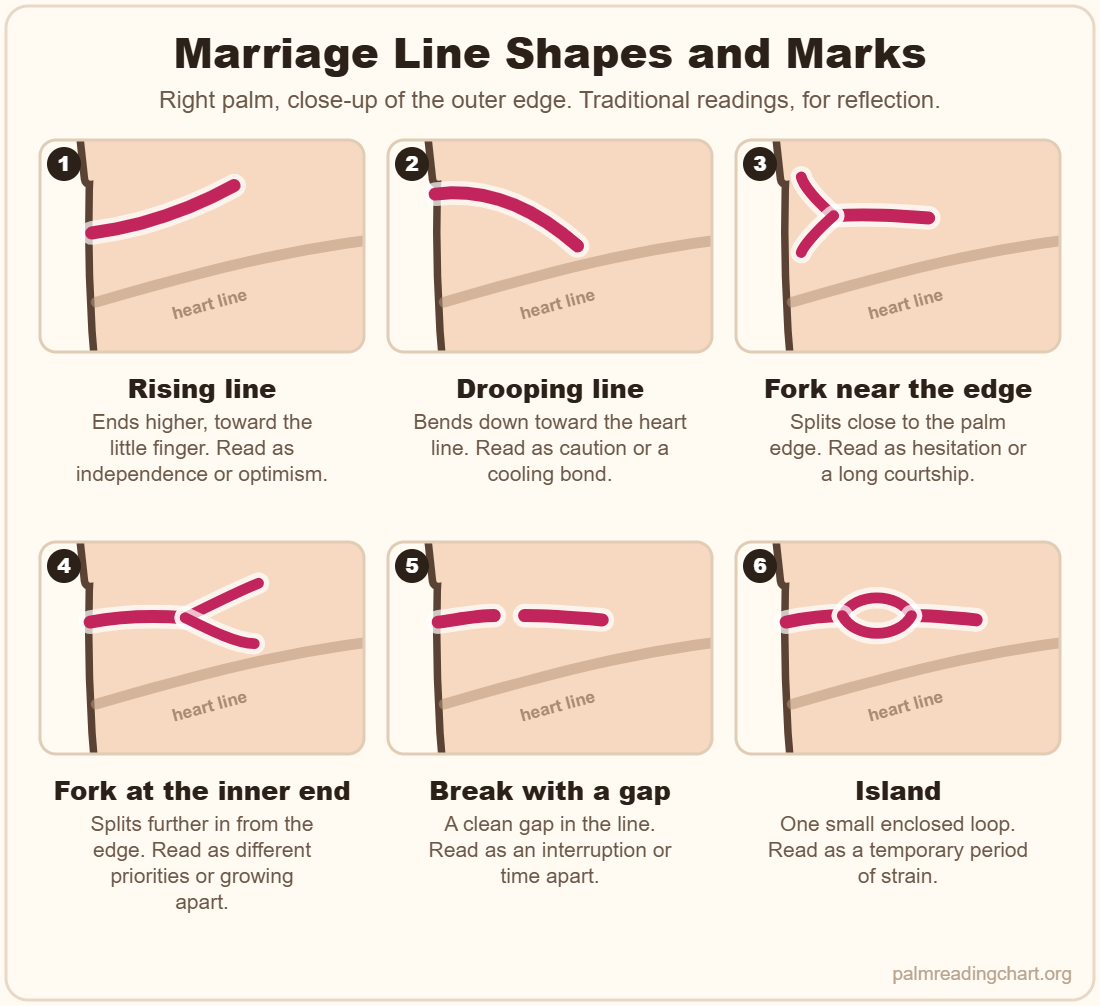
A line that rises toward the little finger is read as independence, optimism or contentment, alone or with a partner, and sites differ on which. A line that bends down toward the heart line is read as caution, emotional work or a bond that cools over time. Many guides attach darker meanings to a drooping line, including meanings about a partner’s life. We leave those out because nothing supports them.
Forked marriage lines
Sites read the two ends differently, and one reverses the usual view. A fork near the edge of the palm is read as hesitation, a slow start or a long courtship. A fork at the inner end is read in several ways, from different priorities to growing apart, and some guides call it a parting of ways. A small fork is read as a turning point, not a failure, and one site says a fork does not signal a breakup.
Broken marriage lines
A gap is read as an interruption, such as time apart, a disagreement or a turning point. A line that picks up again after the gap suggests a bond that continues. Ends that overlap suggest a restart on different terms. One site frames a break as transformation rather than an ending.
Islands and double lines
A small island on the line is read as a temporary period of strain or doubt. Few sources discuss islands, so treat it as a minor detail. One site reads two similar lines side by side as two bonds of comparable weight, or one relationship with two chapters.
Does Distance From the Heart Line Show Timing?
Some sites divide the space between the heart line and the little finger into life stages. A line close to the heart line is read as an earlier bond, and a line close to the little finger as a later one. The sites do not agree on ages. One puts the middle of the zone in the thirties and forties, another at roughly 25 to 35, and others say there is no reliable scale at all.
Treat the idea as loose symbolism. Where a line sits does not tell you when, or whether, you will marry.
Quick Guide to Marriage Line Patterns
These are traditional symbols for reflection, not predictions.
| Pattern | Traditional reading |
|---|---|
| No marriage line | Not a bad sign, say several sites; others read a more private style |
| One clear line | A single defining bond |
| Two or three lines | Several meaningful bonds; the deepest is the main one |
| Many fine lines | An open, warm emotional life (some sites) |
| Long line | A major, defining attachment |
| Short line | A smaller bond |
| Deep line | Strong emotional presence |
| Faint line | A lighter or more private bond |
| Rising line | Independence or optimism |
| Drooping line | Caution or emotional work; sources differ |
| Fork near the edge | Hesitation or a long courtship |
| Fork at the inner end | Different priorities or growing apart; sources differ |
| Break with a gap | An interruption or time apart |
| Break that overlaps | A restart on new terms |
| Island | A temporary period of strain or doubt |
| Double lines | Two bonds of similar weight, or two chapters (one site) |
What Marriage Lines Cannot Tell You
Marriage lines do not show whether you will marry or stay single, and they do not measure how happy a relationship is. The sources we drew on stress that these are symbols for reflection, and they are not a reason to make or reject a relationship decision.
Some sites link these lines to specific life events or to a partner’s fate. We leave those readings out. Lines also change over a lifetime, and lighting or skin pressure can create marks that are not part of the line. If you read a friend’s hand, ask first and keep the tone light.
Which Hand to Read for Marriage Lines
Look at both hands. Use the hand you write with for the relationships you are living today, and the other hand for the nature you were born with, as palmists describe it. One site calls differences between the two hands especially revealing. Some traditions pick a hand by gender, and they disagree with each other. Our article on which hand to read in palm reading compares the options.
Marriage Lines in Palms FAQ
Does the number of marriage lines show how many times I will marry?
No. Sites agree that the number of lines points to significant relationships, not to the number of marriages.
Is it bad if I have no marriage line?
No. Some hands show none, and several sites say a missing line does not mean you will not find love.
Which hand shows the marriage lines?
Both hands show them. Palmists usually start with the hand you write with, then compare the other.
Do marriage lines change over time?
Several sites say they do: lines can fade, deepen or gain small marks as life goes on. It is fine to look again now and then.
Are marriage lines read differently for men and women?
Two sites say the meaning is the same for women and men. One Vedic-style site gives separate readings, and some traditions choose the hand to read by gender, so the rules vary.
What are the short upright lines above a marriage line?
Some palmists read short lines that rise from a marriage line toward the little finger as children or creative projects, while other sources read crossing lines differently. Our guide to child line palm reading covers them.
Conclusion
Marriage lines in palms are small creases that palmists read as symbols of important relationships. Treat them as reflection, never as a forecast. Count them, note how long and deep they are, read both hands and keep the readings light. For the bigger picture, use our palm reading chart and our beginner guide on how to read your palm.


Leave a Reply