Heart line palm reading looks at the long crease near the base of your fingers. Palmists link it with how you feel, how you love and how you bond with people. Many guides also call it the love line.
This article shows where the heart line sits, how to find it and what its ending, curve, depth and forks are said to mean. The drawings show a right palm, and a left palm is the mirror image. Where guides differ in ways that matter, the text says so, and it leaves out the harshest readings.
Treat all of it as tradition, not as fact. Wikipedia’s article on palmistry says it is widely viewed as a pseudoscience, because its predictions lack supporting evidence. A crease on your hand cannot tell you who you will love or how a relationship will go.
Table of Contents
Where Is the Heart Line on Your Palm?
The heart line is the topmost of the long creases across the palm. It sits below the bases of your fingers and above the head line. Most guides trace it from the pinky-side edge of the palm, under the little finger, toward the index or middle finger.
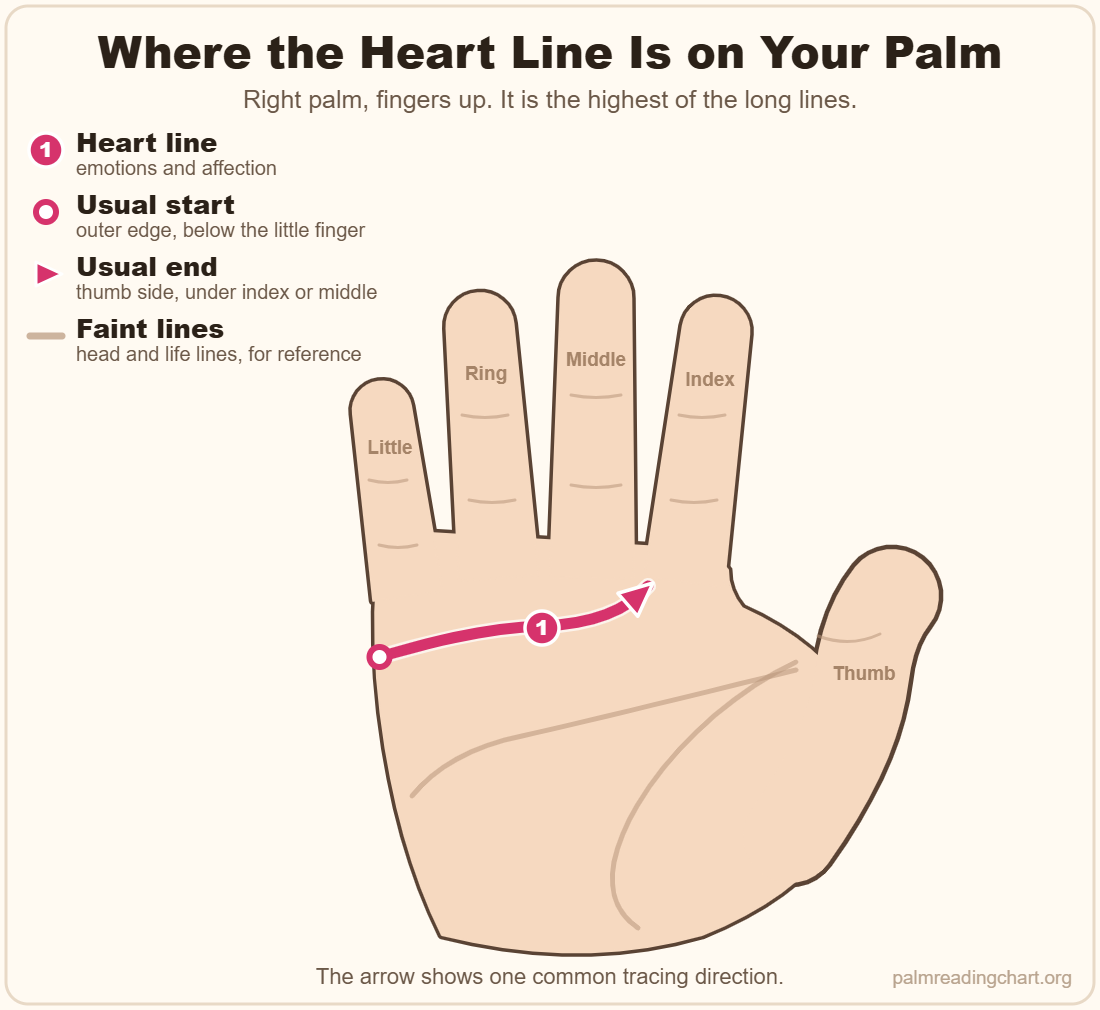
One guide notes that the palmist Cheiro traced it the same way, and says many modern palmists reverse the direction. Either way, guides give the most weight to the thumb-side end, the one nearest the index finger.
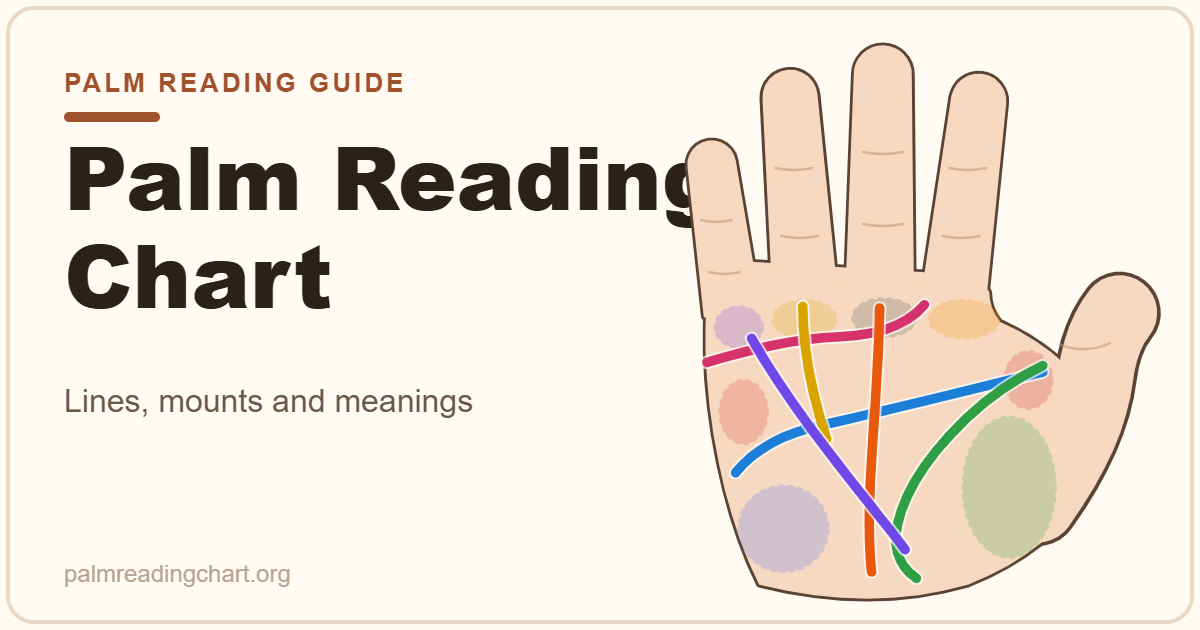
Many guides name three major lines: the heart line, the head line and the life line. Our palm reading chart adds the fate line as a fourth main line and labels all four on one diagram.
The name can mislead. Several guides describe the line as your emotional style in general, not only your romantic life. Two guides stress that it shows a style of feeling, not how much a person loves.
How to Find Your Heart Line in 5 Steps
- Rest your writing hand in bright, even light, with the palm toward you and the fingers relaxed.
- Find the uppermost long crease, just below the bases of the four fingers.
- Look at its thumb-side end. Does it point under the index finger, between the index and middle fingers, or under the middle finger?
- Note the curve and the depth. Is the line curved or straight, deep or faint?
- Repeat with your other hand and compare the two.
Keep the hand relaxed, not stretched. If the crease looks very different from the drawing, check your other hand before you decide which crease is which. If you see only one crease across the upper palm, jump to the section on a merged line below.
Heart Line Palm Reading: Where the Line Ends
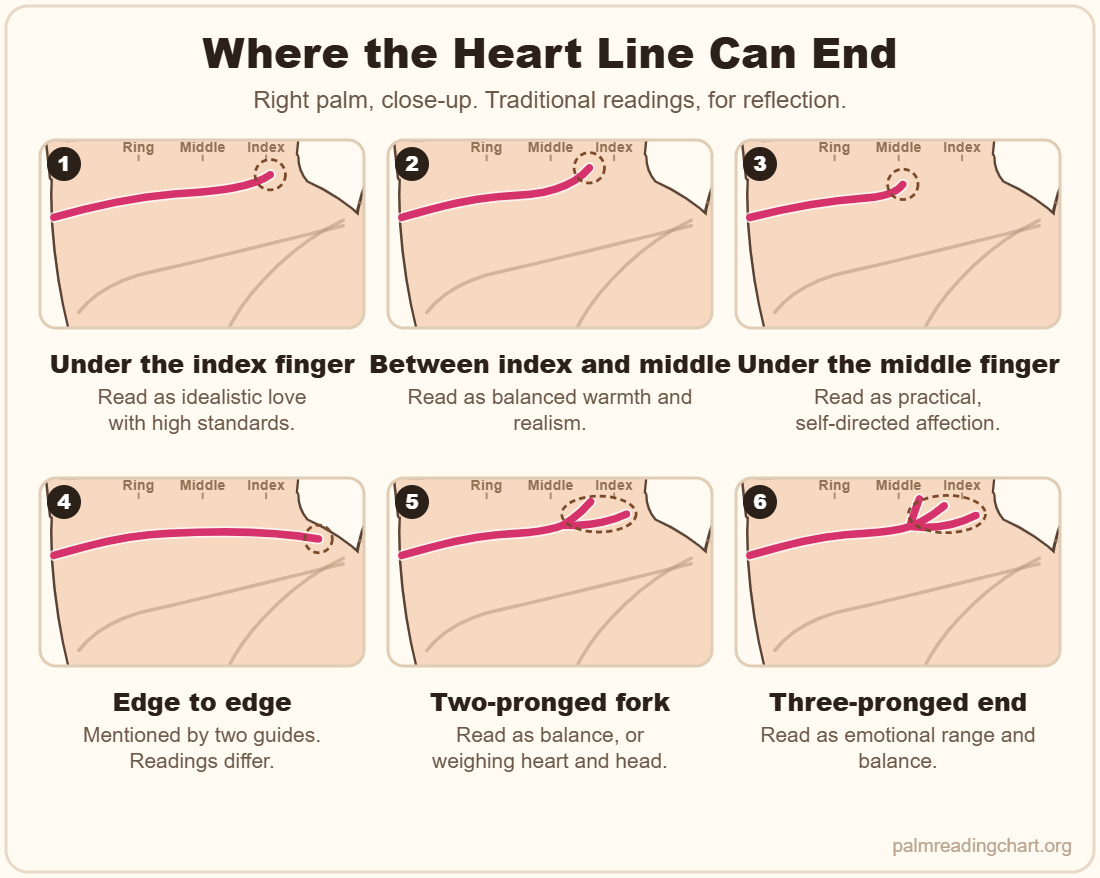
Most guides treat the thumb-side end as the key feature. They sort it by the finger it points toward. The two mounts named most often are Jupiter below the index finger and Saturn below the middle finger. Our guide to the mounts of the palm shows where those pads sit.
Under the index finger
Most guides read an ending under the index finger as idealistic, romantic or devoted love with high standards. One guide adds loyalty and deep commitment once someone is chosen.
Between the index and middle fingers
An ending in the gap between the index and middle fingers is described as balanced, warm and realistic. Several guides use the word balance for it, and one calls it the most common pattern.
Under the middle finger
An ending under the middle finger is linked with practical, self-directed love. Some guides add words such as guarded or independent. Others use blunter words, and this article leaves them out. A line that stops before the middle finger, or under the ring finger, counts as short, and the length section below covers it.
Edge to edge
Only two guides mention a heart line that runs the full width of the palm, and their readings do not match. With so little agreement, this article has no mild reading to offer. Treat it as an unusual pattern to note, not to interpret.
Forked ends
A heart line can split into two or three branches near the thumb-side end. A two-pronged end is read as weighing heart and head together. A three-pronged end is read as emotional range, with a mix of idealism, warmth and practical affection.
Most guides read forks as balance. One guide says forks are rarely read negatively, and another calls them fortunate and common.
Heart Line Shape, Length and Depth
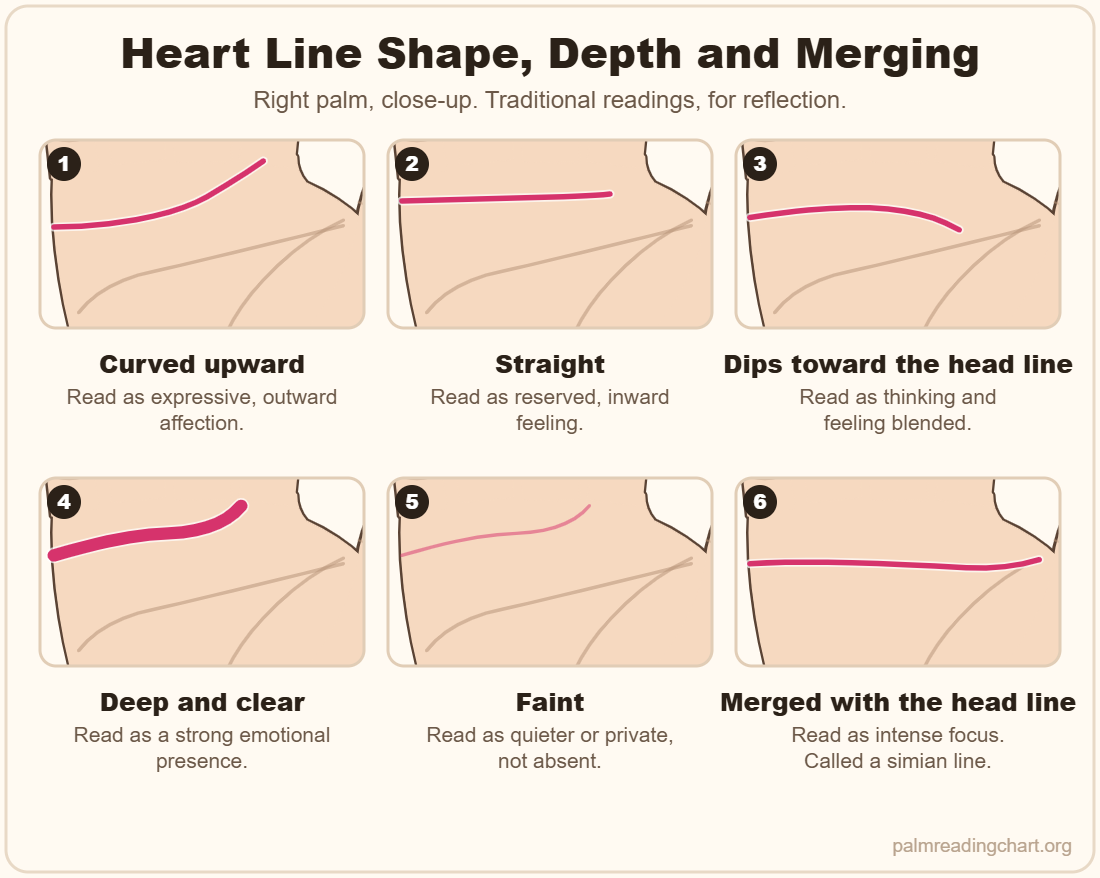
Beyond the ending, guides look at how the line curves, how far it runs and how deep it is. The drawing shows six looks side by side. The last one, a merged line, has its own section below.
Curved upward or straight
Most guides read an upward curve as expressive, outward affection. A straight line is read as reserved or inward. Several guides stress that a straight line still means deep feeling, only kept private.
Long or short
Guides judge length by how far the line reaches across the palm. A long line that reaches under the index finger is read as warm and open, and a short one as private or selective. Some guides call a line short when it stops before or under the middle finger, or under the ring finger.
Several guides say plainly that a short line is not a sign of a cold heart. One guide uses much harsher words for a short line, and this article leaves them out.
One guide frames it as scope. A long line means relationships sit near the center of life, and a short line means love is one priority among several.
Deep or faint
Guides read a deep, clear line as a strong emotional presence. They read a faint line as quieter, lighter or more private feeling, and some tie it to less outward expression. One guide says outright that a faint line is not an absence of feeling.
The same guide adds that lines can deepen or fade over time. A faint line today is not a fixed trait.
Dipping toward the head line
Two guides read a heart line that dips toward the head line as thinking and feeling blended, with reason sometimes outweighing feeling. Other guides read a downward curve more harshly, and this article leaves that out. Our head line guide shows how guides read the line below this one.
Breaks, Chains and Islands on the Heart Line
Small marks on the line get a lot of attention online. Several guides read them as notes about change or sensitivity, not as warnings.
A break is a gap where the line stops and starts again, and guides read it as an emotional turning point. When the two pieces overlap, they read the change as smoother, and a clean gap as sharper. A chain, a row of small linked loops, is read as sensitivity or changeable feeling. An island, a small oval, is read as a passing period of emotional strain.
Our broken heart line guide sorts true breaks from look-alikes and shows each one in a drawing.
Some guides tie these marks to health problems or to a marriage ending. This article leaves those readings out, because a crease on your palm cannot tell you either one.
When the Heart Line Merges With the Head Line
On some palms the heart line and head line are replaced by a single crease across the palm. Palmistry calls this a simian line, an older term that some writers now avoid. Guides read it as an intense, single-focused blend of feeling and thinking.
One guide calls it a normal variation, not a warning. Another calls the old low-intelligence reading discredited. See our simian line guide for the types, the look-alikes and how often sites say it appears.
Heart Line on the Left Hand or Right Hand
Guides that mention hands usually say to read both. Your writing hand is read as your present emotional life, and your other hand as your inborn tendencies. Several guides state this rule outright.
One guide says similar lines on both hands give a steady reading, and reads a sharp gap as a conscious change in how you handle feelings. Another says a gap may show a difference between inner feeling and outward expression. If you write with your left hand, your left hand is the writing hand. Our post on which hand to read explains the rule in full.
Heart Line Meanings at a Glance
The table gathers the common readings in one place. It uses the milder wording, and it shows how well the guides agree.
| Heart line feature | Common reading | How guides compare |
|---|---|---|
| Ends under the index finger | Idealistic, devoted, high standards | Most guides agree; one adds loyalty |
| Ends between index and middle | Balanced, warm, realistic | Several use the word balance |
| Ends under the middle finger | Practical, self-directed | Some guides use blunter words, left out here |
| Runs edge to edge | No mild reading to give | Only two guides mention it, and they differ |
| Curved upward | Expressive, outward affection | Most guides agree |
| Straight | Reserved, inward feeling | Several say it is not less feeling |
| Long line | Warm, open, wide emotional reach | Most guides agree |
| Short line | Private or selective, not cold | Several say not cold; one uses harsher words |
| Dips toward the head line | Thinking and feeling blended | Two guides; others use harsher words, left out here |
| Deep and clear | Strong emotional presence | Most guides agree |
| Faint | Quieter, lighter or more private feeling | One says it is not an absence of feeling |
| Fork at the end | Balance, emotional range | Most guides agree; two call forks fortunate or rarely negative |
| Break | Turning point or change | Overlap read as smoother, clean gap as sharper |
| Merged with the head line | Intense, single-focused | One calls it a normal variation |
What the Heart Line Cannot Tell You
The heart line cannot tell you who you will love, when you will meet someone or whether a relationship will last. One guide says so directly, and adds that the line tells you nothing about sexual orientation or a partner’s gender.
Some guides map the line to ages or life stages. One places the little-finger end in early life and the index end in the present and future. Another uses vertical lines from the fingers to mark ages. The two methods differ, so this article leaves timing out.
A heart line is not a medical test, and Wikipedia says palmistry’s predictions lack evidence. Please do not use it to decide anything about your health, your money or your relationships.
Heart Line Palm Reading FAQ
Where is the heart line on the palm?
It is the top long crease on the palm, just below the bases of the four fingers and above the head line. Most guides trace it from the pinky-side edge toward the index or middle finger.
What does the heart line show in palm reading?
Guides read it as emotional style: how you give and receive affection and how you bond with people. Two guides stress that it describes a style, not how much you love.
What does a heart line ending under the index finger mean?
Most guides read it as idealistic or romantic love with high standards. Read it as a theme to reflect on, not as a prediction.
What if I cannot find a clear heart line?
Look again in bright light and check your other hand. If you see only one crease across the upper palm, it may be a simian line. One guide reads a faint or fragmented line as private feeling, not missing feeling.
Does the heart line show who you will marry?
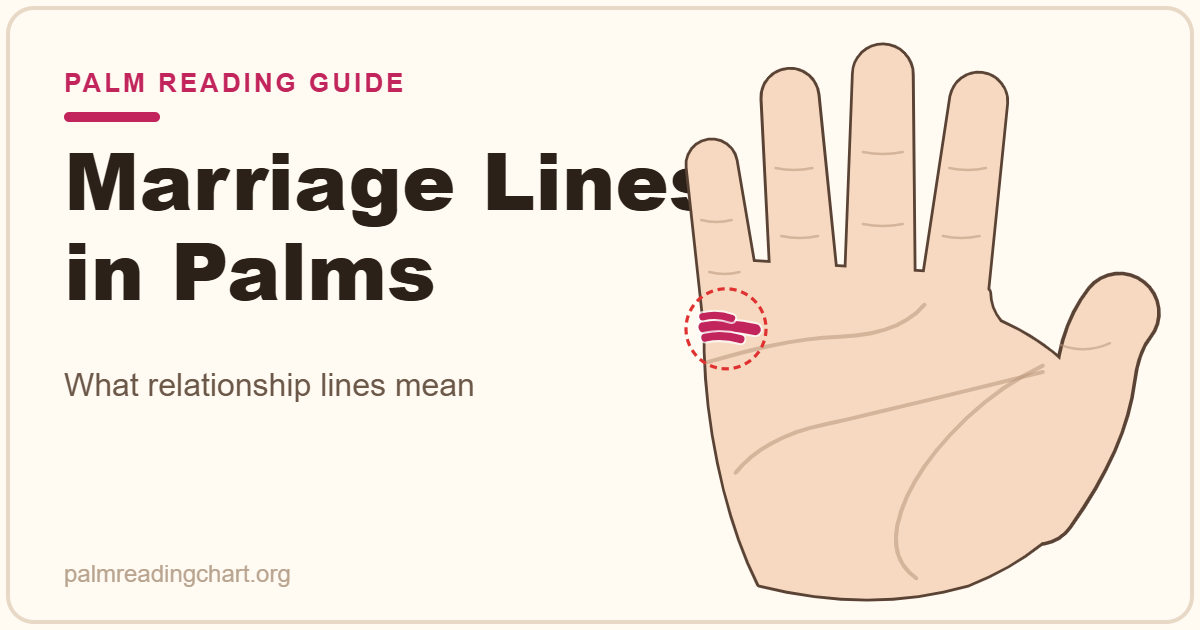
No. Palmistry usually reads marriage from small lines near the edge of the palm, not from the heart line, and even those are tradition. See our guide to marriage lines in palms.
Can the heart line change over time?
One guide says lines can deepen, fade or change over time, and another reads a sharp gap between your two hands as a conscious change in how you handle feelings. Neither is a fixed label.
Conclusion
Heart line palm reading starts with one question: where does the thumb-side end of the line point? Then look at the curve, the depth and any forks, and compare both hands. Treat every meaning as symbolism and skip anything that sounds like a warning. For the bigger picture, read palm lines and what they mean, then try the step-by-step guide to how to read your palm.


Leave a Reply