Palm lines and what they mean come down to four main creases and a few smaller ones. Palmists tie each one to emotion, thinking, vitality or direction.
This guide shows where each line sits, what it is traditionally said to mean, and how the mounts fit in. Each drawing shows a right palm, and a left hand mirrors it.
Treat what follows as symbolism and self-reflection. Palmistry is widely viewed as a pseudoscience, and its predictions lack evidence.
Table of Contents
What Are Palm Lines?
Palm lines are creases in the skin of the palm. The basic pattern is set before birth, though lines can deepen or fade over the years. Palmists read the lines together with the mounts and the shape of the hand, and guides stress that no line is read in isolation.
The Four Major Palm Lines
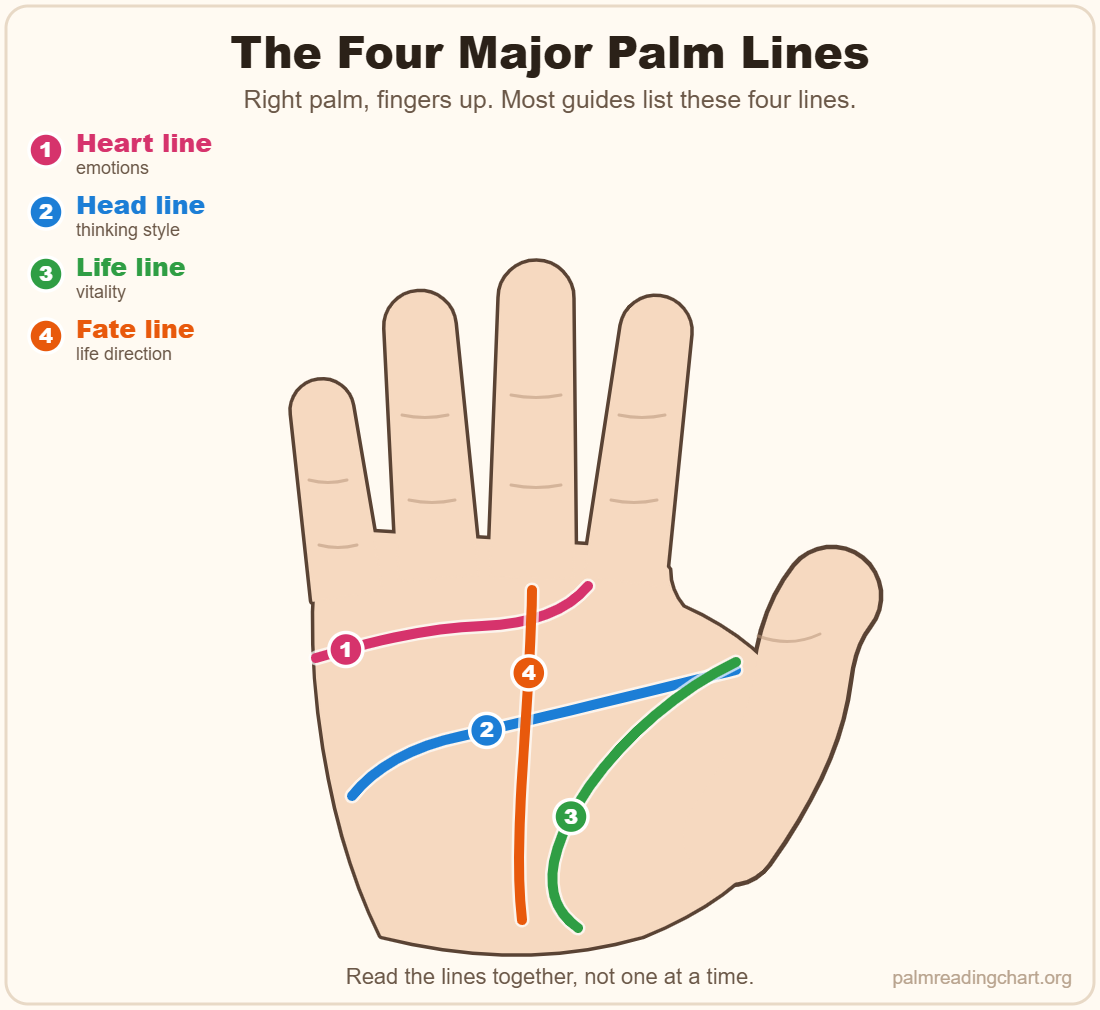
Most guides name four major lines: heart, head, life and fate. One guide lists only three and treats the fate line as minor, and another adds the sun line as a fifth, so counts differ between sources.
Heart line
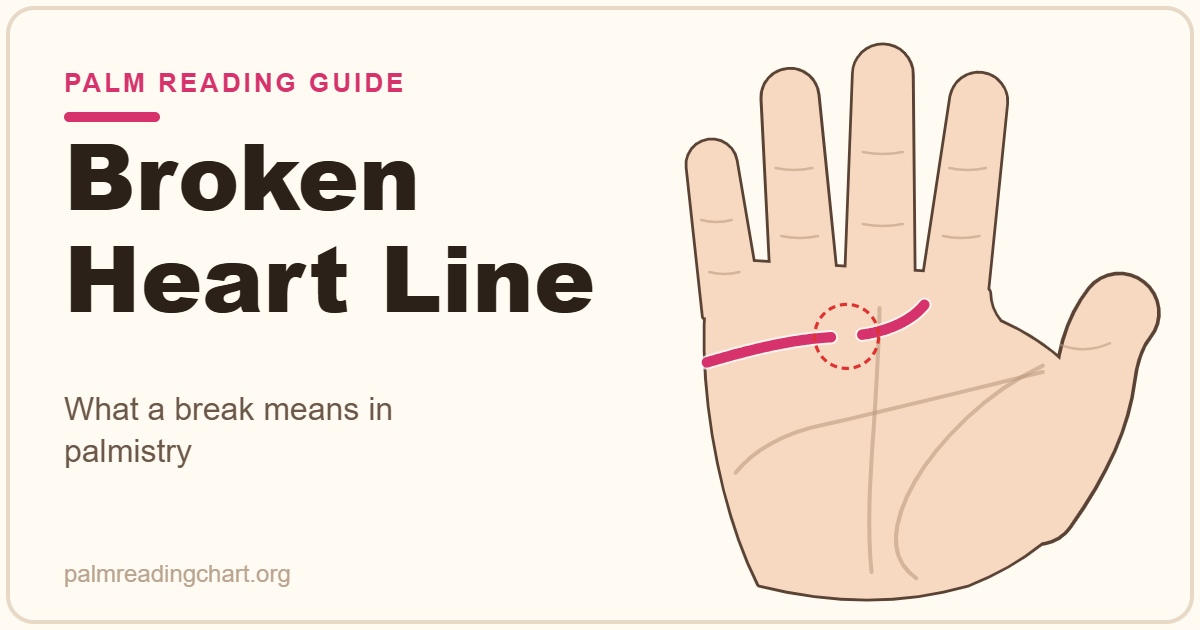
The heart line is the top horizontal crease. It runs under the fingers from the outer edge of the palm toward the index or middle finger. Palmists read it as your emotional style and how you handle close relationships. Many guides say a curved line suggests expressiveness and a straight one a more rational approach. Our heart line guide covers the details.
Head line
The head line crosses the middle of the palm below the heart line. It begins on the thumb side, close to the index finger, and runs toward the outer edge. Most guides read it as thinking style, not as a measure of intelligence, though one guide ties it to intelligence and memory. Many read a straight line as practical thinking and a curved one as imaginative thinking. See our head line guide for more.
Life line
The life line curves around the base of the thumb toward the wrist. It stands for vitality, energy and major life changes. Guides stress that its length does not show how long you will live, so a short life line says nothing about lifespan. Our life line guide goes further.
Fate line
The fate line climbs the center of the palm toward the middle finger. It is read as career, direction and sense of purpose. Many hands show a faint fate line or none, and several sites treat that as normal, not as a bad sign. Read more in our fate line guide.
Minor Palm Lines and What They Mean
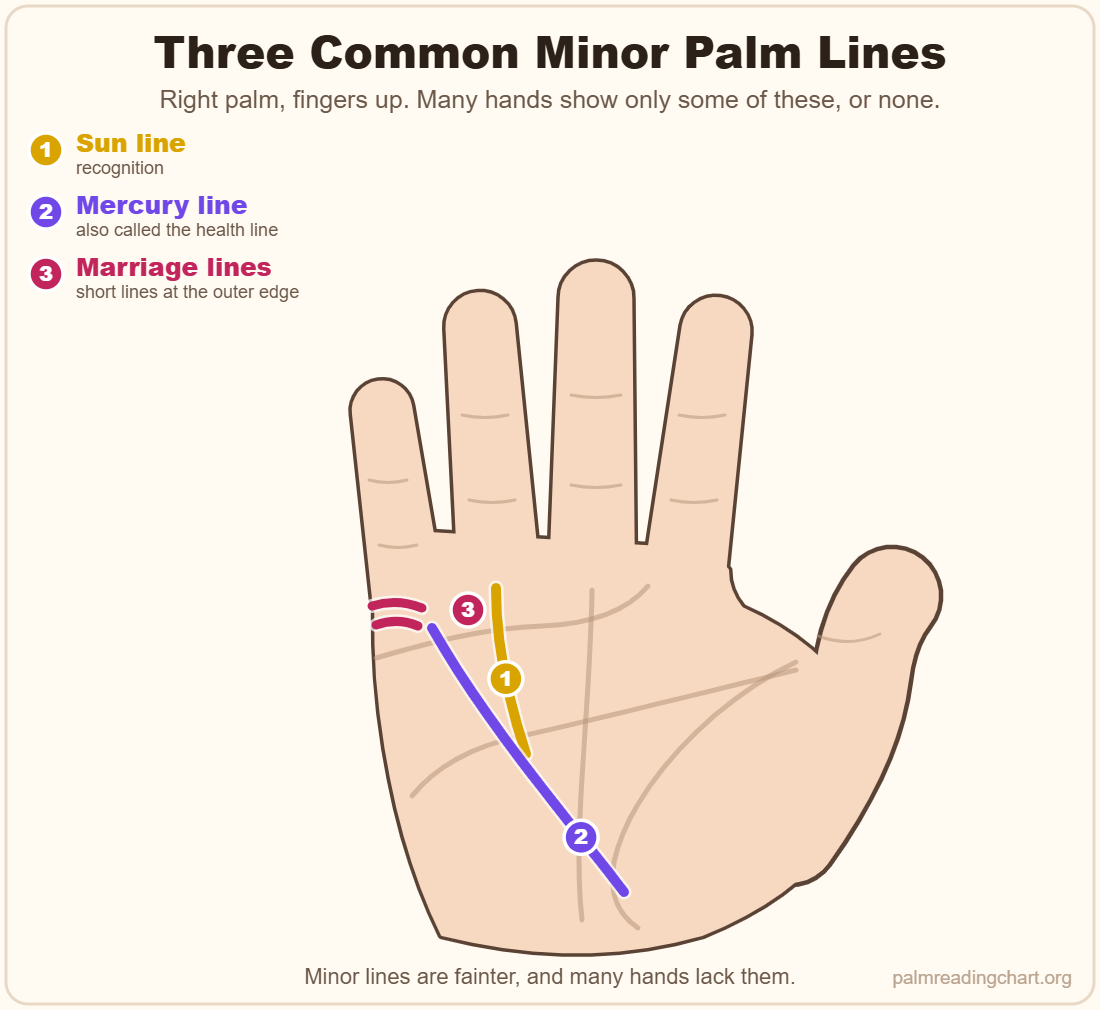
Minor lines are fainter and less common than the major four. One site notes that many hands lack them, so a missing minor line is not a flaw.
Sun line
The sun line, also called the Apollo line, runs up the palm toward the ring finger. It is tied to creativity, recognition and visible success.
Mercury line
The Mercury line slants from the base of the palm toward the little finger. It is tied to communication and business sense, and many guides also call it the health line. Two sites read a missing Mercury line as a good sign, and one warns against treating a present one as a diagnosis. See our health line guide.
Marriage lines
Marriage lines are short horizontal creases on the outer edge, under the little finger. Guides read them as significant bonds, and several say they are not simply a count of marriages. Our marriage lines guide covers the patterns.
Children lines
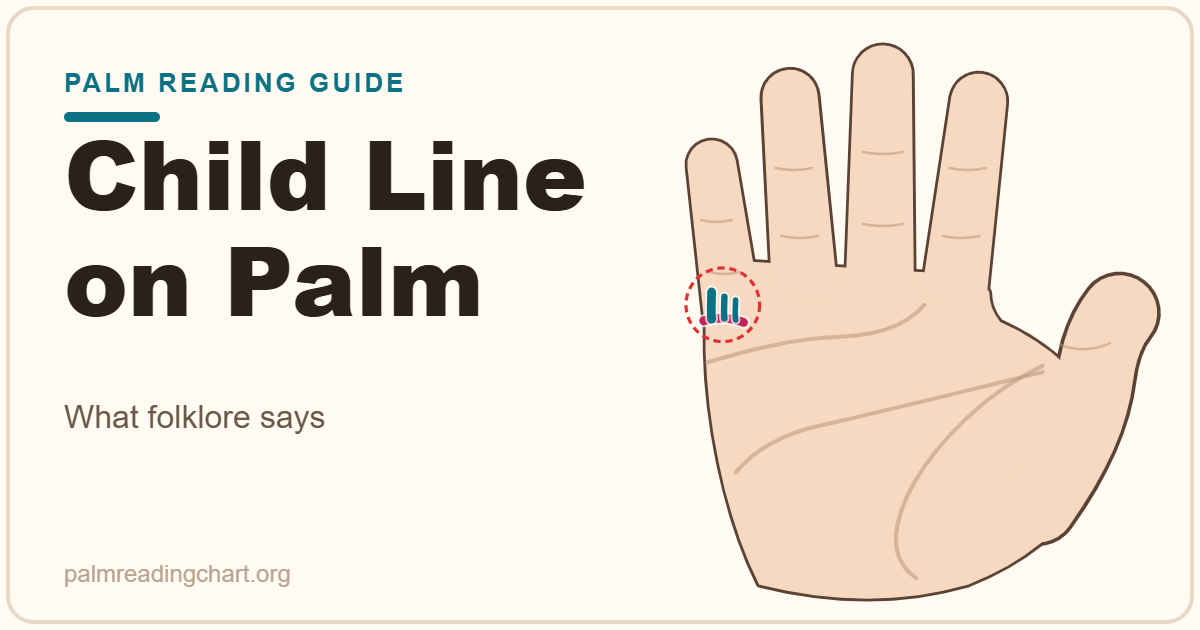
Children lines are tiny upright creases that rise above the marriage lines. One guide reads them as children or close bonds with children, and it adds that a count has no scientific basis. See child line palm reading.
Other minor lines and rare patterns
Some guides add travel lines (read as journeys), bracelet lines at the wrist and the girdle of Venus, a curved line above the heart line. Among rare patterns, the simian line is one crease in place of the heart and head lines, covered in our simian line guide. An M shape formed by the main lines is covered in M on palm meaning.
The Mounts of the Palm
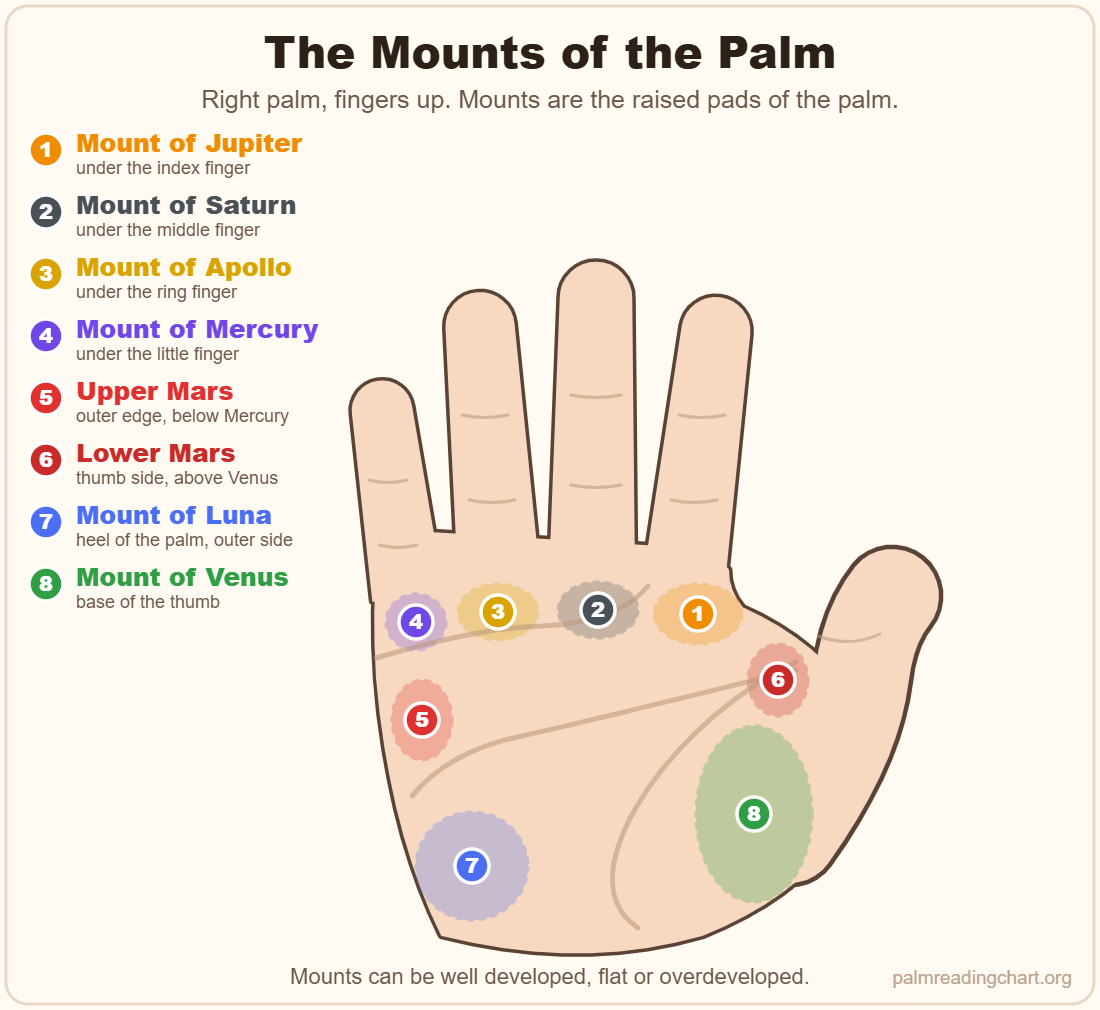
Mounts are the raised pads of flesh on the palm. Each one is tied to a set of traits, and palmists use the mounts alongside the lines.
| Mount | Where it sits | Traditionally linked with |
|---|---|---|
| Jupiter | Under the index finger | Ambition and leadership |
| Saturn | Under the middle finger | Discipline and responsibility |
| Apollo (Sun) | Under the ring finger | Creativity and success |
| Mercury | Under the little finger | Communication and business |
| Upper Mars | Outer edge, below Mercury | Courage and resilience |
| Lower Mars | Thumb side, above Venus | Courage and resilience |
| Luna (Moon) | Heel of the palm, outer side | Imagination and intuition |
| Venus | Base of the thumb | Love and life energy |
One guide describes each mount as well developed, flat or overdeveloped. It reads a flat mount as a quieter trait and an overdeveloped one as the trait in excess. Another guide says mounts amplify or soften what the lines suggest.
Guides do not agree on the full list. Some name a single Plain of Mars at the center of the palm, and Wikipedia also lists Neptune, so this table follows the common eight-mount layout.
How to Read Your Palm Lines in 4 Steps
- Rest both hands in good light, palms up and fingers relaxed.
- Find the four major lines first, starting with the heart line near the fingers and the life line around the thumb.
- Note how long, deep and curved each line is, and whether it has forks, breaks or small marks.
- Add the minor lines and mounts you can see, then compare your two hands.
For a longer walk-through, try our step-by-step tutorial on how to read your palm. Our palm reading chart works as a one-page reference.
Which Hand to Read
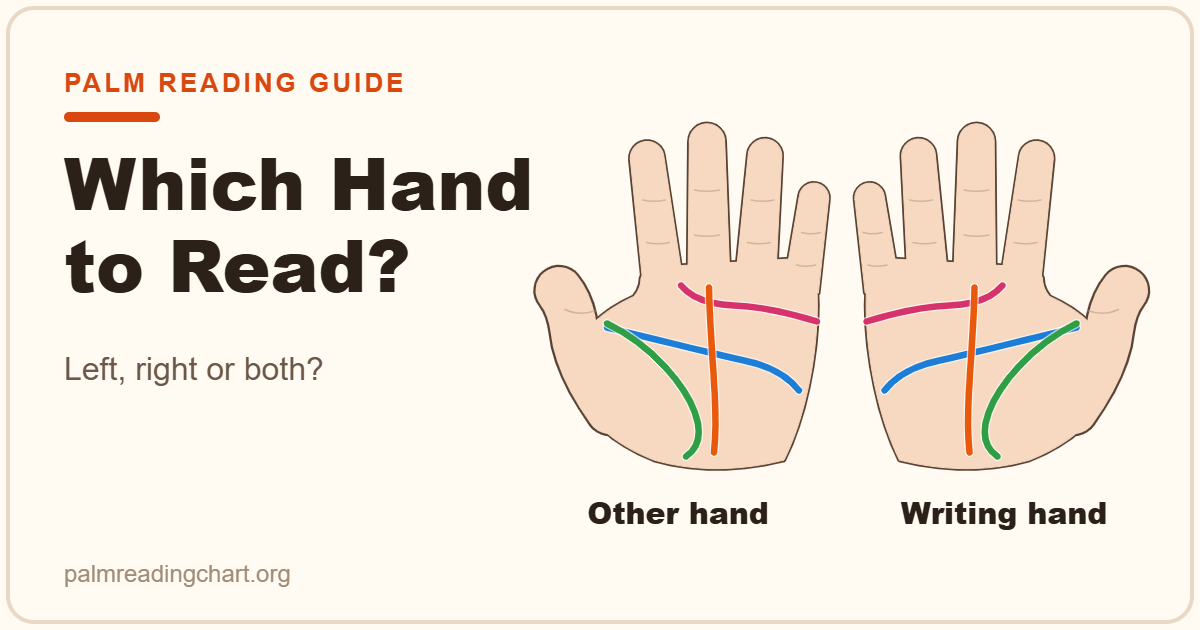
Many guides read the hand you write with for your present life and choices, and the other hand for inborn tendencies, then compare them. Conventions differ, and our post on which hand to read compares them.
Quick Guide to Palm Lines
The table below puts the lines side by side.
| Line | Where it sits | Traditional reading |
|---|---|---|
| Heart line | Top of the palm, under the fingers | Emotional style and relationships |
| Head line | Middle of the palm, below the heart line | Thinking style and decisions |
| Life line | Curves around the base of the thumb | Vitality and major life changes |
| Fate line | Up the center toward the middle finger | Career and direction |
| Sun line | Toward the ring finger | Creativity and recognition |
| Mercury line | Base of the palm toward the little finger | Communication and business sense; also called the health line |
| Marriage lines | Outer edge, below the little finger | Significant bonds |
| Children lines | Rise above the marriage lines | Children or close bonds with children; a count has no scientific basis |
| Simian line | One crease in place of the heart and head lines | Intense, focused energy (readings vary) |
What Palm Lines Cannot Tell You
Palm lines cannot predict events, dates or lifespan, and they cannot diagnose a health condition. If a health worry brought you here, ask a doctor.
Wikipedia notes that palmistry teachings often contradict one another. It also says skeptics link palmists to cold reading, a method of making likely guesses and picking up cues from the client. Science also studies palm skin patterns. A field called dermatoglyphics examines them for genetic and medical purposes, but that is a different subject from palmistry.
Palm Lines and What They Mean FAQ
How many major lines are there on the palm?
Most guides name four: heart, head, life and fate. One guide counts three, and another adds the sun line as a fifth.
Which palm line is the most important?
Most guides do not rank them, though one reports that author William Benham rated the head line most important. Guides advise reading the lines together instead of leaning on one.
Do palm lines change over time?
Sources differ. One guide says the main lines stay broadly stable while finer lines come and go, and others say any line can change with age, health and habits.
Is it normal to be missing a line?
For the fate line and the minor lines, yes. They are often absent, and several sites treat that as normal. A missing heart or head line is rare, and one crease in place of both is called a simian line.
Is palm reading real?
Not as a way to predict anything. Wikipedia says its predictions lack evidence, yet many people enjoy palmistry as a symbol system for reflection.
Conclusion
Palm lines and what they mean start with the four major lines, then add the minor lines and the mounts. Read both hands, keep the readings light and treat every reading as symbolism.


Leave a Reply