A broken heart line is a heart line that stops and starts again, or is cut into pieces, somewhere on its path across the palm. In palmistry it is read as a turning point in your emotional life. It is not a sign that your heart will be broken.
The name sounds dramatic, so it helps to know what it covers. This guide shows what counts as a break, how it differs from a chain, an island or a fork, what the position of the break is said to mean and why what the line does afterward matters as much as the gap itself. The drawings show a right hand held fingers-up; on a left hand everything is mirrored.
Treat everything here as a traditional way to reflect on yourself, not as a forecast. Palmistry cannot predict your relationships or diagnose heart problems.
Table of Contents
What Is a Broken Heart Line in Palmistry?
The heart line is the topmost of the main lines. In the usual Western description it starts at the outer edge of the palm, below the little finger, and runs across toward the index and middle fingers. Palmists link it to how you give and receive affection, how you attach to people and how you handle closeness. For a full walk-through of the line itself, see our guide to the heart line.
A broken heart line is one where that crease is interrupted. Traditional readers see the break as a marker of change: an ending, a period of distance or a shift in what you want from love. The word “broken” describes how the line looks, not what will happen to you. Most readers treat a break as a record of change and pay close attention to how the line continues after it.
How to Tell a Broken Heart Line From a Chain, Island or Fork
Many people who search for a broken heart line are actually looking at a different feature. Look closely in good light, and let your fingers rest open, because stretching the palm flat can make faint lines look interrupted. The diagram shows six common looks. Only the first two are true breaks, and the other four are related features that are often mistaken for one.
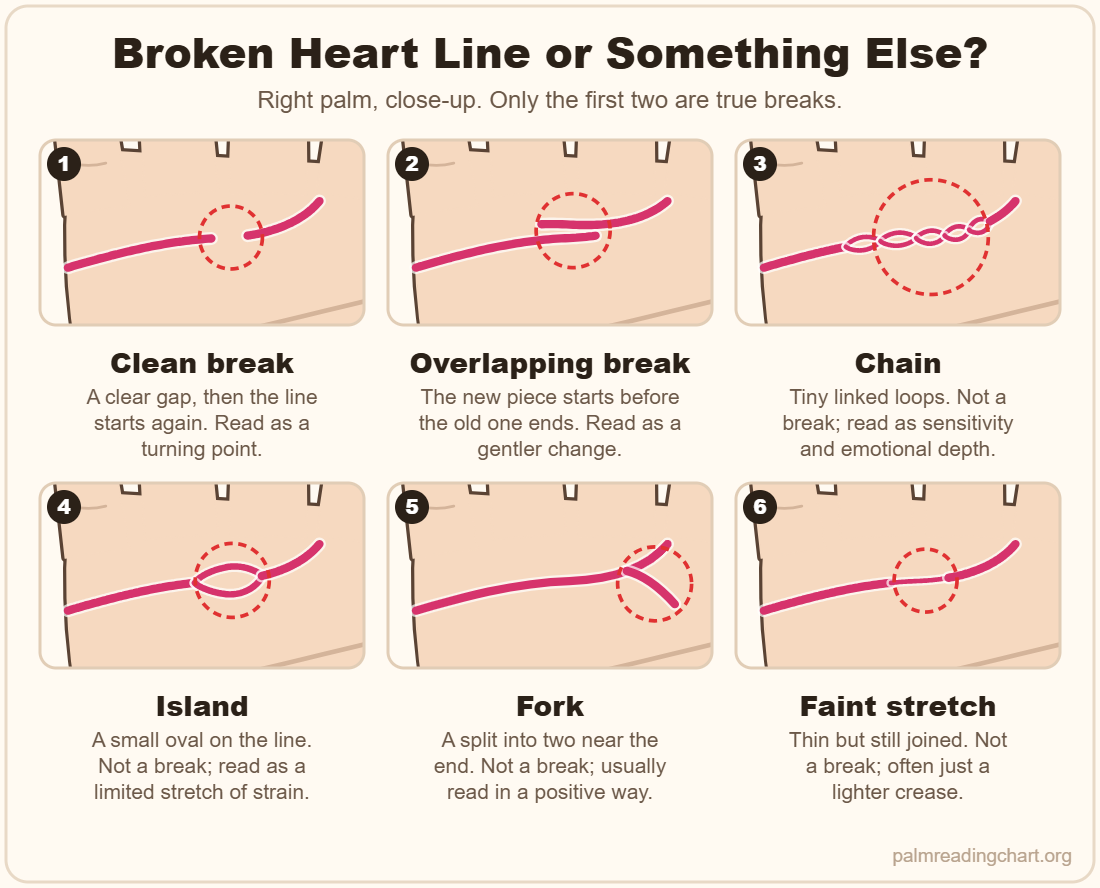
Clean break
A clean break is a clear gap where the line stops and picks up again further along. Palmists read it as a distinct turning point, such as the end of a relationship or a period of emotional distance that took time to work through.
Overlapping break
If the new piece of line begins before the old one ends, so that the two run side by side for a short stretch, readers see a smoother and more gradual change. The overlap is often described as a transition you had time to prepare for.
Several small breaks
A line with more than one gap is sometimes read as more than one period of change, not as damage or as a worse sign. As with a single break, the way the line carries on after each gap matters as much as the gaps themselves.
Chain
A chain is a run of tiny linked loops, a little like a row of beads. The line is still continuous, so it is a separate feature rather than a break. It is read as sensitivity and emotional depth, a heart that responds strongly to the people around it.
Island
An island is a small oval where the line splits and then joins up again, so it is not a break either. It is read as a limited stretch of emotional strain. When the line continues cleanly after it, readers take that as a sign that the period passes.
Fork
A fork is a split into two branches, usually near the end of the line. It is not a break, and it is often read as a good sign: a heart that can balance feeling with practical judgment. Some readers describe the two branches as being pulled between two ways of loving, so treat the meaning as one view among several.
Faint stretch
Sometimes one section is simply thinner or lighter than the rest. If you can still see the line running through it, it is a faint stretch and not a break. Readers link faint sections with privacy or reserve, not with a lack of feeling.
Where a Break Sits on the Heart Line
Palmists also look at where along the line the break falls. One common method uses the fingers above as a guide, since each finger sits over a mount that is linked with its own theme. The diagram shows four zones. Sources do not agree on every detail, so treat these as general ideas rather than rules.
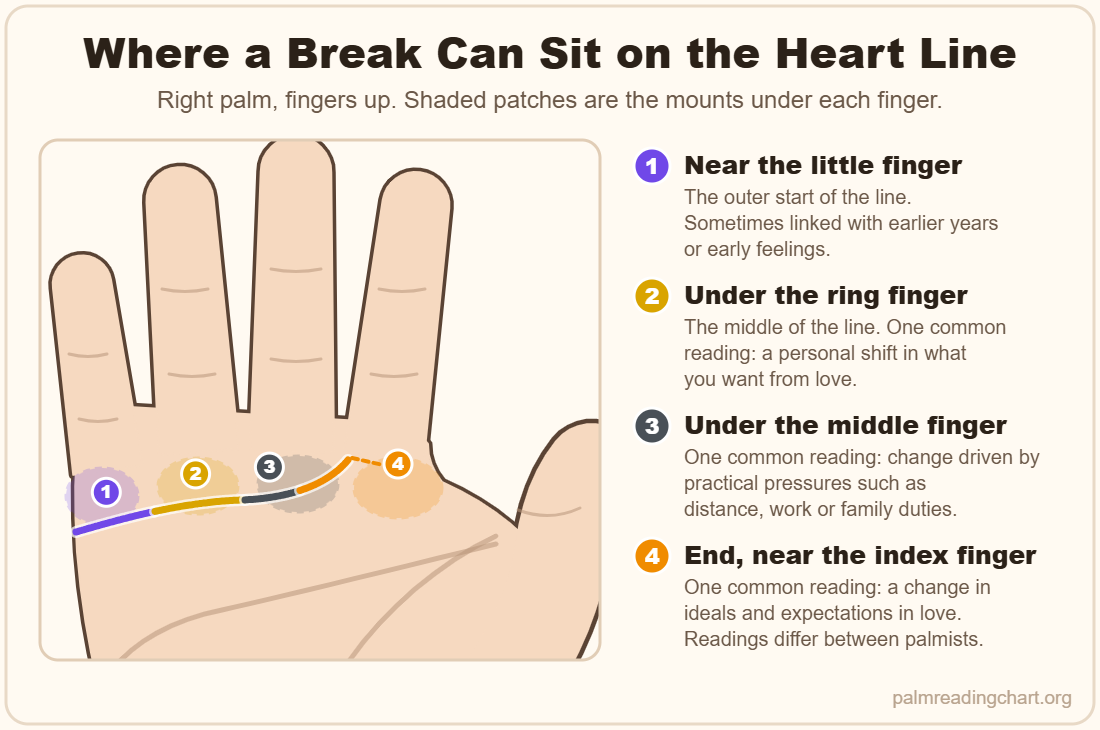
Near the little finger
A break at the outer start of the line is sometimes linked with earlier years, or with feelings that took shape early in life. Few sources say more than that, so keep the reading loose.
Under the ring finger
The ring finger sits above the Mount of Apollo, which is linked with creativity and self-expression. One common reading is a personal shift, such as outgrowing a relationship or changing what love means to you.
Under the middle finger
The middle finger sits above the Mount of Saturn, which is linked with duty and practicality. One common reading is a change driven by outside pressure, such as distance, work or family duties, rather than by a lack of feeling.
At the end, near the index finger
The index finger sits above the Mount of Jupiter, which is linked with ambition and ideals. One common reading is a change in your hopes or expectations in love, such as letting go of an idealized picture and becoming more realistic.
Some readers also treat the line as a rough timeline, with earlier years at the little-finger end and later years near the index finger, and some traditions read the line from the other end. Sources do not give a reliable way to date a break, so avoid putting an age on any one.
What the Line Does After the Break
Palmists rarely read a break on its own. They follow the line past the gap and ask what it does next.
A clear restart
If the line begins again deep and clear, readers describe a heart that rebuilt itself and moved into a new phase.
A thin or faint restart
If the line comes back thin and light, the usual reading is a quieter, more careful phase in which you keep your feelings private for a while. It describes a mood, not a verdict.
A support line beside the break
A fine line running next to the break, often called a sister line or repair line, is read as extra support during the change. Unlike an overlap, it does not take over from the main line. Names for it differ between sources.
Broken Heart Line on the Left Hand or the Right Hand
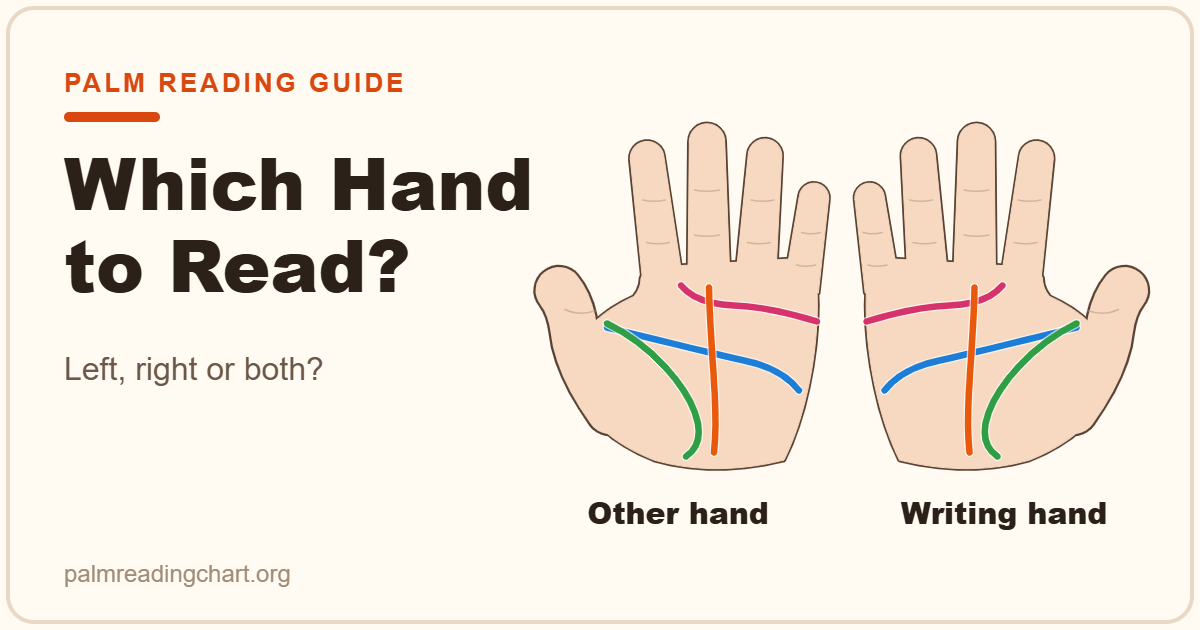
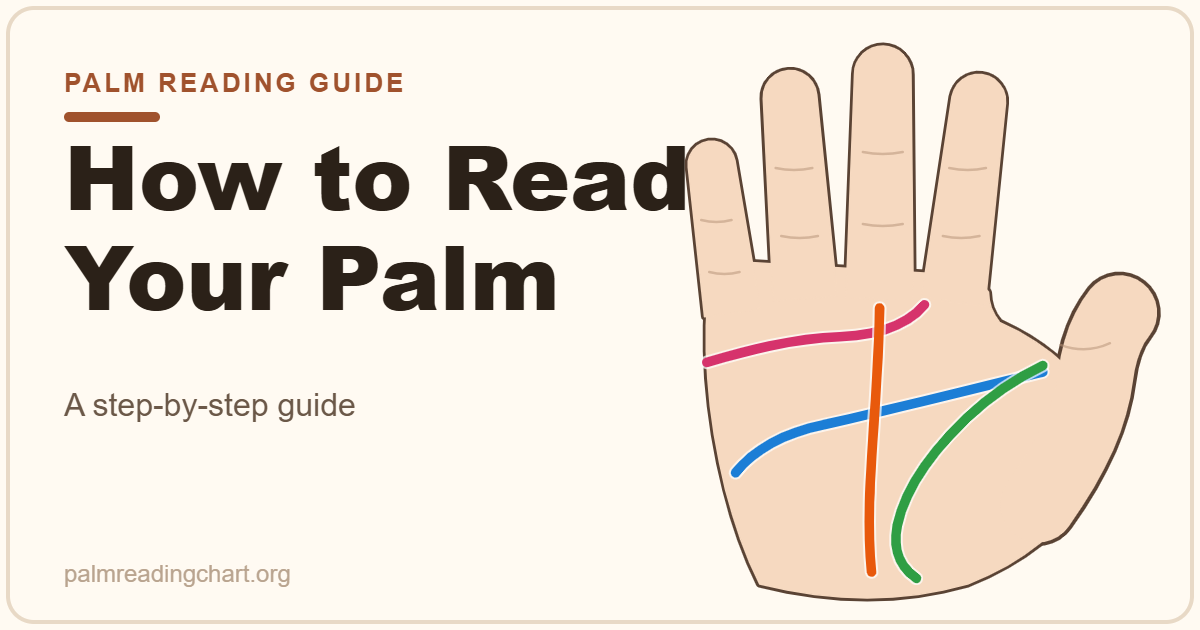
Palmists usually look at both hands. The writing hand is said to show the life you are living now, and the other hand the pattern you started with. Which physical hand that is depends on which one you write with, so for a left-handed person the writing hand is the left. A break on both hands is read as something long-standing, while a break on the writing hand only is read as something shaped by experience. A break only on the other hand is sometimes described as an early pattern that did not carry into daily life, though sources vary, so hold that lightly. For the full rule on choosing a hand, see which hand to read in palm reading. Beginners can start with how to read your palm step by step.
Broken Heart Line Meanings at a Glance
| Feature | What readers say |
|---|---|
| Clean break | A distinct turning point in emotional life |
| Overlapping break | A gradual, better-prepared change |
| Chain | Sensitivity and emotional depth (not a break) |
| Island | A limited stretch of emotional strain (not a break) |
| Fork | Feeling balanced with practical judgment (not a break) |
| Faint stretch | Privacy or reserve (not a break) |
| Several small breaks | More than one period of change |
| Break near the little finger | Earlier years or early-formed feelings |
| Break under the ring finger | A personal shift in what you want from love |
| Break under the middle finger | Change driven by practical pressures |
| Break near the index finger | A change in ideals and expectations |
| Clear restart after the break | A new phase; the heart rebuilt |
| Thin restart after the break | A quieter, more private phase |
| Support line beside the break | Extra support during the change |
Does a Broken Heart Line Mean Heartbreak or Heart Trouble?
No, and science gives it no support: palm lines have not been shown to predict relationships, breakups or heart health. Mainstream science treats palmistry as a pseudoscience, and the heart line has nothing to do with the organ in your chest. Modern palmists use the word “heart” for emotions. A break does not mean a relationship will fail, and an unbroken line does not guarantee a happy one. If you are worried about your heart health, talk to a doctor.
How the Heart Line Fits With Other Lines
A single line never tells the whole story. Set the heart line beside the life line, which stands for energy, and the fate line, which stands for work and direction. Readers also look at whether a change shows up on more than one line, because that is said to point to a bigger turning point. For the small lines on the edge of the palm that palmists link with relationships, see marriage lines in palms.
To see where this line sits among the others, browse palm lines and what they mean or check your hand against the palm reading chart.
How to Read Your Own Heart Line in 6 Steps
- Sit by a window or under a bright lamp and let your hand rest open without stretching the fingers.
- Pick a hand, or better, plan to look at both: the writing hand for your present life and the other for your starting pattern.
- Find the heart line: the highest of the main creases, beginning on the outer edge under the little finger.
- Follow it toward the index and middle fingers, noting any gaps, loops, ovals or splits.
- Decide what you see, using the first diagram: a break, an overlap, a chain, an island, a fork or just a faint stretch.
- Check where the feature sits and how the line continues after it, then compare both hands.
Broken Heart Line FAQ
Does a broken heart line mean my relationship will fail?
No. Palmists read a break as a record of change, not as a prediction of a breakup. Nothing on the palm can tell you whether a relationship will last.
Is a broken heart line good or bad?
Neither. It describes a change in your emotional life, and what the line does next matters as much as the break itself.
What is the difference between a broken line and a chained line?
A break is a gap in the line. A chain is a run of tiny linked loops where the line is still continuous, and a fork is a split into two branches. Each has its own traditional reading.
What if the line starts again clearly after the break?
That is usually the more hopeful reading. A clear restart is described as the start of a new phase after a change, so the strength of the line after the gap matters as much as the gap itself.
Can a broken heart line change over time?
Fine lines can look different from one year to the next, and some palmists re-read their hands after major life events. Whether that carries any meaning is a matter of belief, because science does not support palm reading.
Is a broken heart line different for women and men?
Not in the method used on this site: the meanings and the two-hand comparison are the same for everyone. Some older traditions choose which hand to read by gender, and they are best treated as an alternative approach.
Conclusion
A broken heart line is a break in the line on your palm, not a break in your future. Check first that it is a real break, then look at where it sits and how the line continues, and read both hands together with the other main lines.


Leave a Reply