Travel lines on palm are short creases usually placed along the outer side of the hand, in the stretch between the little finger and the wrist. Palmists traditionally read them as journeys, moves and changes of scene, and every one of the nine guides we read uses the name travel line.
This guide shows where the lines sit, how to spot them on your own hand and how to tell them from folds and neighboring lines. It then covers length, depth, slant and the marks guides add, such as stars and crosses, before turning to timing, rarity and hand choice. We also flag the points where the nine guides disagree. Palmistry is a folk tradition that Wikipedia describes as a pseudoscience, so read each description as food for thought, not a forecast. Every picture here is a right palm with the fingers pointing up. Mirror it to picture your left hand.
Table of Contents
What Are Travel Lines on Palm?
Travel lines are minor lines, not one of the major ones. The traditional meaning rests on movement: trips, relocations and the shifts in daily life that come with them. Readers new to palmistry may want our overview of palm lines first.
All nine guides use the name travel line. Two add the Indian name Yatra Rekha and two add voyage line. A few use foreign travel line, and one uses journey lines. The names point to the same general idea, though the guides differ on where the lines sit and how far the idea stretches.
Where Travel Lines Sit on the Palm
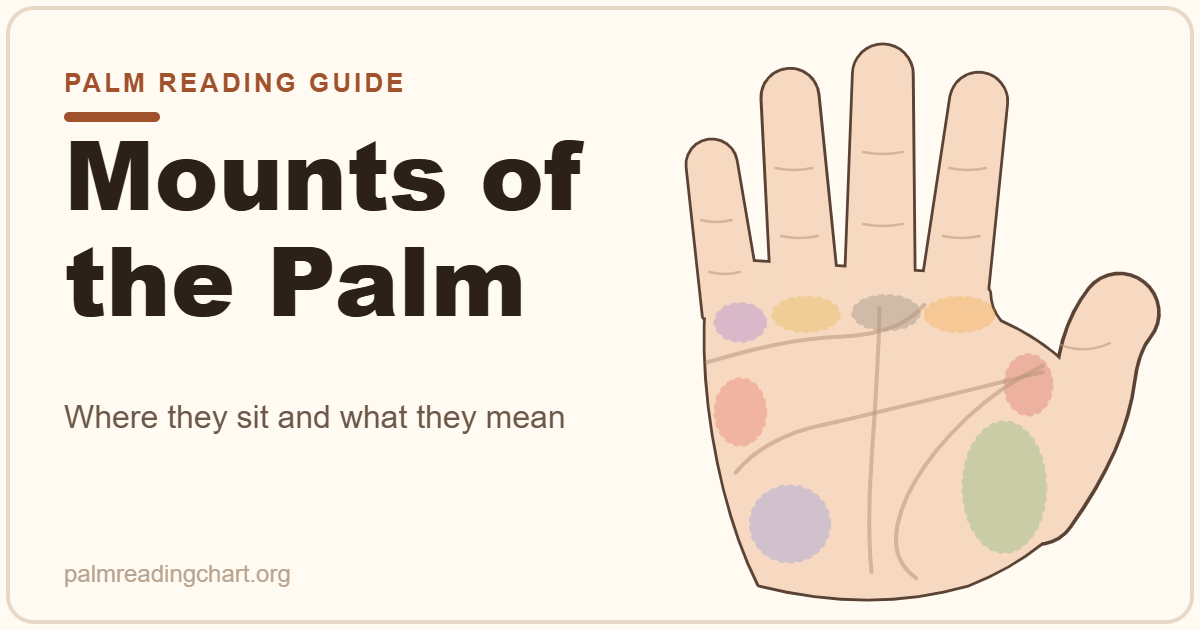
Face the palm toward you and trace the outer edge, the side away from the thumb. Most guides place the lines on the Mount of the Moon, the fleshy heel of the hand, or on the edge between the little finger and the wrist. Several describe them as horizontal or nearly so, running inward from the edge. Our mounts of the palm guide labels every pad. Figure 1 shows the two places guides describe, drawn in indigo.
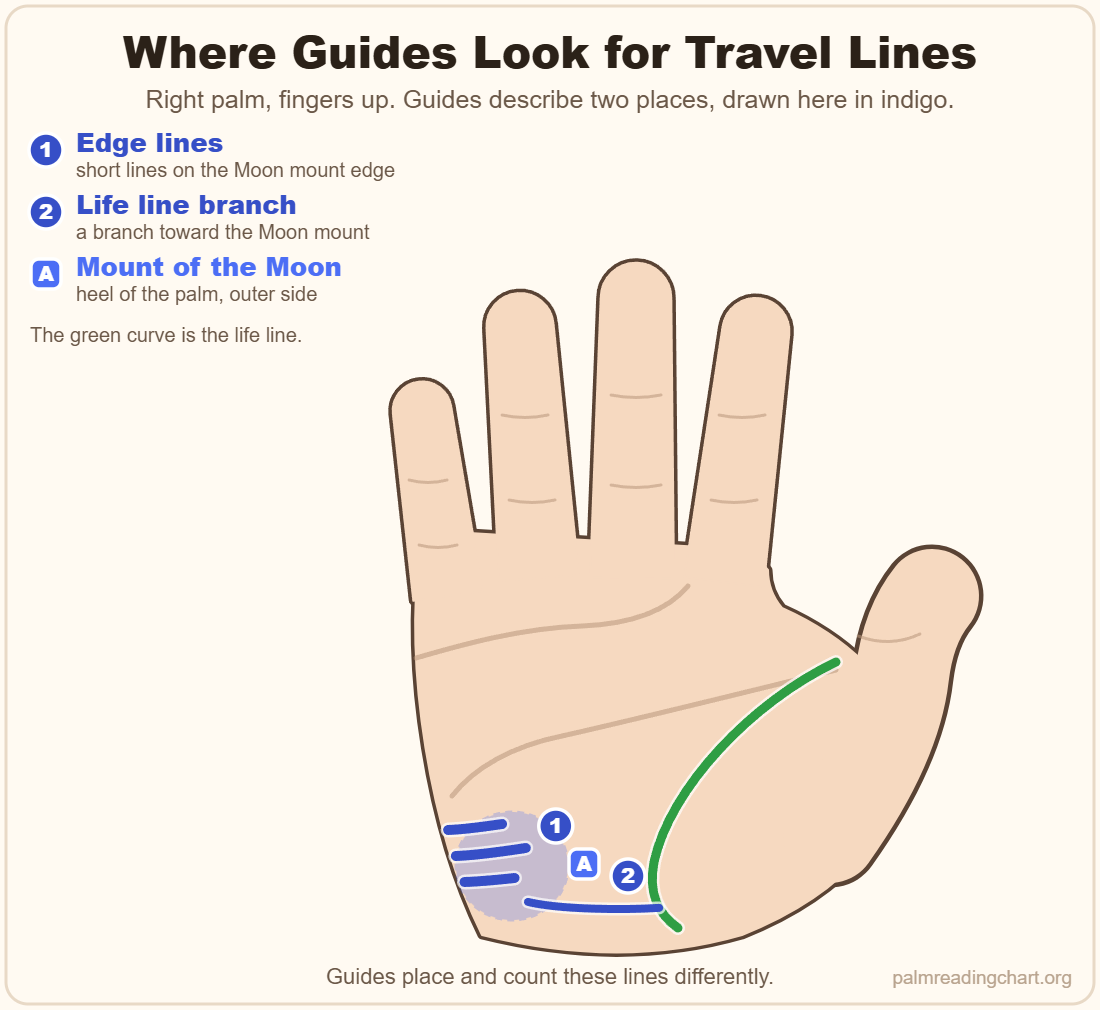
Beyond the edge itself, most guides bring in the life line. Several count a branch of the life line as a travel line, and some draw it heading toward the Moon mount. One guide says not to confuse such a branch with one. Our life line guide shows the usual route of that line.
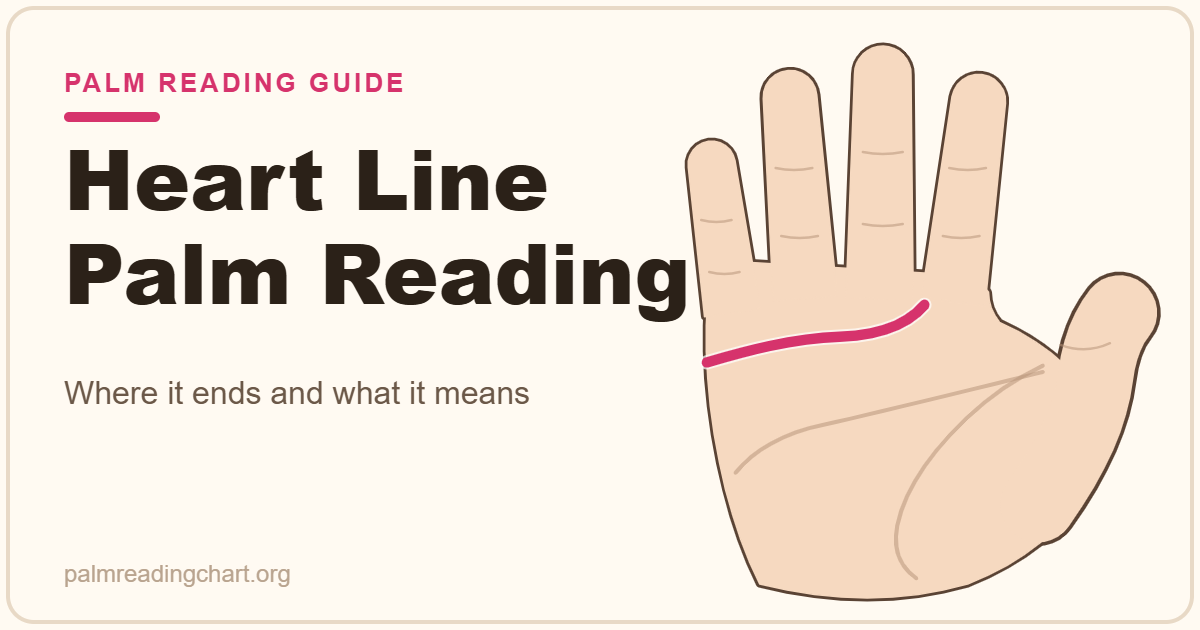
Several guides mention a link to the fate line, and most of those read it as travel for work or career. Our fate line guide explains where that line runs. Some guides also bring in the head line, and some mention the sun line, which our sun line guide describes.
How to Find Travel Lines on Your Own Hand
Short edge creases are easy to overlook and equally easy to imagine. These steps keep the search honest.
- Work in even daylight without glare, and angle the hand so the light grazes the edge sideways.
- Face your dominant palm toward you and locate the outer edge beneath the little finger.
- Look at the edge from the side as well as from above. Travel lines show as short marks running inward from it.
- Count only clear creases that start at the edge. Faint, wavering marks that fade when you relax the hand are more likely skin folds.
- Compare the other hand and note which marks appear on both.
- Look again after some time, since several guides say lines change over time.
Travel Line or Look-Alike?
Several marks near the edge can pass for travel lines. The list below covers four, and Figure 3, further down, pictures two of them.
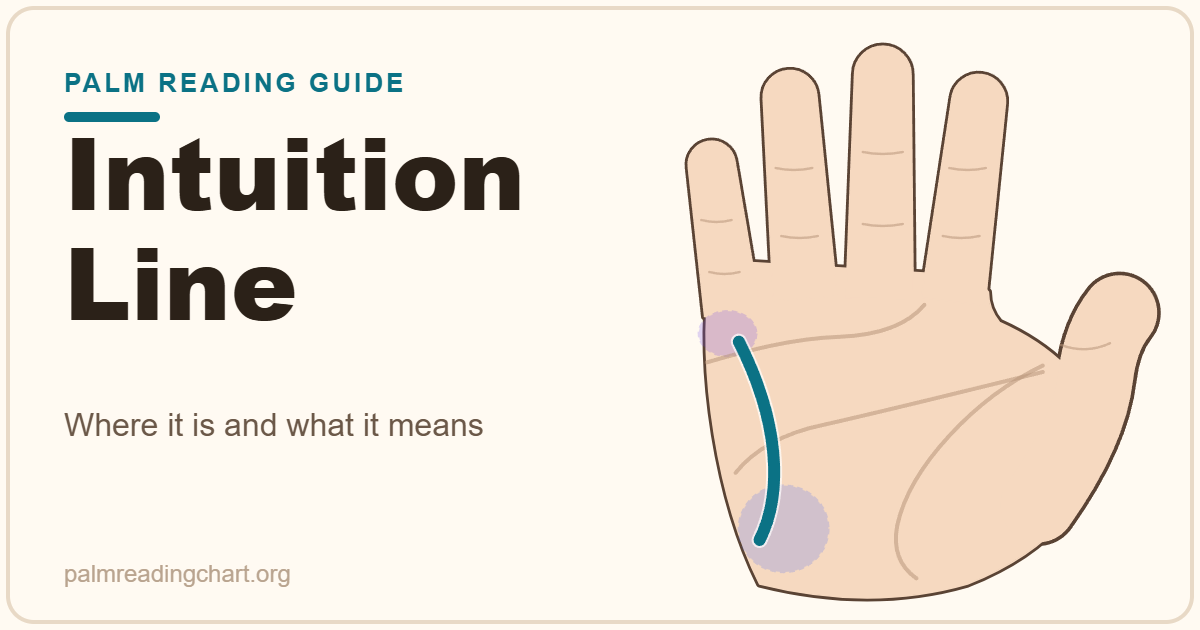
- Intuition line. One guide separates a smooth, upright arc, the intuition line, from the horizontal travel lines. Our intuition line guide shows the difference.
- Skin folds. Two guides warn that creases from how you hold the hand can pose as lines. These fade at rest.
- Wrist bracelets. Two guides tell readers not to mix travel lines with the bracelets, the curved creases at the wrist. One more guide counts lines that rise from the bracelets as a source of travel lines, so check which view a page takes. Our bracelet lines guide covers them.
- Marriage lines. None of the nine guides lists these as a look-alike, but they share the same edge. They sit higher, below the little finger and above the heart line. Our marriage lines guide covers them.
What Travel Lines Are Said to Mean
Traditional readings treat a travel line as a record of movement: a trip, a move or a stretch away from home. Most guides read the line’s length as the size of the journey, and most read a deep, clear line as a more significant one. Six read several lines as several journeys or as frequent travel. Those three themes carry the core of the reading.
Several guides add that a travel line can describe an inner journey, not only a physical one. So the mark need not point to a plane ticket at all.
Do Travel Lines Promise a Trip?
Several of the nine guides say no. They say a line cannot promise a trip, a move abroad or a given destination, and one adds a warning against fixed timing. Several guides also say lines change over time, which fits the caution, because the marks you see now are a snapshot of one hand.
A clear line is better held as a prompt to ask what travel or change means to you than as a booking. That is also how the rest of this article uses it.
Travel Line Patterns and What Guides Say
Count, length, depth and slant change the reading. Figure 2 pictures six patterns in close-up.
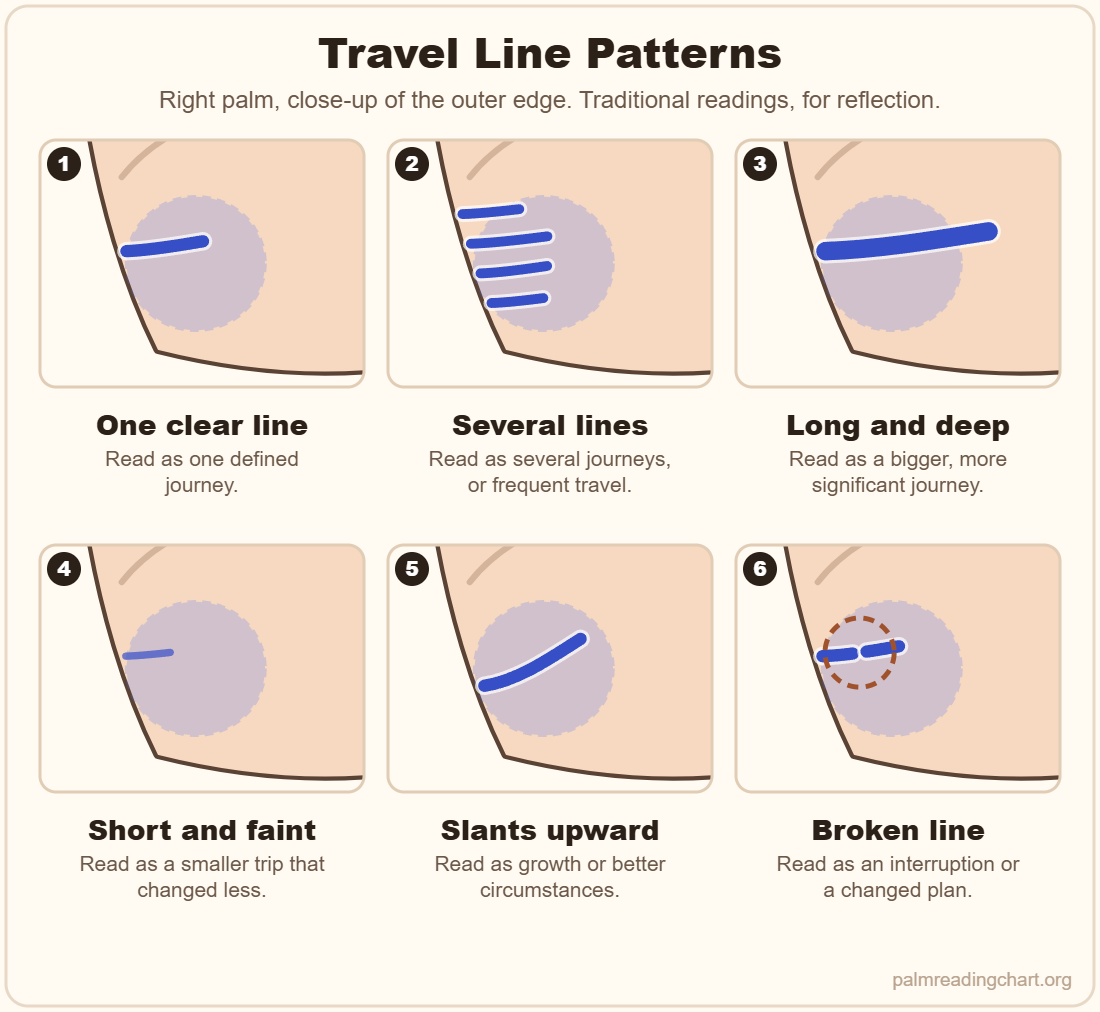
One Line or Several
One guide reads a single clear line as one defined journey. Six guides read several lines as several journeys or as frequent travel. Counting is a little subjective, since whether a faint crease counts changes the total.
Long, Deep, Short and Faint
Most guides read a longer line as a bigger journey, and most read a deep, clear line as more significant. Several read a short or faint line as a smaller trip, or one that changed less. Put together, a long, deep line is read as a bigger, more significant journey.
Upward and Downward Slants
Three guides read a line that slants upward as growth or better circumstances, and a line that slants downward as a harder stretch. Guides word the direction differently, so treat the slant as a loose clue.
Marks on Travel Lines: Stars, Squares, Crosses, Islands and Breaks
Small marks on a line are read as notes on the journey. Figure 3 pictures four of them in close-up, beside two look-alikes. A break appears in Figure 2, panel 6.
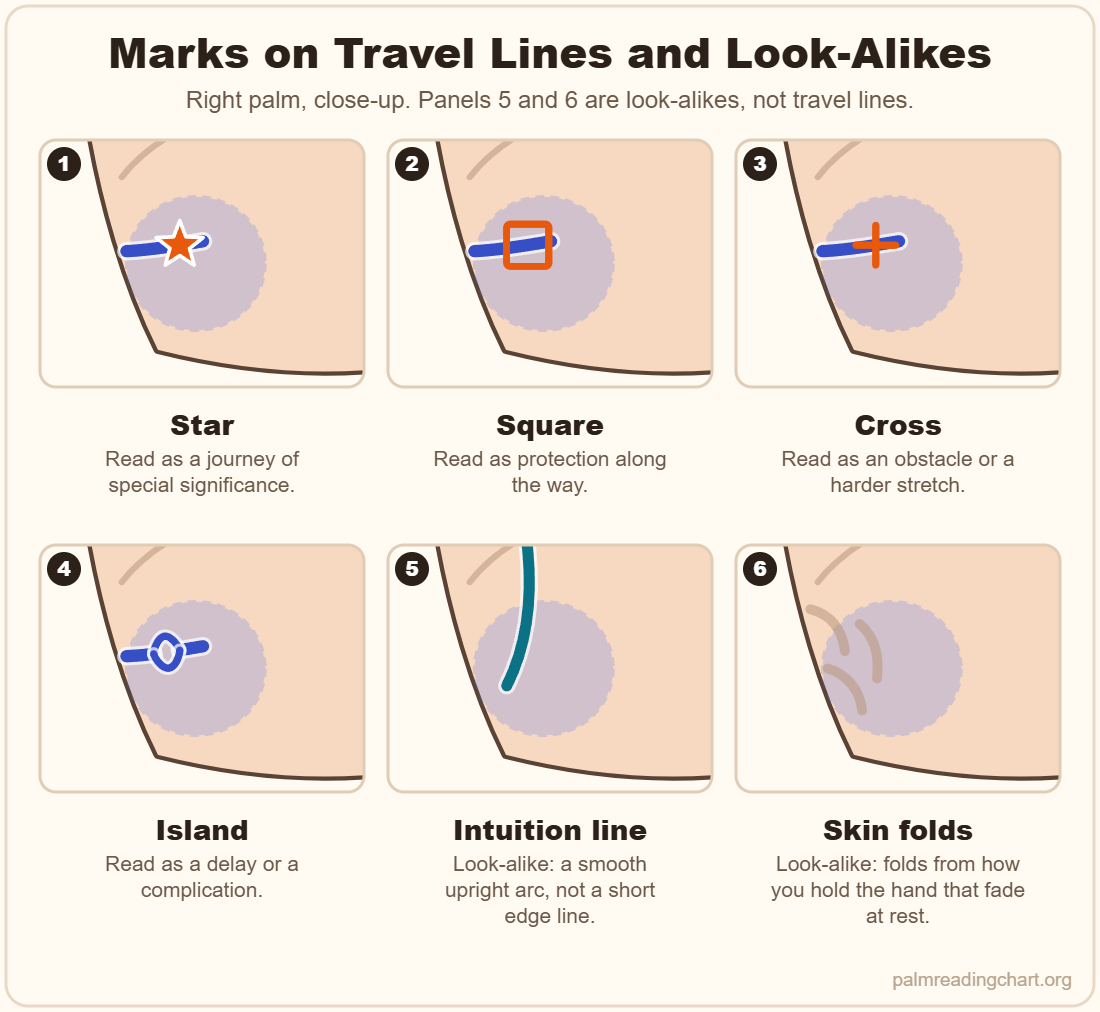
Stars and Squares
Four guides read a star as a journey of special significance. One of those four adds that it can be a difficult journey. Four read a square as protection along the way.
Crosses and Islands
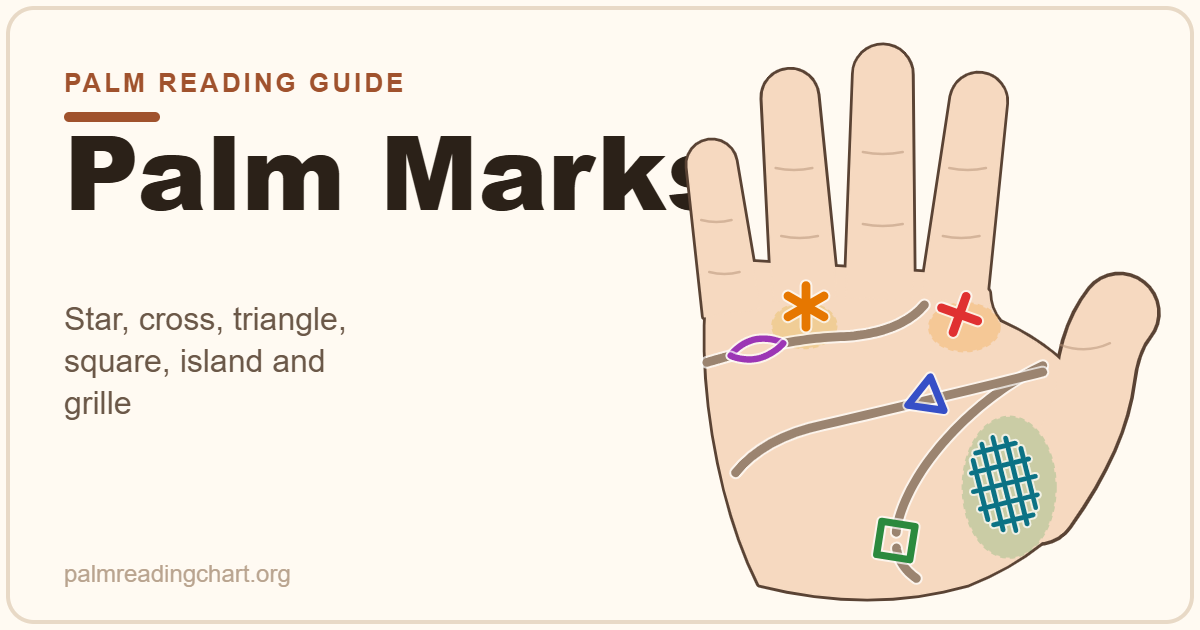
Several guides read a cross on the line as an obstacle or a hard stretch. Two guides read an X made by two crossing lines as helpful instead, so what the mark is matters. Three read an island as a delay, a complication or stress. Our palm marks guide covers these signs across the whole hand.
Breaks
Five guides read a break as an interruption or a changed plan. One adds that palmists disagree on whether a line that vanishes means a cancelled trip or a finished one.
Can Travel Lines Show When You Will Travel?
The guides that try to time a journey do not agree. Three describe methods, and the methods differ. One reads timing from where the line sits on the Moon mount. Two read it from where a branch meets the life line, with one example of age 30. One more guide warns against promising fixed timing.
This article gives no ages, since the methods differ and a crease cannot date an event.
How Common Are Travel Lines?
The numbers conflict. One guide says about 35 percent of palms have them, and another says about 65 percent. A third guide says a palm with none is common and that one or two lines is the usual count. None of the guides names a study, so treat each figure as a guess.
Which Hand Shows Travel Lines?
Two guides share one rule for reading these lines: read the dominant hand for what is happening now and the other hand for what you were born with. That matches the rule in our which hand to read guide, which also explains how it works for left-handers. Compare both hands, and treat a line that shows on only one as a point to note, not a verdict.
Travel Lines at a Glance
| Mark | How guides read it | What to check |
|---|---|---|
| One clear line | One defined journey (one guide) | That it starts at the edge and is a crease, not a fold |
| Several lines | Several or frequent journeys (six guides) | How many are clear and how many are faint |
| Long line | A bigger journey (most guides) | Where it starts and ends, on both hands |
| Deep, clear line | A more significant journey (most guides) | Even light and a relaxed hand |
| Short, faint line | A smaller trip (several guides) | Whether it is a fold that fades at rest |
| Upward slant | Growth or better circumstances (three guides) | That the line rises from the edge |
| Broken line | An interruption or a changed plan (five guides) | Whether a crossing crease makes the gap |
| Star | A journey of special significance (four guides) | That it is a true star and not crossing creases |
| Square | Protection along the way (four guides) | That it is a closed box on the line |
| Cross | An obstacle or a hard stretch (several guides) | Whether it is a cross or an X of two lines |
| Island | A delay or a complication (three guides) | A closed loop, not two creases |
Where the Nine Guides Disagree
On the name and the general idea the sources line up. All nine use the name travel line. Most put the lines on the outer edge or the Moon mount, and most read length as the size of the journey. They split on life line branches, with several counting one as a travel line and one warning against it. They also differ on how many palms have travel lines and on how to time a trip. A last split is how to read crosses: several call a cross on the line an obstacle, while two read an X made by two lines as helpful.
Some pages go further and attach alarming outcomes to certain crossings and marks. We leave those out because no crease can support them, and we keep the gentler readings about journeys, change and protection that several guides share.
What Travel Lines Cannot Tell You
Most of the nine guides carry some kind of caution. Two say palmistry is not science, and several describe it as entertainment or as a tool for reflection. A crease cannot show whether you will move, when a trip will happen or how it will go. For real decisions about travel, work or relocation, lean on facts, planning and people you trust. Use travel lines as a prompt to think about change in your own life, nothing more.
Travel Lines on Palm FAQ
What do travel lines on palm mean?
Guides read them as journeys, moves and changes of place, with length and depth tied to the size of the journey. Several guides say a line cannot promise a trip, and several say it can describe an inner journey.
Where are travel lines on the palm?
Most guides place them on the outer edge or the Mount of the Moon, between the little finger and the wrist, and several describe them as horizontal. Several also count a branch of the life line.
How many travel lines should I have?
The guides give no single answer. One says a palm with none is common and that one or two lines is the usual count. Two others give about 35 and 65 percent for palms that have them. Six guides read several lines as frequent journeys.
Do travel lines show when I will travel?
Palmistry cannot date a trip. Three guides give timing methods that differ, and another warns against fixed timing.
What if I have no travel lines?
Guides differ here. One calls a palm with none common, and at least one other links a missing line to less travel. Several guides say a line cannot promise a trip, so by the same logic a missing line cannot rule one out. The other lines on your hand still carry plenty of traditional meaning.
Conclusion
Travel lines on palm are short edge creases between the little finger and the wrist, read as journeys and changes of place. Look for clear marks in even light, check the other hand and rule out skin folds before reading anything into them. Guides tie length and depth to the size of the journey, and they disagree on timing, rarity and the meaning of some marks. Our step-by-step palm reading guide takes you through a complete reading, and the labeled palm reading chart places travel lines among the other lines and mounts.
Leave a Reply