The intuition line is a curved mark on the outer edge of the palm. Most guides place it between the pad below the little finger and the pad at the heel of the hand. Palmists traditionally read it as a sign of gut feeling, sensitivity and vivid inner imagery. All ten guides we read link it to intuition, and eight describe it as rare, uncommon or missing from most hands.
This guide locates the line on the palm and separates it from look-alikes such as the Mercury line and the sister line. It then walks through the common patterns, from deep and faint to broken, chained and starred, and what guides say about each. Rarity, hand choice and the meaning of a missing line get their own sections, and we flag the main points where the ten guides disagree. Palmistry rests on tradition, not evidence, and Wikipedia describes it as a pseudoscience, so treat every reading here as folklore to think about. The drawings show a right palm with the fingers up. Flip them left to right to picture a left hand.
Table of Contents
What Is the Intuition Line?
The intuition line is a curved minor line, not one of the major ones. Traditional readings center on a feel for people and situations that arrives without step-by-step reasoning. If you are still learning the major lines, our overview of palm lines is the place to begin.
All ten guides use the name Line of Intuition or intuition line. Two add psychic line. One adds Line of the Moon (Linea Lunae) and the Hindi name Antarjnan Rekha, and another adds Line of Uranus. Two guides also bring in one more Latin name, which one treats as a synonym and the other as a different line, so we leave it out.
Where the Intuition Line Sits on Your Palm
Turn your palm toward you and look along the outer edge, the side opposite the thumb. Two pads matter here. The Mount of Mercury sits below the little finger. The Mount of the Moon, also called Luna, is the fleshy heel of the palm on the same side. For a map of every pad, see our mounts of the palm guide. Figure 1 shows the line in teal on a right palm.
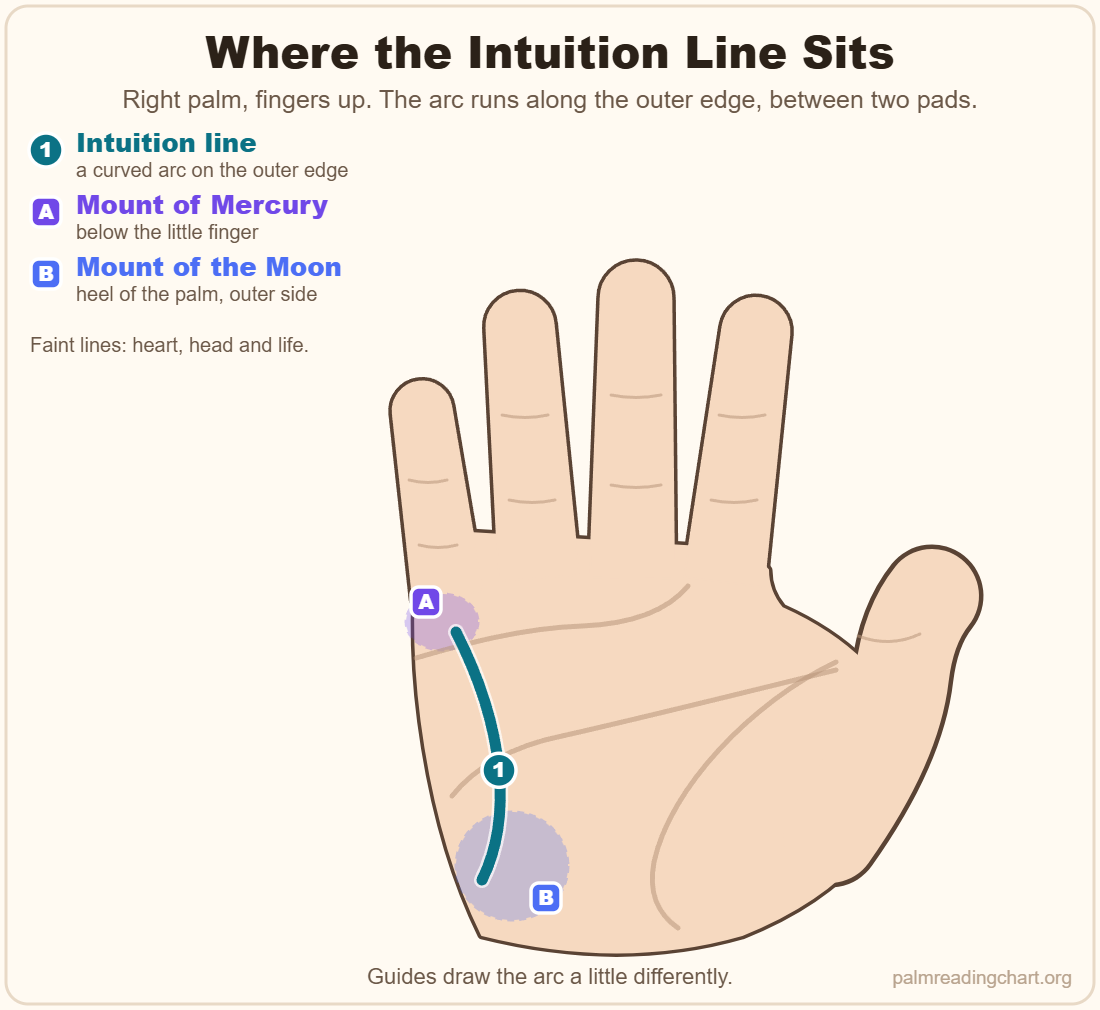
Eight of the ten guides describe a line that runs between those two pads. Nine describe a curve, crescent or semicircle. One guide keeps the whole line on the Mount of the Moon. Another describes something different: a diagonal that starts near the life line and closes a triangle with the life and head lines. We treat that one as a separate version and show it in Figure 2, but we still count its readings of meaning below.
The guides also differ on the bow of the curve. One says it opens toward the thumb, and another says it opens toward the outer edge. On contact with the major lines, one guide says the line does not touch the heart or head line. Two read meaning into the part of the line that lies close to them. Expect your own palm to differ from any drawing.
How to Find an Intuition Line on Your Own Hand
A fine curve on the edge of the hand is easy to miss and just as easy to imagine. These steps keep the search honest.
- Pick a spot with even daylight and no glare, then turn the hand slightly so the light crosses the edge from the side.
- Hold your dominant palm toward you and find the outer edge. One guide starts the search there.
- Locate the two pads, the one below the little finger and the heel of the hand. Cupping the palm a little lifts the edge into view.
- Look for one clear, curved crease between them, not a bundle of short ones. One guide says to check that the line is clear before reading it.
- Change the angle and relax the hand. A mark that vanishes is more likely a fold or a shadow than a line.
- Do the same on the other hand, then compare. Three guides note that lines change over time, so look again after some months.
Intuition Line or Look-Alike?
Several marks on the palm can be mistaken for an intuition line. Figure 2 sets the line beside five of them.
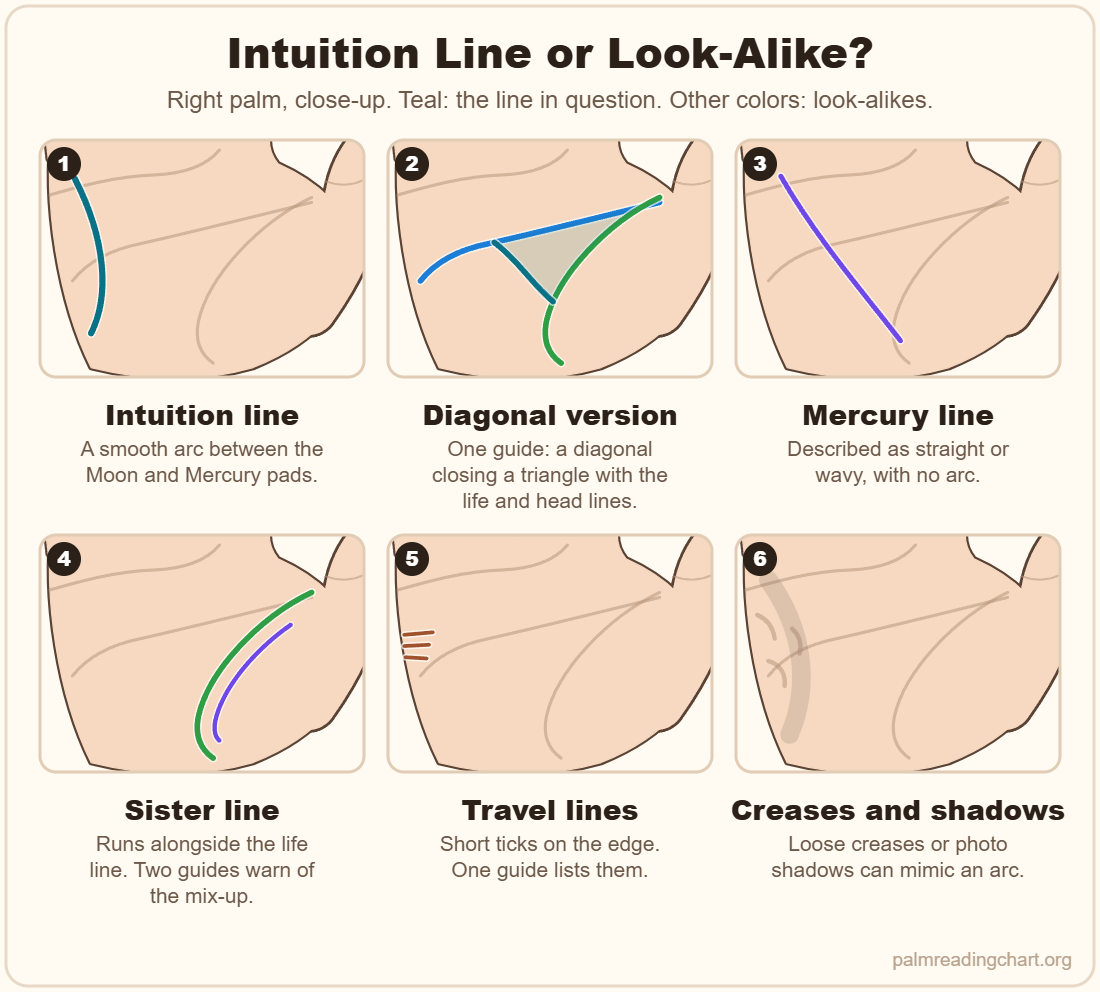
These are the usual traps, with what the guides say about each.
- Diagonal version. One guide uses the name for a diagonal near the life line that closes a triangle with the life and head lines. It is a different mark from the edge arc, so check which one a guide means.
- Mercury line. This line, which some guides call the health line, is described as straight or wavy, with no arc. Three guides warn against confusing the two, and our health line guide shows its usual routes.
- Sister line. A line that runs alongside the life line can look like a stray intuition line. Two guides warn about a line inside or beside the life line. One calls it the Line of Mars and the other a sister or safety line. Our double life line guide explains it.
- Travel lines. One guide lists short horizontal ticks on the outer edge as another trap.
- Creases and shadows. One guide warns that random side creases are common and that a faint, broken or photo-shadowed arc needs care.
What the Intuition Line Is Said to Mean
All ten guides tie the line to intuition. Nine add sensitivity, whether to moods, to atmospheres or to subtle cues. Six bring in dreams or vivid inner imagery. Two guides link the Mount of the Moon with imagination, and three pair the line with a full Moon mount. Three guides pair it with a head line that slopes or curves toward the Moon pad, and our head line guide shows what that looks like.
The guides split on how far to go. Several speak of psychic ability, extrasensory perception or premonitions. Three say outright that the line is not proof of magic or psychic power. Two guides also stress that it does not predict the future. This article follows those guides, since a crease cannot show psychic power.
Intuition Line Patterns and What Guides Say
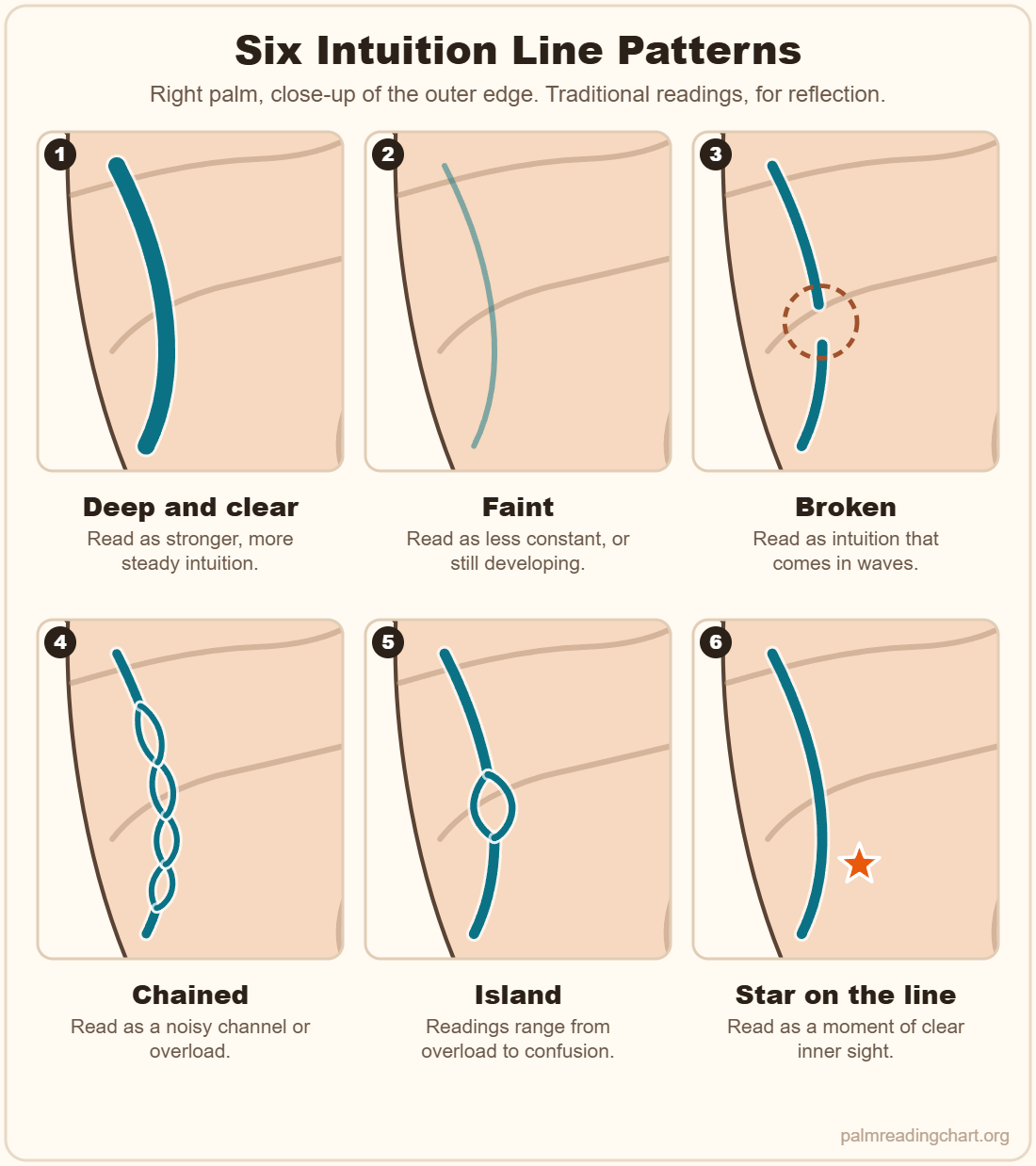
Depth, breaks, chains and marks change the reading. Figure 3 shows six patterns in close-up.
Deep and Clear Lines
Five guides read a deep or clear line as stronger or steadier intuition. One adds that a clear line suggests imagination that is organized instead of noisy. One guide reads a long, clear line as a lifelong theme and a short one as real but tied to certain situations. Another reads a long line as heightened sensitivity and awareness.
Faint and Broken Lines
Three guides read a faint line as less constant intuition or one that is still undeveloped. Three read a broken line as intermittent, erratic or coming in waves. Two guides use harsher words, such as a defective gift or emotional imbalance, and we leave those out. A faint arc is also the hardest to tell from a crease, so give it extra care.
Chained and Island Lines
Two guides read a chained line as overload or a noisy channel. Three mention an island. Two of them read it as confusion or overload, and the third offers a clinical-sounding reading that a crease cannot support. Our palm marks guide covers islands and other small signs in general.
Stars, Forks and Other Marks
Three guides mention a star and read it as a high point, such as a moment of clear inner sight, success or a sudden breakthrough. One guide reads a fork near the top as intuition about people and a fork toward the wrist as strong dream recall. Treat each of these as imagery to reflect on.
Where on the Line Is It Strongest?
Two guides read the line by the stretch that looks clearest. Near the head line it is read as mental, with flashes of knowing and vivid dreams. Near the heart line it is read as emotional, with a strong feel for what others are going through. Near the life line, or low on the palm, it is read as a gut feeling. The two guides word this differently, so use it as a prompt for self-reflection and not as a map.
Is the Intuition Line Rare?
Eight of the ten describe the line as rare, uncommon or missing from most hands. One gives no view. The tenth says the opposite: that roughly one-eighth to one-quarter of palms lack it. That gap may come from describing a different mark, since the same guide draws a diagonal near the life line.
Three guides offer numbers, and they cannot all be right. One says it might be clear on about two in a hundred palms and calls that an illustration, not a survey. Another says about six percent. The third implies that three-quarters or more of palms have it. None of them cites a study, so treat the figures as guesses.
Does Having No Intuition Line Mean Anything?
Four guides say a missing line is nothing to worry about. One calls it no flaw and adds that people without it simply lean on the head line, the heart line or experience. Another says it is not bad luck and says nothing negative. These guides treat it as a quiet feature of a hand, not a gap in anyone.
Dominant Hand, Other Hand or Both?
Two guides give a rule for this line. They read the dominant hand for how the line shows up now and the other hand for inborn tendency. Two more describe a general method for the whole palm. One reads the left hand as inborn and the right as what you have made of it. The other reads the dominant hand for the present and the passive hand for the future. Most of the others say nothing. Our which hand to read guide explains how the dominant-hand rule works for left-handers.
Four guides also tie the line to hand shape and say some shapes make it likelier. We leave those claims out, since they sort people by hand type with no support. Our hand shapes guide explains the system itself.
Intuition Line at a Glance
| Sign | Traditional reading | Worth checking |
|---|---|---|
| Deep, clear arc | Stronger, steadier intuition (five guides) | That it is one clean curve, not a crease |
| Faint arc | Less constant or still developing (three guides) | Even light, a tilt of the hand and the other palm |
| Broken line | Intermittent, erratic or in waves (three guides) | Whether the gap is a crossing crease |
| Chained line | Overload or a noisy channel (two guides) | That the links are not many tiny creases |
| Island | Confusion or overload (two guides) | That it is a true loop on the line |
| Star on the line | A high point, such as clear inner sight or a breakthrough (three guides) | That it is a real star and not crossing creases |
| Long line | A lifelong theme or heightened sensitivity (one guide each) | Where it starts and ends |
| No line | Nothing to worry about, with other lines to read instead (four guides) | Both palms, side by side |
Where the Ten Guides Disagree
On the main theme the sources line up: all ten tie the line to intuition, and nine add sensitivity. They part ways on where the line runs, with one keeping it on the Moon mount and one drawing a diagonal. They also split on which way it bows, how rare it is and which hand to read.
Some pages go further than that. They claim that the line can predict danger and that a habit can destroy the gift. They also claim that some people are likelier to have it and that gemstones can strengthen it. We skip these because a crease cannot back them, and we keep the milder reading of sensitivity and inner imagery that most guides share.
What an Intuition Line Cannot Tell You
Seven of the ten guides carry a disclaimer of some kind, such as entertainment, reflection or not a fixed prediction. Two say palmistry is not scientific. A crease cannot show whether a hunch will be right, whether a dream will come true or whether a decision is wise. For choices that matter, lean on facts and on people you trust. Use the line as a prompt to notice your own instincts, nothing more.
Intuition Line FAQ
What does an intuition line mean?
Guides link it to a feel for people and situations, with sensitivity and vivid inner imagery. They differ on how far to take it, and three say it is not proof of magic or psychic power.
Where is the intuition line on the palm?
Most guides place it on the outer edge, between the pad below the little finger and the heel of the hand. One guide describes a diagonal near the life line instead.
Is the intuition line the same as the Mercury line?
No. The Mercury line is described as straight or wavy, while the intuition line is a curve on the outer edge. Three guides warn against mixing the two up.
Which hand shows the intuition line?
The guides do not agree. Two give a rule for this line and read the dominant hand for how it shows up now. Two more describe a general method for the whole palm.
What if I do not have an intuition line?
Eight guides describe the line as rare or uncommon, so many palms lack it. Four say a missing line is nothing to worry about, and the other lines carry plenty of traditional meaning.
Conclusion
The intuition line is a curved mark on the outer edge of the palm, between the Mercury and Moon pads. Look for one clear arc in even light, then check it from a new angle and on the other palm before reading anything into it. Guides tie it to intuition, sensitivity and dreams, and they disagree on its shape, its rarity and how far the meaning goes. Our step-by-step palm reading guide walks through a full reading from start to finish. The labeled palm reading chart places the intuition line among the other lines and mounts.
Leave a Reply