Fingers in palmistry are read as five small signposts on one hand: the thumb, the index finger, the middle finger, the ring finger and the little finger. Guides traditionally tie each one to a theme, then look at its length, its tip, its spacing and how it bends. Most begin with the planet names, so the first step is knowing which finger is which.
This guide covers what each finger and the thumb are traditionally said to mean and how to compare finger length. It also covers what fingertip shapes, gaps and leaning fingers add. Nine palmistry guides informed this article. We note which points they share and which they dispute. Researchers regard palmistry as a pseudoscience, so treat everything below as folklore to think about, not as a measurement of you. A finger cannot diagnose anything or predict anything. Each hand drawing shows a right palm with the fingers up, so mirror it for a left hand.
Table of Contents
The Planets Behind Each Finger
Palmistry gives the four long fingers the planetary themes that name the mounts beneath them. Jupiter sits under the index finger, Saturn under the middle finger, Apollo under the ring finger and Mercury under the little finger. Most of the guides we read attach a planet to each finger this way. Two guides skip the planets and give plain themes, such as ambition for the index finger and expression for the ring finger.
The thumb stands apart. In most guides it carries no planet and is tied to willpower and decision-making instead. Our mounts of the palm guide shows the pad under each finger, and our palm reading chart puts the main lines and mounts on one diagram.
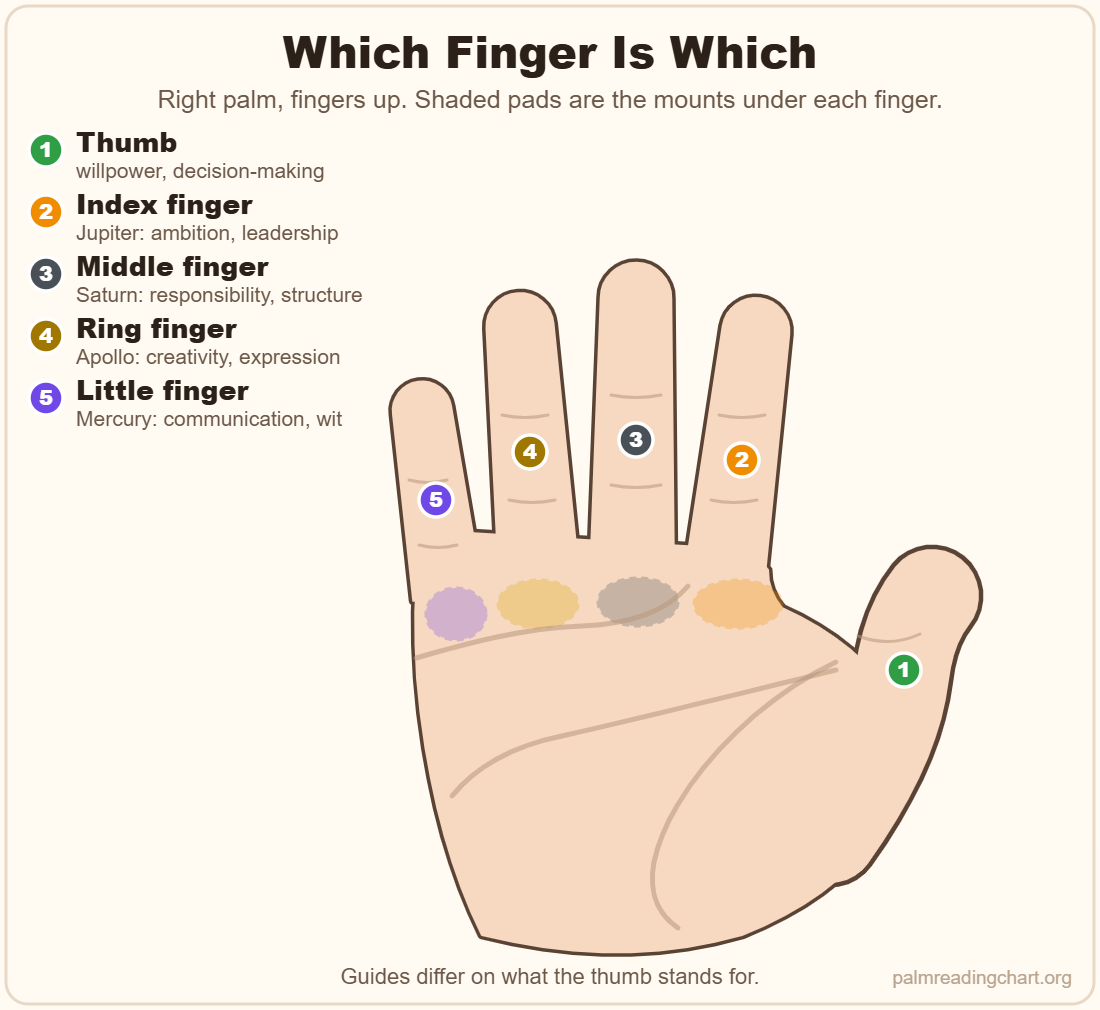
Figure 1 numbers the five fingers on a right palm and lists the theme guides link with each one. Guides differ most on the thumb, so treat that label as the loosest of the five.
How to Look at Your Fingers
Finger readings depend on comparison, so the way you hold your hand changes what you see. Work through these steps in good light.
- Rest your hand open on a table, palm up, with the fingers loose and not stretched.
- Take in the whole hand first. Are the fingers long or short next to the palm?
- Find the middle finger. Several guides note that it is normally the longest, so the others are judged against it.
- Compare, do not measure. What matters is how each finger sits next to its neighbors, not its size in millimeters.
- Note how each finger stands: straight or leaning, flexible or stiff, and how wide the gaps are at rest.
- Repeat on the other hand. Palmistry traditionally links the writing hand with the present and the other hand with what you were born with. For the usual method, see our which hand to read article.
Jot down your observations before you check any guide. Notes made first are less likely to bend toward a reading you have just seen.
Fingers in Palmistry: What Each One Represents
The Thumb
Most guides link the thumb with willpower and decision-making, and several add self-control or judgment. One guide names Venus for the thumb. Another discusses the Mount of Venus at its base and brings in Mars for the thumb itself. The rest name no planet at all.
Two guides tie a long thumb to strong decision-making and a short one to a cooperative, steady style. Two others look at flexibility: a thumb that bends back easily is linked with adaptability or open-mindedness, and a stiff, upright thumb with caution or firmness. Two guides list the angle and the two visible sections of the thumb as factors but give no meanings for them.
Index Finger: Jupiter
The index finger is traditionally linked with Jupiter and with ambition, confidence, leadership and the way you relate to authority. Several guides tie a long or prominent index finger to a wish to lead or direct. Two read a shorter one as a preference for working alongside others or a quieter, private ambition. The Mount of Jupiter sits beneath it.
Middle Finger: Saturn
The middle finger is linked with Saturn and with responsibility, discipline, structure and a sense of boundaries. One guide calls it the anchor of the hand. Because it is normally the longest finger, guides look at whether it stands out more or less than expected.
Several guides tie a prominent middle finger to seriousness and care about rules, and a noticeably short one to a more relaxed attitude toward rules and routine. A few add gloomier moods to the long and short versions. This guide leaves those out.
Ring Finger: Apollo, or the Sun
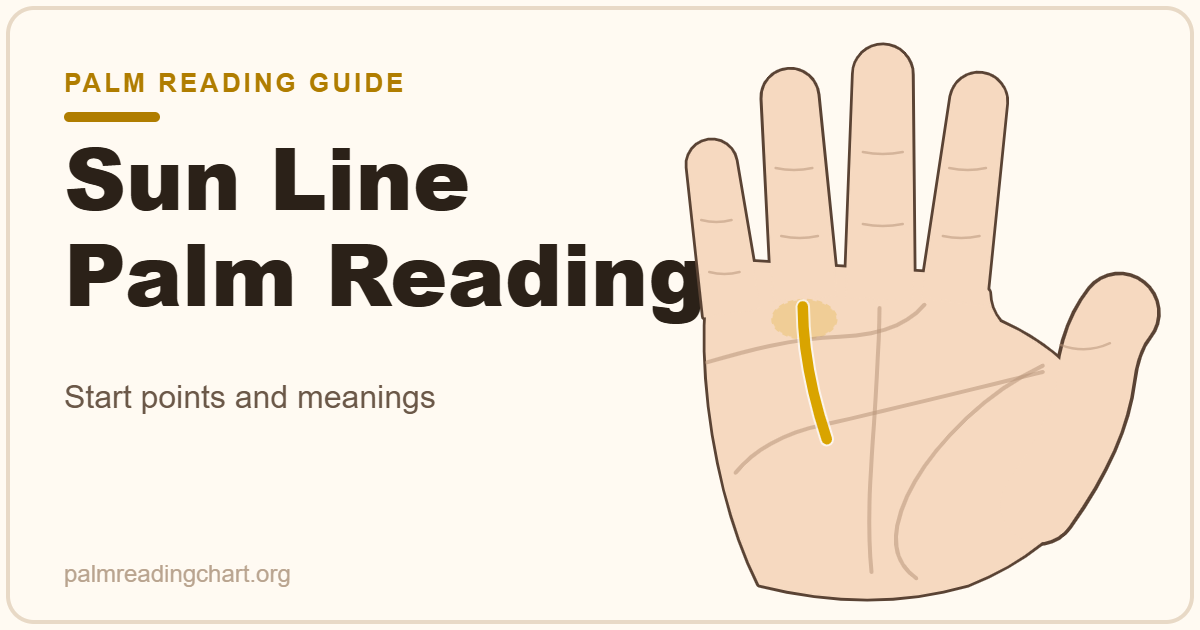
The ring finger is linked with Apollo, which a couple of guides also call the Sun, and with creativity, self-expression, recognition and a love of beauty. Several guides tie a long or graceful ring finger to comfort in the spotlight and a wish to create. Two read a shorter one as a creative life kept more private. One guide links a ring finger close to the middle finger in length with taking risks. For the line that runs toward this finger, see our sun line guide.
Little Finger: Mercury
The little finger is linked with Mercury and with communication, wit, adaptability and business sense. Several guides tie a long or strong little finger to a gift for speaking or selling. One reads a short little finger as a quieter style of speech and adds that it says nothing about intelligence. The pad beneath it is the Mount of Mercury, and our money line guide covers the short lines guides look for there.
How to Compare Finger Length
Length is the most common finger test, and guides ask for comparison, not measurement. Two comparisons come up most: the index finger against the ring finger, and the little finger against the top crease of the ring finger. The middle finger is the yardstick. One guide adds that a middle finger only slightly longer than its neighbors gives a softer Saturn theme.
Index Finger Against Ring Finger
Most guides compare these two, and they agree on the basic split. When the index finger is longer than the ring finger, Jupiter themes come first: leadership, direction and high standards. When the ring finger is longer, Apollo themes come first: creativity, confidence and a wish for recognition.
One guide reads equal length as a balance of the two themes. Two guides also mention the 2D:4D digit ratio, which researchers study in other settings. A ratio study is not a palmistry test, so treat this comparison as symbolism.
Little Finger Against the Ring Finger Crease
Several guides give the little finger a reference point: its tip should reach about the top crease of the ring finger, the one nearest the fingertip. Two guides read a tip that reaches that crease or rises above it as natural ease with words. They read a tip clearly below it as a quieter, more private way of speaking. Two others give the reference point without a meaning.
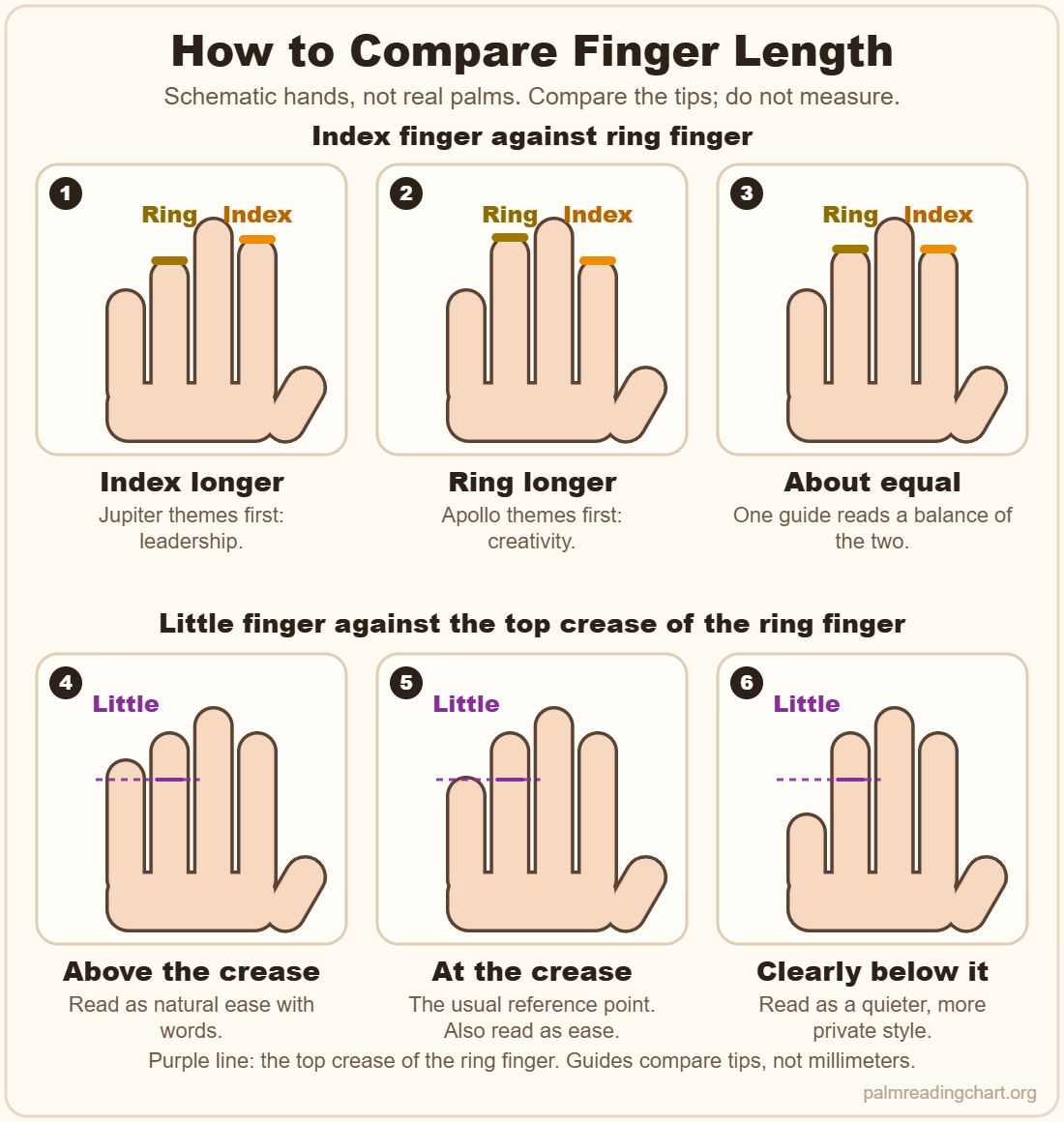
Figure 2 draws both comparisons on schematic hands. Real fingers are rarely this tidy. A low-set little finger can look shorter than it is, so check the whole hand before reading anything into one tip.
Long and Short Fingers Overall
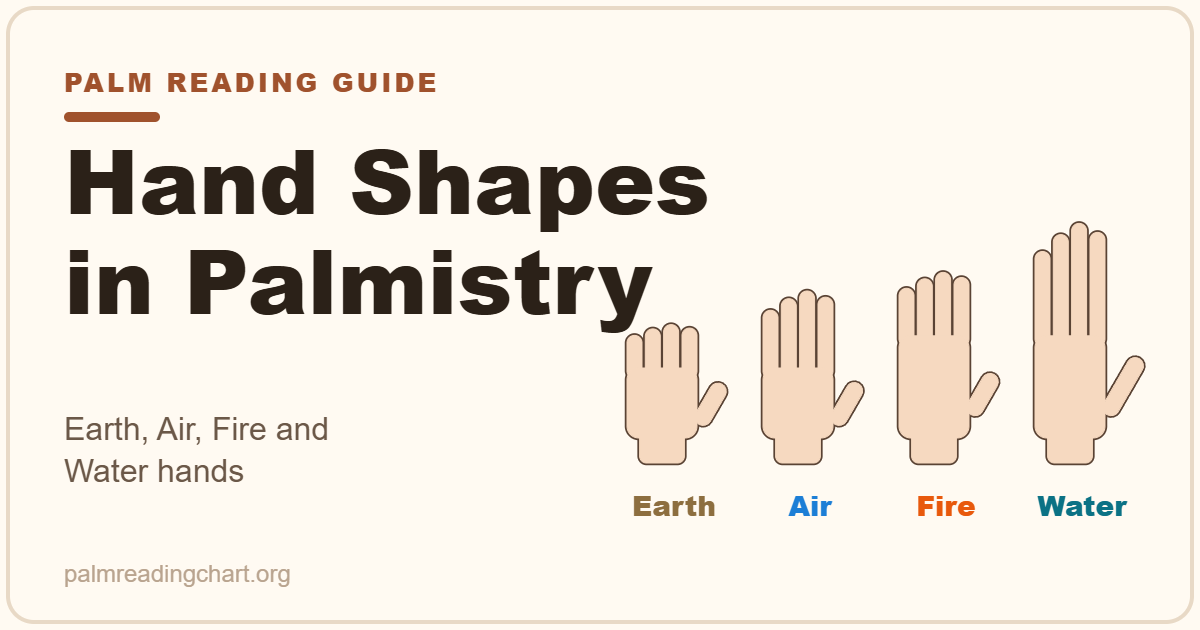
Several guides also compare overall finger length with the palm. Long fingers are linked with detail, patience and reflection, and short fingers with quick, big-picture, decisive thinking. One guide stresses that neither is better, only different. Our hand shapes guide combines palm shape and finger length into the Earth, Air, Fire and Water types.
Fingertip Shapes in Palmistry
Only a few of the guides we read describe fingertip shapes, and those that do agree closely. Square tips are tied to a practical, orderly and dependable nature. Pointed tips are tied to a sensitive, imaginative and idealistic one, and one guide calls them relatively uncommon.
Conic tips, gently rounded, are linked with intuition, charm and expressiveness. Spatulate tips, broad at the end, are linked with an active, inventive and action-oriented nature. Some guides treat “rounded” as another name for conic, not a separate shape.
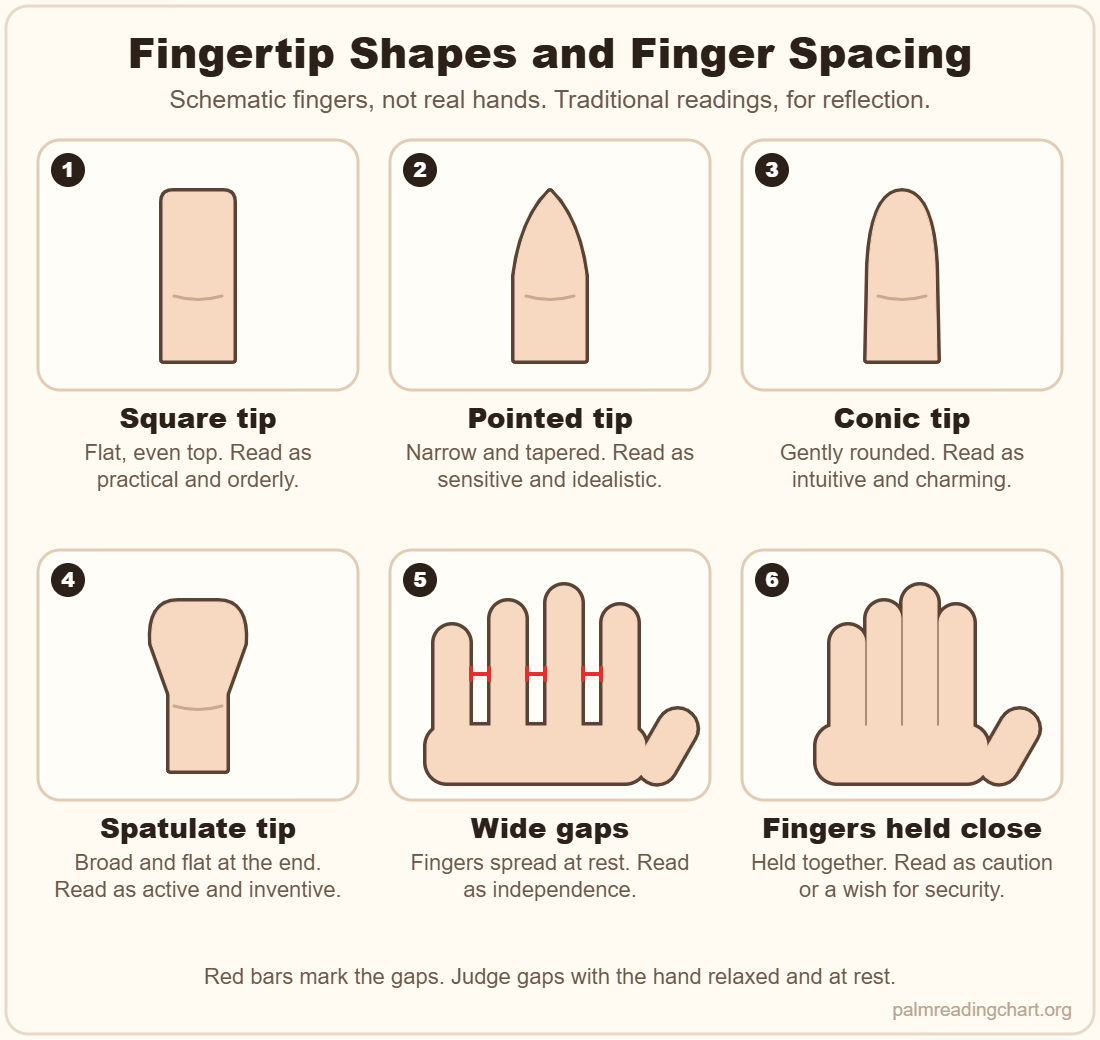
Figure 3 shows the four tip shapes in panels 1 to 4. Look at the fingertip from the front with the hand at rest, and judge the overall outline, not one fingertip on a bad day.
Finger Gaps, Leaning and Flexibility
Gaps Between the Fingers
Several guides look at the space between the fingers when the hand rests naturally. Wide gaps are linked with free thinking and an independent lifestyle, and fingers held close together with caution, careful decisions or a wish for security. Panels 5 and 6 of Figure 3 show the two patterns.
Two guides go further and read each gap. A wide gap between the index and middle fingers is taken as independent thinking. Between the middle and ring fingers, it is taken as emotional independence or a carefree view of the future. Between the ring and little fingers, it is taken as independence in action or unconventional communication. Judge gaps only with the hand at rest, because a stretched hand shows nothing.
Fingers That Lean
Four of the guides say a finger that leans toward its neighbor borrows that neighbor’s theme. In one example, a little finger that bends toward the ring finger blends communication with creativity. Another guide notes that a slight natural curve is common, so leave a small lean unread.
A crooked or bent finger is simply a shape of the hand. The harsher labels a few guides attach to it are left out here.
Low-Set Fingers and Flexibility
A few guides mention finger set. A low-set finger starts lower on the palm and can look shorter than it is. Guides treat a low-set or short finger as a quieter expression of its theme, not a missing one.
A few guides also read flexibility. Flexible fingers are traditionally linked with adaptability and open-mindedness, and stiff fingers with caution or reserve. One guide notes that stiffness changes with age, work and joint comfort, so do not read it from a single day.
Fingers at a Glance
| Finger | Planet or theme | Traditional themes | What guides compare |
|---|---|---|---|
| Thumb | Willpower (Venus in one guide) | Willpower, decision-making, judgment | Length and flexibility |
| Index | Jupiter | Ambition, confidence, leadership | Length against the ring finger |
| Middle | Saturn | Responsibility, discipline, structure | How far it rises above its neighbors |
| Ring | Apollo (Sun in a couple of guides) | Creativity, self-expression, recognition | Length against the index finger |
| Little | Mercury | Communication, wit, adaptability | Tip against the top crease of the ring finger |
| Hand overall | Whole hand | Tip shape, spacing, leaning, flexibility | Square, pointed, conic or spatulate tips; wide or close gaps; lean toward a neighbor; flexible or stiff |
Where Guides Disagree
The guides agree on the basic themes and split on detail. The thumb is the clearest gap: one names Venus, another brings in Mars, and the rest name no planet. The ring finger is Apollo in most guides, with the Sun as an alternate name in a couple. Some guides give a meaning for short fingers, while others cover only long ones.
Spacing and leaning vary most. Two guides read every gap, while one only says the gaps matter and sends readers to a separate page. A few guides attach harsh labels to long, short or crooked fingers. This guide keeps the gentler readings and leaves the harsher ones out, because the shape of a finger cannot support them.
What the Fingers Cannot Tell You
Four guides in our set of nine call their readings guidance, reflection or entertainment, and one says finger lengths do not scientifically reveal personality. Finger length and shape also change with age, work, injury and joint stiffness, and photos distort them. Fingers cannot replace medical advice, predict a career or judge a person. If a real worry is weighing on you, talk to a doctor, a counselor or another qualified person rather than consulting a hand.
Fingers in Palmistry FAQ
What does each finger mean in palmistry?
Traditionally, the index finger is linked with Jupiter and leadership, and the middle finger with Saturn and responsibility. The ring finger goes with Apollo and creativity, and the little finger with Mercury and communication. The thumb is tied to willpower and decision-making.
Which finger is usually the longest?
The middle finger, according to several guides. The other fingers are compared with it.
What does it mean if my ring finger is longer than my index finger?
Guides put Apollo themes first, such as creativity and confidence. A longer index finger puts Jupiter themes first, such as leadership. Both are presented as styles to reflect on, not scores.
Do gaps between the fingers mean anything?
Guides link wide gaps at rest with independence and fingers held close with caution or a wish for security. Treat it as one small detail, and look with the hand at rest.
Can I read my fingers from a photo?
Not reliably. Angle, lens distortion and posture change how long the fingers look. Compare your real hands, at rest, in soft daylight.
Conclusion
Fingers in palmistry work best as small comparisons. Start with the thumb for willpower and the four long fingers for their planets, then check length against a neighbor, tip shape, spacing and lean. Look at the whole hand at rest, compare instead of measuring, and hold every reading lightly. Our step-by-step palm reading guide gives the bigger picture, and our guide to palm lines shows how the fingers fit with the lines.

Leave a Reply