A double life line is a second line that runs beside the main life line around the base of the thumb. Palmists traditionally read it as extra support or a reserve of energy. Seven of the nine guides we read call it a sister line.
This guide shows where the second line sits and how to tell it from a fork or a skin fold. It also sets out what full, partial, faint and wide versions are said to mean. It covers how rare the line is and how the dominant hand compares with the other. Guides say the line is not a measure of how long you will live. We point out where the nine guides disagree. Palmistry has no scientific support, and Wikipedia classes it as a pseudoscience, so take each reading as folklore to reflect on. Every drawing is of a right palm held fingers up, so flip the picture in your mind for a left hand.
Table of Contents
What Is a Double Life Line?
The life line is the curved crease that starts between the thumb and the index finger and arcs around the thumb pad. When a second crease keeps pace with that arc, palmists speak of a double life line. If you have not found your main line yet, our life line guide shows where to look first.
The second line has many names. Seven of the nine guides use sister line. Three also call it the Mars line or the Line of Mars, three use inner life line, and two use support line. One guide adds guardian angel line for a line near the thumb and gives the Indian name Shukra Rekha, or Venus line, for one very close to it. The guides mostly use these names for the same feature, so this article says sister line or double life line.
Where the Sister Line Sits on Your Palm
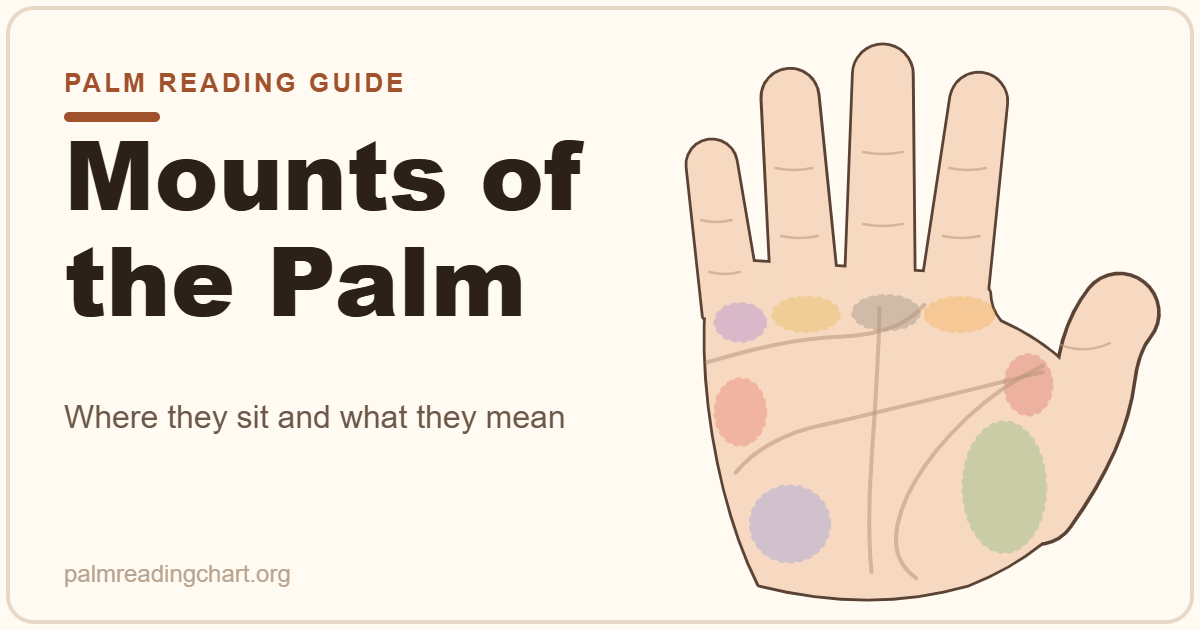
Look in the space inside the arc of the life line, between that line and the thumb pad. Palmistry calls the pad the Mount of Venus, and our mounts of the palm guide maps it with the other pads. Figure 1 shows the main life line in green and a sister line in violet on a right palm.
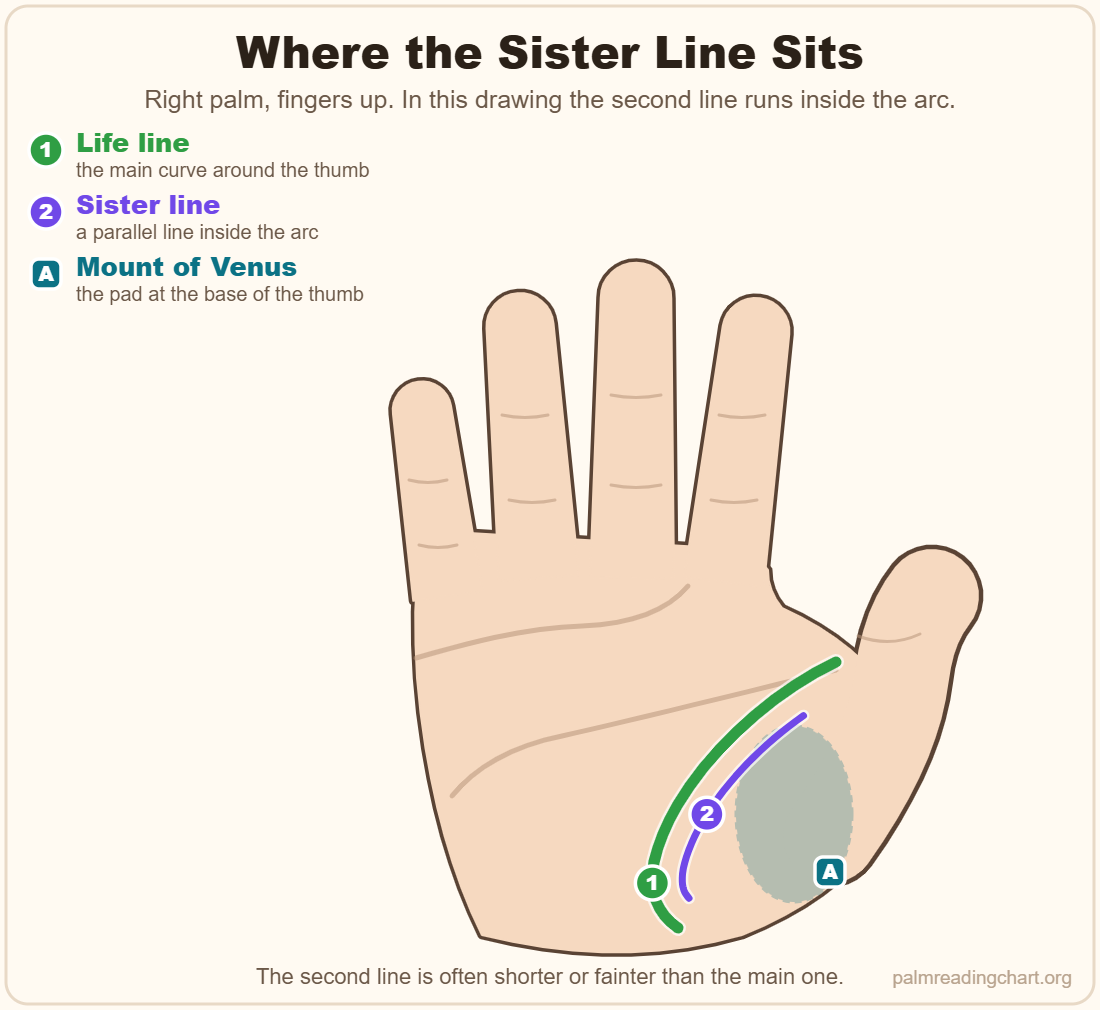
Guides differ on the side. Three place the second line inside the arc, and a fourth says it runs along the thumb side. One accepts either side. It reads an inner line as inner strength or family influence, and an outer line as outside influences such as a partner, friend or mentor. Another treats the line nearest the thumb as the main life line, which puts the second line farther out.
Guides also differ on how far the second line must run. One asks for a parallel stretch of at least a third of the life line. Four accept a line that follows the whole arc or only a section, and one warns against treating a short segment as proof of a rare mark. One guide says a close, even gap supports the case. It adds that a wider gap may still count if the line keeps pace with the main one for a sustained stretch.
How to Find a Double Life Line on Your Own Hand
A faint second line is easy to miss and easy to imagine, so a few habits help. Work through these steps.
- Sit near a window and tilt your palm until soft side light rakes across the thumb pad. Glare and harsh shadows can hide fine lines or fake them.
- Trace the main life line first, from between the thumb and index finger around the pad toward the wrist.
- Let the thumb rest relaxed. One guide advises this so the pad is not stretched.
- Scan the space inside the arc for a second line, often fainter or shorter than the main one, that keeps a steady distance from it.
- Check it from a second angle, then gently cup the hand and relax it again. A line that vanishes when you change the angle may be a fold or a shadow.
- Look at your other hand too. One guide gives a line on both hands more weight.
Double Life Line or Look-Alike?
Many look-alikes sit near the life line. Figure 2 sets a true sister line beside five common ones.
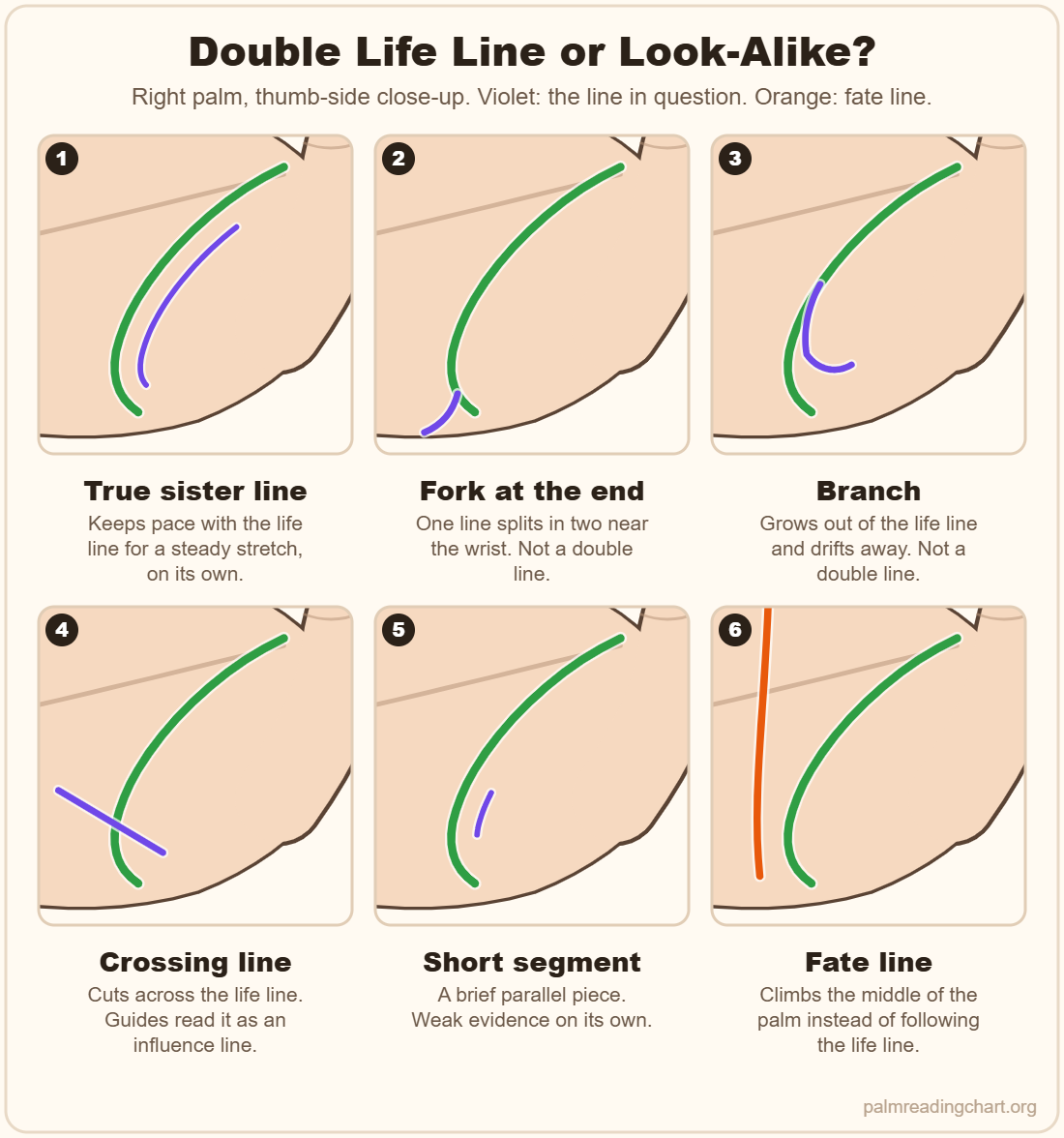
These are the usual traps, with the points the guides make about each.
- Fork at the end. One life line that splits into two prongs, usually near the wrist, is a fork with readings of its own. Three guides separate a fork from a parallel line.
- Branch. A branch grows out of the main line, then curves away or back, while a sister line runs on its own. Two guides say a branch does not count as a second line.
- Crossing line. A line that cuts across the life line is more likely an influence line or a change line. Two guides link such lines to influence, and our palm marks guide covers crosses and other small signs.
- Short segment. One guide warns against treating a short segment as proof of a rare mark, and another sets a floor of a third of the life line.
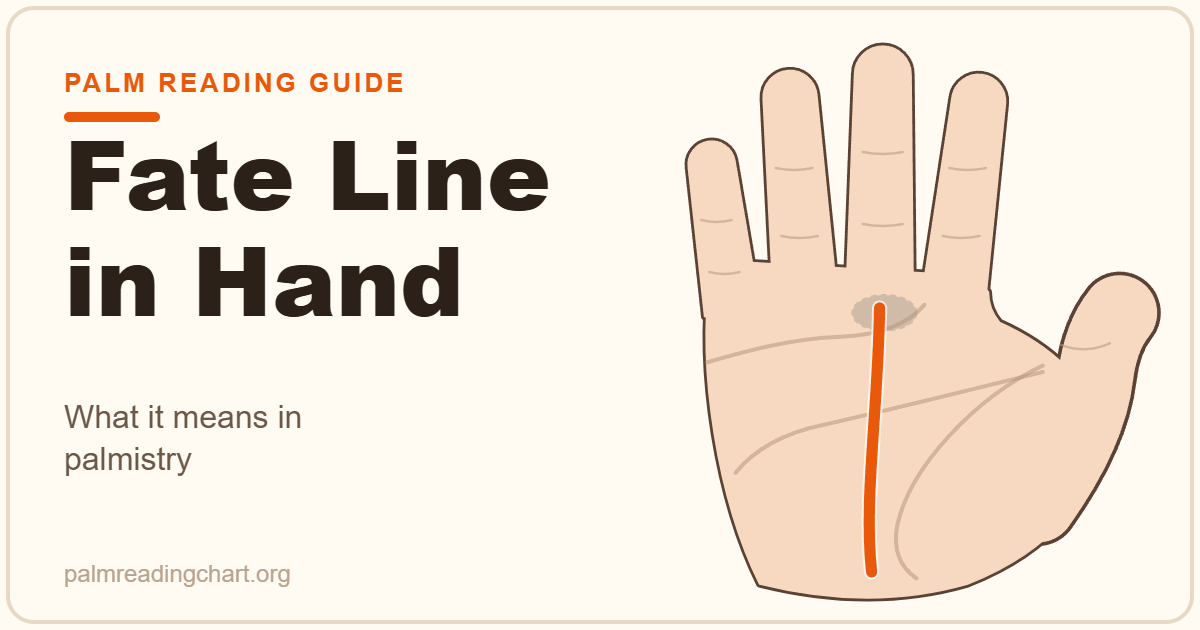
- Fate line. The fate line climbs the middle of the palm toward the fingers instead of following the life line. Two guides separate it from a sister line, and our fate line guide shows the usual routes.
- Fold, shadow or glare. Three guides warn that skin folds, shadows, glare or a doubled edge can imitate a second line.
Double Life Line Patterns and What Guides Say
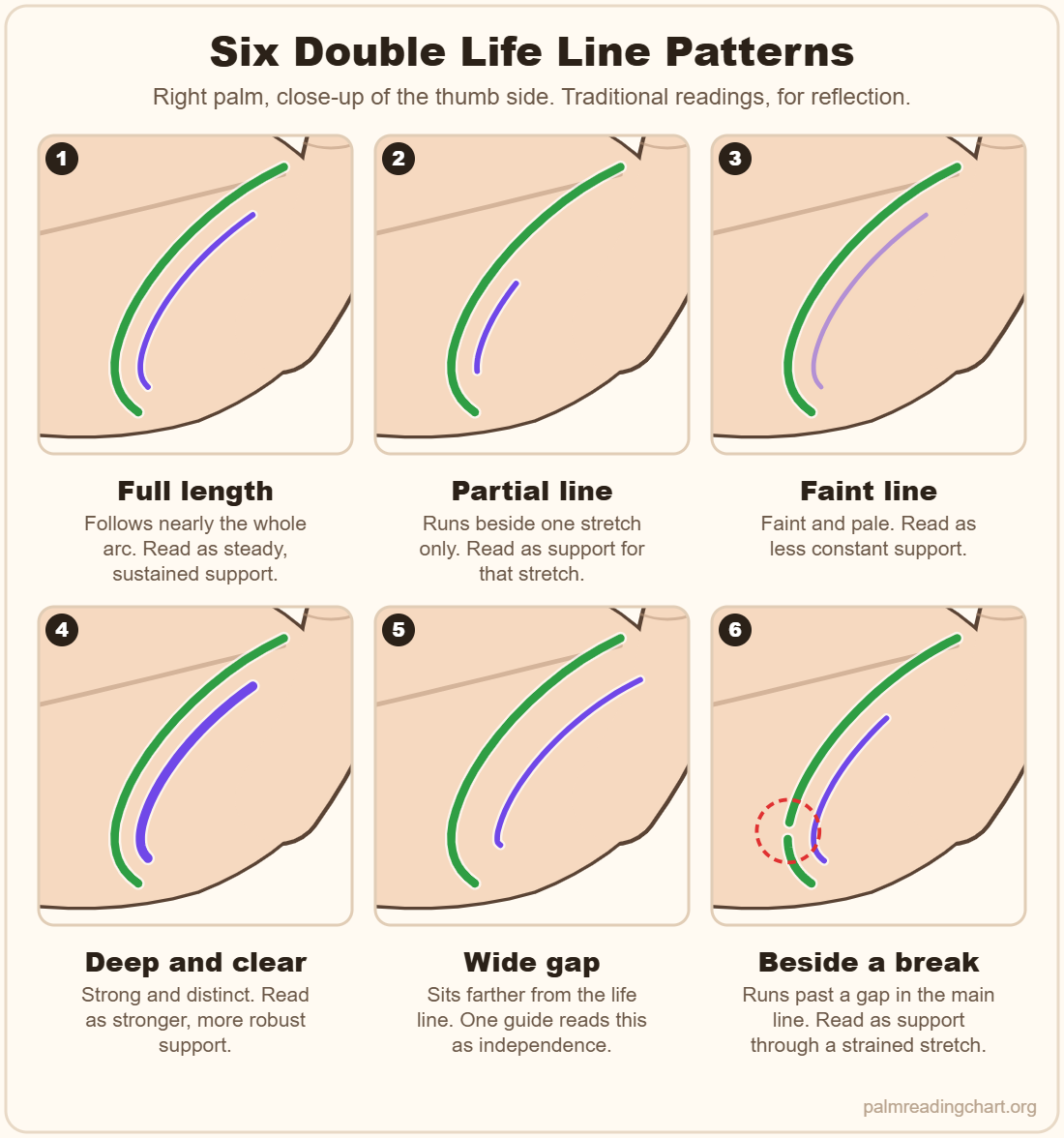
All nine guides share one core theme: support, reserve and resilience. They describe extra energy, a backup alongside the main line, or help that arrives under strain. At least six describe the line as protective in some way, and several add that this is a theme and not a guarantee. The details change with the pattern, which Figure 3 shows in close-up.
Full-Length and Partial Lines
One guide reads a second line that follows most of the life line as steady, sustained support and calls it the most favorable form. A partial line is read as support over the stretch it covers, a view three guides share. Those guides link position along the arc with a stage of life, and one adds that length does not count years.
Faint, Deep and Clear Lines
Four guides give a faint second line a milder reading, such as support that is less constant or not yet fully realized. Their wording differs, and a pale line needs extra care, since folds and shadows can mimic one. At the other end, four guides read a deep, clear second line as stronger, more robust support.
Close and Wide Gaps
One guide reads a narrow gap as reliance on close support and a wide gap as independence. Another says a wider gap may still count if the line runs alongside for a sustained length. Gap width is easy to misjudge by eye, so hold both readings lightly.
A Sister Line Beside a Break
Two guides describe a second line running beside a break or a weak, chained stretch of the main line. They read it as support carried through a difficult period, not as a way around it. Breaks and chains on the main line have their own meanings, which the life line guide covers.
Where Does the Support Come From?
Guides do not agree on what the support stands for. Their lists include family, a partner, friends, a mentor, loved ones, work and personal resilience. One guide says the mark alone cannot point to a particular supporter, which is a fair limit to keep in mind.
What Does the Word Double Suggest?
Four guides read the word double as a second act in life, such as two careers, two stages of life or a second chance. One of them treats such readings as metaphor, not forecast. Treat these as imagery, since a crease cannot show how a life will unfold.
Is a Double Life Line Rare?
Five of the nine guides comment, and they do not agree. One calls partial lines reasonably common and full-length lines less so. The others use words that run from occasional to relatively rare to rare. One offers a figure of 15 to 20 percent of people but names no study, so we would not rely on it.
Does a Double Life Line Mean a Longer Life?
Guides mostly say not. Four of the nine reject the idea directly, and two more call it no guarantee of a longer life. One adds that the life line shows quality and intensity, not duration. Another says the number of lines has no more to do with lifespan than their length does. Palmists read this mark as extra support, not extra years, and guides say the life line itself is not a measure of how long anyone will live.
Dominant Hand, Other Hand or Both?
Three guides address the hands. Two read the dominant hand as what you have built or are living now and the other hand as underlying or inborn capacity. One of those two gives a line on both hands more weight. The third suggests that a contrast between the hands may show whether support feels inherited, practiced or tied to present pressure. For left-handers the dominant hand is the left, and the full rule is in our which hand to read article.
Double Life Line at a Glance
| What you see | Traditional reading | What to check |
|---|---|---|
| Second line along most of the life line | Steady, sustained support (one guide) | That it runs on its own and is not a branch |
| Partial line | Support for the stretch it covers | Length: one guide asks for at least a third of the life line |
| Faint line | Less constant or not yet fully realized support | Soft light, a second angle and the other hand |
| Deep, clear line | Stronger, more robust support | That it is not a fold or a crossing line |
| Close gap | Reliance on close support (one guide) | Whether the gap stays steady (another guide’s test) |
| Wide gap | Independence (one guide) | That it still runs alongside for a sustained stretch |
| Beside a break or a chain | Support carried through a strained stretch (two guides) | Which part of the main line it follows |
| On one hand only | A contrast between the hands, such as built versus inherited support (one guide) | Both hands, in the same light |
Where Guides Disagree
The nine guides agree on the broad theme and split on the details. They differ on the name, with Mars line and Line of Mars in only three of them. They also differ on which side of the life line the second line sits, how far it must run and how rare it is.
Several guides add bolder claims that this article leaves out, about health, escaping danger, psychic ability or luck. A crease cannot support them, and the wording sounds more certain than the evidence allows. We keep the milder reading of support and reserve that most guides share.
What a Double Life Line Cannot Tell You
Six of the nine guides call their readings entertainment, reflection or both, and one says it will not infer health problems or future events from a second line. A crease cannot show how healthy you are, how long you will live or whether trouble will find you. It also cannot say who supports you. If a worry about your health or safety is on your mind, speak with a doctor, a counselor or someone you trust instead.
Double Life Line FAQ
What does a double life line mean in palmistry?
Traditionally, it is read as extra support, reserve and resilience that runs alongside the main life line. Guides differ on the source of the support and on the details of each pattern.
Is a double life line the same as a sister line?
In most guides, yes. Seven of the nine use sister line, and three add Mars line or Line of Mars as another name for the same feature.
Is a double life line good?
Most guides present it as a supportive mark, and several say it is no guarantee of luck or protection. Read it as a theme to think about, not a verdict.
Which hand shows a double life line?
It can appear on either hand or on both. Two guides read the dominant hand as what you have built and the other hand as your underlying capacity. One of them gives a line on both hands more weight.
Can I find a double life line in a photo?
Only with care. Shadows, folds and glare can mimic a second line. Check your real palm in soft light, from more than one angle, and compare both hands.
Conclusion
A double life line is a second line that keeps pace with the main life line. Guides most often place it inside the arc, toward the thumb. Look for a steady distance, check it in soft light and from a second angle, and compare both hands before you read anything into it. Guides read it as support and reserve and disagree on the rest. Keep it apart from questions of health, luck and lifespan. Our step-by-step palm reading guide shows how to put it with the rest of the hand, and the overview of palm lines places it among the other lines.

Leave a Reply