Palm marks are small shapes that sit on a line, between lines or on a mount: a star, a cross, a triangle, a square, an island or a grille. Palmistry guides traditionally read each one as a note added to the line or mount underneath it, not as a verdict of its own. Many apparent marks turn out to be ordinary creases, so the first skill is knowing what counts.
This guide shows how to spot each of the six, what palmistry sites traditionally say each one means, and why the place a mark sits matters as much as its shape. We read nine palmistry guides and note where they agree and where they split. Scientists class palmistry as pseudoscience, so what follows is tradition, not fact: a small mark cannot diagnose anything or tell you what will happen. Every drawing here is a right palm; flip it in your mind for a left hand.
Table of Contents
What Are Palm Marks?
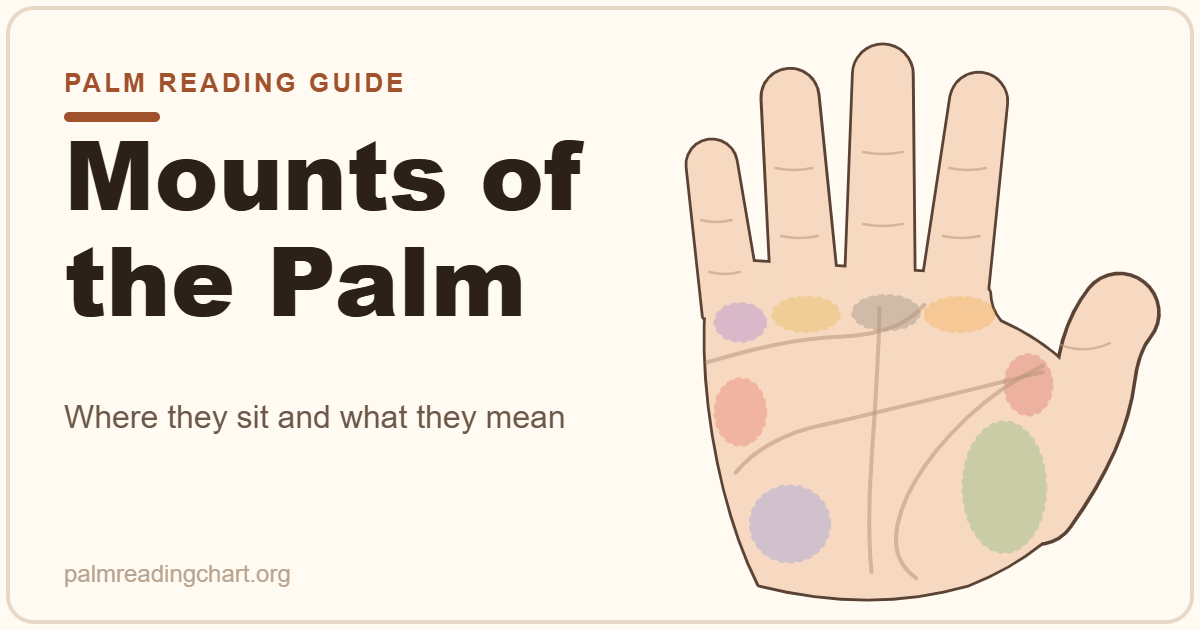
A palm mark is a small, distinct shape. Palmistry keeps marks apart from the main lines (heart, head and life) and from the mounts, the raised pads under the fingers and at the base of the thumb. Our guide to palm lines covers the lines, and for a map of each pad, open our mounts of the palm article. A pattern made by the lines themselves, such as the letter formed across the palm, is a different topic, covered in our guide to the M on the palm.
Star, cross, triangle, square and island appear in all nine guides we read, and eight of them also cover the grille. Some guides add circles, dots, tridents and chains. This guide leaves those out, because fewer sources cover them and the readings vary even more.

Figure 1 draws each shape in its simplest form. Real marks are messier, so the test is whether a shape is complete and clear, not whether it matches the drawing exactly.
How to Spot Palm Marks on Your Own Hand
Marks are tiny, so the way you look changes what you find. Four guides advise soft or natural light. Three warn that creases, scratches or skin folds can pass for marks. Two add a rule worth repeating: never join gaps or invent a missing side to finish a shape.
- Hold your hand open in soft daylight, fingers relaxed.
- Find the heart, head and life lines first, then the mounts, so you can say where a shape sits.
- Look for a closed or clearly crossing shape. A magnifying glass helps.
- Count the strokes: three or more crossing lines for a star, three sides for a triangle, four for a square.
- Note which line or mount the shape touches, and whether it sits on the line or beside it.
- Repeat on the other hand and compare.
If a shape needs imagination to complete, leave it unread and write “unclear”.
Why Location Changes What a Mark Means
All nine guides tie the reading to the spot where a mark sits, though some apply that idea to only a few marks. The same star is read one way on a mount and another way on a line. Several guides put place ahead of shape, and two say context is everything.

Figure 2 puts an example of each mark on a single palm, with the mystic cross added as a seventh marker. The positions are illustrations, not a rule for where marks should appear. One guide gives a simple checklist for describing any mark: where it sits, how clear it is, and which nearby marks support or compete with it.
Palm Mark Meanings: Star, Cross, Triangle, Square, Island and Grille
Star on the Palm
A star is three or more short lines that cross at one point, like a small asterisk. Two crossing lines make a cross instead, so count the strokes. Guides read a star as sudden emphasis, a spot where energy or attention gathers.
On a mount, most guides read a star favorably, linking the Mount of Apollo, under the ring finger, with recognition, brilliance or creative success and the Mount of Jupiter, under the index finger, with leadership, recognition or success. Four treat a star on the Mount of Saturn, under the middle finger, as mixed or cautionary.
On a line, the reading shifts to a burst of intensity at that point, for example an emotional moment on the heart line. Several guides stress that a star shows a tendency, not a promise, and one adds that no star can guarantee a particular outcome. Guides also disagree on how rare stars are: one calls them among the rarest marks, while another says they turn up regularly.
Cross on the Palm and the Mystic Cross
A cross is two short lines that meet at a clear angle. Three guides stress that it must be distinct from a branch, a main line or a skin fold.
Most guides read a cross as a choice point or a turning point rather than bad news. Three say outright that a cross is not inherently negative, while two put more weight on obstacles or disruption. Location adds detail. Five guides link a cross on the Mount of Jupiter with a significant partnership or lasting love, and three read one on the Mount of Saturn as a call for caution.
The mystic cross is the best-known version: a cross in the open space between the heart line and the head line. Six guides read it as intuition or an interest in the mystical, and two add that it is more common than popular palmistry suggests. Our heart line guide and head line guide show the two lines it sits between.
Triangle on the Palm
A triangle is three lines that close into a shape with three visible sides. Two guides say all three sides must show, and two more say a triangle that forms by accident from crossing creases carries little weight.
Eight of the nine guides read a clean triangle favorably, as talent, skill or focused thinking. Several place it on the head line for analytical ability, and a few read one on the heart line as emotional intelligence. Several say a triangle on a mount sharpens that mount’s theme. One guide cautions that a small triangle does not establish skill.
Several guides also describe the Great Triangle, a large shape that the head line, the life line and a third line form together. That is a different feature, made from major lines instead of a small mark.
Square on the Palm
A square is four short lines that form a small box. Two guides accept a rough four-sided shape. Every guide reads the square as protective, and eight tie it to a break in a line or to another mark such as an island, where the box is read as holding a weak spot together. Figure 2 shows one around a gap in the life line.
Two guides add that the protection is symbolic: a square does not make a risky activity safe. One guide goes the other way and reads a square on an unbroken line as being boxed in.
Island on the Palm
An island is a line that splits into a small oval and then rejoins, so the line carries on at both ends. One guide tells readers to check that the line really does continue after the oval.
Guides read an island as a temporary stretch of strain or divided energy on the line it sits on. Five stress that it is passing, not permanent. On the heart line, several guides read emotional strain or mixed feelings, and on the head line, a few read distraction or mental strain. Three guides call islands common.
Some guides also link an island on the life line with a tiring stretch. Several warn against treating an island as a medical sign, so this guide does not repeat health readings. See our life line guide for the line itself.
Grille on the Palm
A grille is a cluster of fine lines that cross like a mesh, usually spread over a mount. One guide separates it from a star: a grille covers an area, while a star is one crossing point with extra strokes.
All eight guides that cover it read a grille as scattered or dispersed energy in the theme of the mount underneath. Several read a grille on the Mount of Venus as restless or scattered emotional energy, and some read one on the Mount of Jupiter as ambition that has not found a focus. Most soften the reading: a grille is a question, a sign that energy needs a channel, not a verdict. One guide reads it more harshly, and this guide leaves the harsher wording out.
Same Mark, Different Places

Figure 3 pairs close-ups of six cases. Traditionally, a star on a mount (1) is read as a spotlight, while a star on a line (2) is read as intensity at that point. A cross on Jupiter (3) is linked with partnership, while a mystic cross (4) is linked with intuition. A square over a break (5) is read as protection, and a grille on a mount (6) as scattered energy in that mount’s theme.
Palm Marks at a Glance
| Mark | What you see | Traditional reading | Where it matters |
|---|---|---|---|
| Star | Three or more short lines crossing at one point | Sudden emphasis or intensity | Mounts (Apollo and Jupiter favorable, Saturn mixed) and lines |
| Cross | Two short lines meeting at a clear angle | A choice or turning point | Jupiter (partnership), Saturn (caution), between heart and head lines (intuition) |
| Triangle | Three lines closing into three clear sides | Talent, skill or focus | Head line, heart line or a mount |
| Square | Four short lines forming a small box | Protection and repair | Around a break in a line |
| Island | A line that splits into an oval and rejoins | A passing stretch of strain or divided energy | The line it sits on |
| Grille | Fine lines crossing like a mesh | Scattered energy | A mount, such as Venus or Jupiter |
Where Guides Disagree
The guides mostly agree on the shapes and split on tone. Crosses are the clearest case: most read a choice point, and two lean toward obstacles. Stars are another, with one guide calling them among the rarest marks and another saying they appear regularly. The grille is a third, softened by most of the guides that cover it and read harshly by one. Even the square, the friendliest mark, gets a footnote from one guide, who reads it as boxed in on an unbroken line.
When sources disagree, this guide keeps the gentler reading, because a small mark cannot support the harsher ones, and it does not repeat predictions of harm. Treat any claim about how common a mark is as an impression, not a statistic.
Do Palm Marks Change, and Which Hand Do You Read?
Most guides say marks can appear, fade or look different over time. Two add that a mark that looks different in another light or another photo does not prove that a person’s path has changed, since skin condition, use and photography all alter fine creases.
Four guides recommend comparing both hands, and three of them describe one hand as the inherited one and the other as the developed one. By that split, a mark on both palms would be read as a long-standing feature, and a mark on one palm only as something that formed or faded along the way. Our guide to which hand to read explains the method.
What Palm Marks Cannot Tell You
Five of the nine guides describe their readings as tools for reflection or entertainment, and one says plainly that no evidence shows a tiny intersection predicting an obstacle or a gift. A mark is not a medical sign, a forecast or a judgment of a person. If a worry is real, ask a doctor, a counselor or another qualified person, not a palm.
Palm Marks FAQ
What does a star on the palm mean?
Traditionally, sudden emphasis. Guides read a star on the Mount of Apollo or Jupiter favorably and a star on a line as a burst of intensity. Several stress that it describes a tendency, not a promise.
What does a cross on the palm mean?
Most guides read it as a choice or turning point. A cross on Jupiter is linked with partnership, and a cross between the heart and head lines, the mystic cross, with intuition. Readings differ, so avoid treating any of them as final.
Is a square on the palm lucky?
Every guide reads it as protective, usually around a break in a line. Two note that this is symbolic and does not make anything safe.
Is an island on the palm bad?
Guides read it as a passing stretch of strain on one line, and five stress that it does not last. It is not a medical sign.
Can I find palm marks in a photo?
Not reliably. Glare, angle and editing can add shapes that are not there, so check your real palm in soft daylight and read only what is clearly visible.
Conclusion
Palm marks are small modifiers: tradition reads a star, cross, triangle, square, island or grille through the line or mount it touches. Check that the shape is complete, name where it sits, and compare both hands before reading anything into it. For the bigger picture, start with our step-by-step palm reading guide, then see how marks fit with the lines and mounts in our palm reading chart. Another minor feature, the girdle of Venus, has its own guide.

Leave a Reply