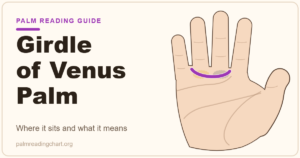
The girdle of Venus is a curved line high on the palm, above the heart line and just below the base of the fingers. Palmistry guides usually link it with strong feeling and a keen eye for beauty. Many palms have no such line at all, and most sites that discuss this treat having none as normal. This guide shows where to look, the main types, what palmistry sites say each one means, and how to tell . . .
Hand Shapes in Palmistry: Earth, Air, Fire and Water Hands
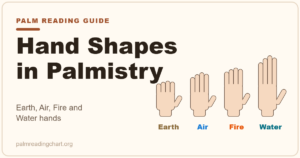
Hand shapes in palmistry are four commonly used types named Earth, Air, Fire and Water. Guides sort a hand by comparing two things. The first is how long the palm is next to how wide it is. The second is how long the fingers are next to the palm. This guide shows how to check your own hand in three steps and what tradition says about each type. Read all of this as tradition rather than science. . . .
Mounts of the Palm: Where They Sit and What They Mean
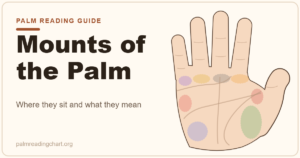
The mounts of the palm are the raised pads of flesh on your hand, and palmistry usually names them after planets. This guide shows where each mount sits, how guides judge a flat or full one and what tradition says about each. The maps show a right palm. Palmistry is tradition, not science. Wikipedia's article on palmistry describes it as a pseudoscience and notes a lack of evidence for its . . .
Sun Line Palm Reading: Where It Starts and What It Means
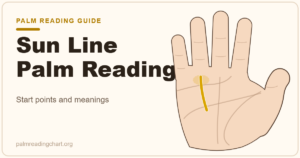
Sun line palm reading looks at a vertical line that rises toward the ring finger. Palmists also call it the Apollo line or the line of success. Most guides link it to recognition and creative fulfillment, and many warn against reading it as a promise of fame or money. This guide covers where the sun line sits, the places it most often starts, what its markings mean and why having no sun line is . . .
Money Line Palm Reading: Where It Is and What the Signs Mean
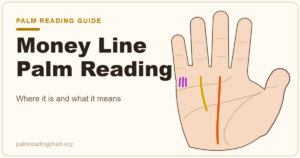
Money line palm reading is unusual because guides say palmistry has no single money line. They use the phrase for several different marks, and they do not all agree on which marks count. This guide sorts out where each money sign sits, what palmists traditionally say it means, and what the signs cannot tell you. Every drawing shows a right palm. Read it as tradition and a prompt for reflection. . . .
Simian Line Palm Reading: Meaning, Types and Both Hands
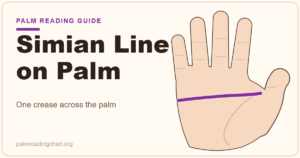
Simian line palm reading is about a single crease that runs straight across your palm where the heart line and head line usually sit. Palmists also call it the simian crease. This guide covers how to spot it, how it differs from look-alikes such as the Sydney line, and what palmists say it means on one hand or both. Every drawing shows a right palm. For a left hand, picture the same lines in . . .
Head Line Palm Reading: What Length, Shape and Forks Mean
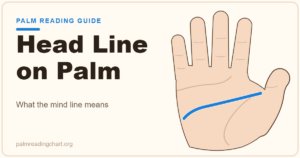
Head line palm reading looks at the crease across the middle of your palm that palmists link with how you think, decide and process the world. Many guides also call it the wisdom line, and some call it the mind line. This guide covers where the line sits, how to find it, and what its length, shape, start and markings are traditionally said to mean. The drawings show a right palm, so flip them in . . .
Which Hand to Read in Palm Reading: Left, Right or Both?
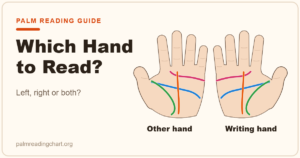
Which hand to read in palm reading comes down to two answers: both, and the writing hand first. Palmistry sites tie the writing hand to your present life and the other hand to what you were born with, and many treat the comparison between the two as the most useful part. Treat the rules below as conventions found on palmistry sites, not as facts about the body. Palmistry is generally classed as a . . .