The life line on a palm is the curved line that wraps around the base of the thumb, and it is often the first line people look for when they open their hand. Many people assume it tells you how long you will live. In palmistry it does not.
Palm readers treat the life line as a picture of your energy, your everyday vitality and the big changes in your life, rather than a measure of how many years you have. This guide shows where the line is, how to read its length, depth and curve, and what breaks, islands, chains, forks and sister lines are traditionally said to mean. All diagrams are drawn for a right palm with the fingers pointing up.
Palm reading is a traditional practice that is best enjoyed for fun and reflection. It cannot diagnose health problems or predict how long you will live.
Table of Contents
Where Is the Life Line on Your Palm?
Hold your hand open with the palm facing you. The life line starts at the edge of the palm, between your thumb and index finger, and curves down around the fleshy pad at the base of your thumb. That pad is called the Mount of Venus. The line usually ends near the wrist. On a left palm everything is mirrored: the thumb is on the left and the line curves around it from that side.
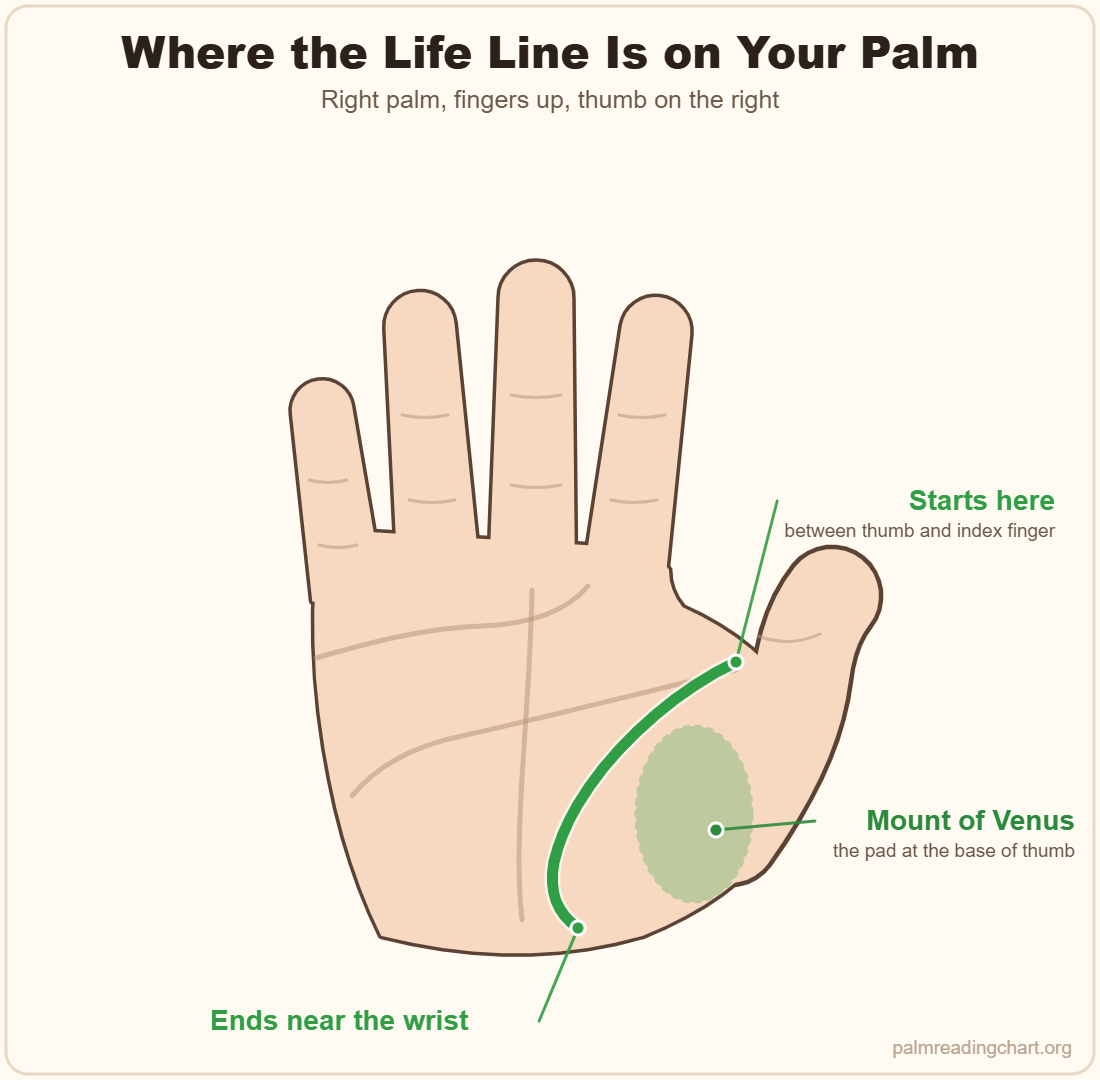
Finding the life line on a palm is easiest if you start at the thumb. Look for the curved crease that circles the thumb pad. The head line also begins near the thumb side, but it runs across the palm instead of curving down toward the wrist.
Many readers look at both hands. A common approach is to read your dominant hand (the one you write with) for the life you are living now and your other hand for what you were born with. If you are new to this, our guide on how to read your palm covers the basics.
What Does the Life Line Mean in Palmistry?
In palmistry the life line is linked to vitality, physical energy and how steadily you move through life. It is also read for major turning points such as a move, a career change or a long period of stress.
Some readers also use the line as a rough map of a life: the part near the index finger for the early years, the sweep around the thumb for the middle years and the stretch near the wrist for later years. Traditions give different ages for each point, so treat this as a loose guide only.
The key idea is that the line describes the kind of energy you bring to life, not how many years you will have. Readers point out that a short line and a long life can go together, and that a long line is no guarantee of anything.
Where the Life Line Starts and Ends
High or low start
Sources do not fully agree here. One common view is that a start high on the palm, near the index finger, points to ambition and drive, while a start closer to the thumb points to a more inward kind of energy.
Joined to the head line or separate
The life line and the head line often begin at the same spot on the edge of the palm, and a short shared section is common. When the two lines travel together for a while, readers describe a careful, practical way of making decisions. When they part early, the description shifts to a more independent, instinctive style. Readings differ between palmists, so use this as one clue among several.
Where the line ends
Most life lines finish near the wrist. A line that ends by curving back toward the thumb is linked with staying close to home, while one that drifts toward the middle of the wrist is linked with moving around and trying new places.
Life Line Length, Depth and Curve
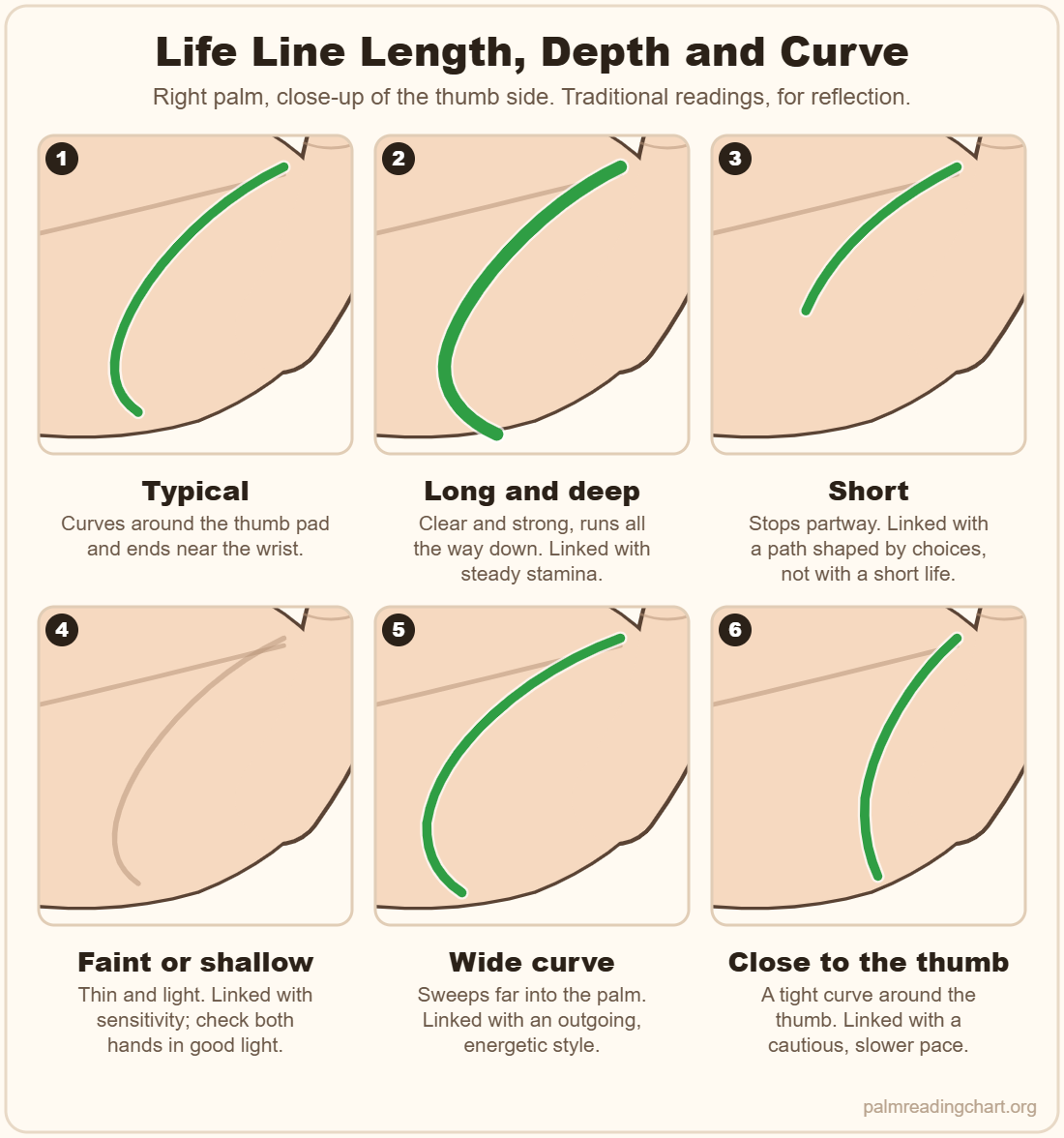
Three things change how the life line looks: how far it runs, how deeply it is marked and how wide it swings around the thumb. The diagram shows a typical line next to five variations.
Long and deep life line
A long, clear and deep line is traditionally linked with strong stamina and a steady approach to life, and with a good ability to bounce back after setbacks.
Short life line
A short line is often misunderstood. Readers link it with self-reliance and a life shaped more by choices than by routine. It is not a warning about lifespan.
Faint or shallow life line
A thin or faint line is linked with lower physical energy or with sensitivity to what is going on around you. Many readers treat it as a nudge to rest and look after yourself.
Wide curve or close to the thumb
A line that sweeps out wide across the palm, leaving the Mount of Venus more room, is traditionally linked with plenty of energy and an outgoing, enthusiastic style. A line that hugs the thumb is linked with a more cautious, slower pace and a need to recharge.
Breaks, Islands, Chains and Forks on the Life Line
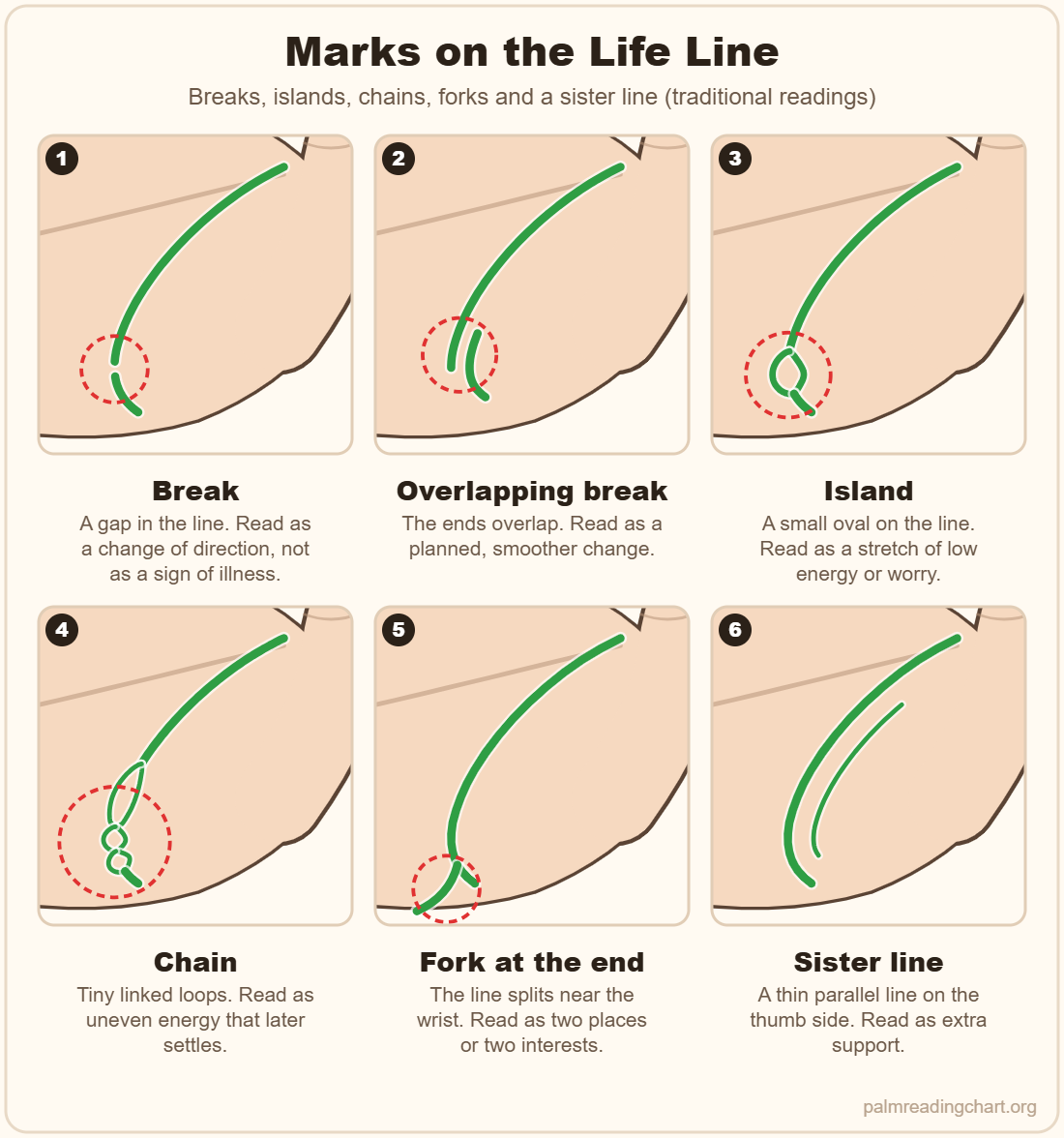
Marks on the line are where most questions come from, especially the search for a “broken life line”. The diagram shows each mark on a right palm. This site treats none of them as a prediction of illness or death, and palmistry cannot diagnose anything.
Broken life line
A break is traditionally read as a major change of direction, such as moving to a new place, changing careers or closing a long chapter of life. What happens after the break matters more than the break itself. If the line carries on clearly, the change is read as a fresh start.
Overlapping break
If the broken ends overlap, so that a second piece of line starts beside the first, readers see the change as planned and smoother, often a step forward rather than a setback.
Island
A small island (a little oval on the line) is said to mark a period of low energy, stress or worry. When the line becomes clear again after the mark, the period is considered temporary.
Chain
A chain of tiny links is read as a stretch of uneven energy, with ups and downs. If the line turns clear and strong again, the unsettled time is seen as something that passes.
Fork at the end
A line that splits into two branches near the wrist is sometimes read as a life divided between two places or two interests. Some readers link it to travel or to living away from where you grew up.
Sister line
A thin line that runs beside the life line on the thumb side is often called a sister line, a double life line or the Line of Mars. It is traditionally read as extra support, such as reserves of energy and quick recovery from stress. Sources differ on its name and details, so treat it as a bonus rather than a rule.
Life Line Meanings at a Glance
| What you see | Traditional reading |
|---|---|
| Long, deep, clear line | Steady stamina and resilience |
| Short line | Self-reliance; a path shaped by choices |
| Faint or shallow line | Lower energy or sensitivity |
| Wide curve | Outgoing, energetic style |
| Close to the thumb | Cautious, slower pace |
| Break | Major change of direction |
| Overlapping break | Planned, smoother change |
| Island | A stretch of low energy, stress or worry |
| Chain | Uneven energy that later settles |
| Fork at the end | Two places or two interests |
| Sister line | Extra support and reserves of energy |
How the Life Line Fits With Other Lines
No line is read alone. Compare the life line with the heart line for your emotional life and the fate line for career and direction, and keep the head line in view because it so often starts beside the life line. Readers also note where lines touch or cross, because those points are said to show where your energy and your direction in life affect each other.
For an overview of every main line, see our guide to palm lines and what they mean, or compare your hand with the palm reading chart.
Does the Life Line Predict How Long You Will Live?
No. There is no scientific evidence that the lines on your palm predict lifespan or health. Palmistry is widely regarded as a pseudoscience, and many modern palmists say the same about the life line. If you are worried about your health, talk to a doctor. The health line has the same limits.
How to Read Your Own Life Line in 6 Steps
- Sit in good light and relax your hand, because a tense hand changes how the lines look.
- Choose which hand to read: your dominant hand for the life you are living now, your other hand for what you were born with.
- Find where the line starts, between your thumb and index finger.
- Trace it around the base of your thumb down to the wrist.
- Note its length, depth and curve.
- Look for breaks, islands, chains, forks and a sister line, then compare both hands.
Life Line FAQ
Is the life line different for women and men?
The meanings are the same for everyone. Use the same approach described above: your dominant hand for the life you are living now and your other hand for what you were born with.
Can the life line change over time?
Many palmists say the lines can shift over the years, especially the finer ones. That is why readers often look again after a big life change.
What if my life line is faint?
A faint line is common. It is linked with lower energy or sensitivity, not with a problem. Check both hands in good light before drawing any conclusion.
What does a short life line mean?
Nothing about how long you will live. Readers link a short line with self-reliance and a path shaped by choices more than by routine.
What is the Mount of Venus?
It is the fleshy pad at the base of the thumb, inside the curve of the life line. A full, firm pad is traditionally linked with warmth, affection and lively physical energy.
Conclusion
The life line on a palm is about energy and change, not lifespan. Use it as a starting point for reflection, and read it together with the heart, head and fate lines for the full picture.


