Head line palm reading looks at the crease across the middle of your palm that palmists link with how you think, decide and process the world. Many guides also call it the wisdom line, and some call it the mind line.
This guide covers where the line sits, how to find it, and what its length, shape, start and markings are traditionally said to mean. The drawings show a right palm, so flip them in your mind for a left hand.
Enjoy it as tradition, not as a test. Palmistry has no scientific support, and in palmistry the head line describes a thinking style, not intelligence or IQ.
Table of Contents
Where Is the Head Line on Your Palm?
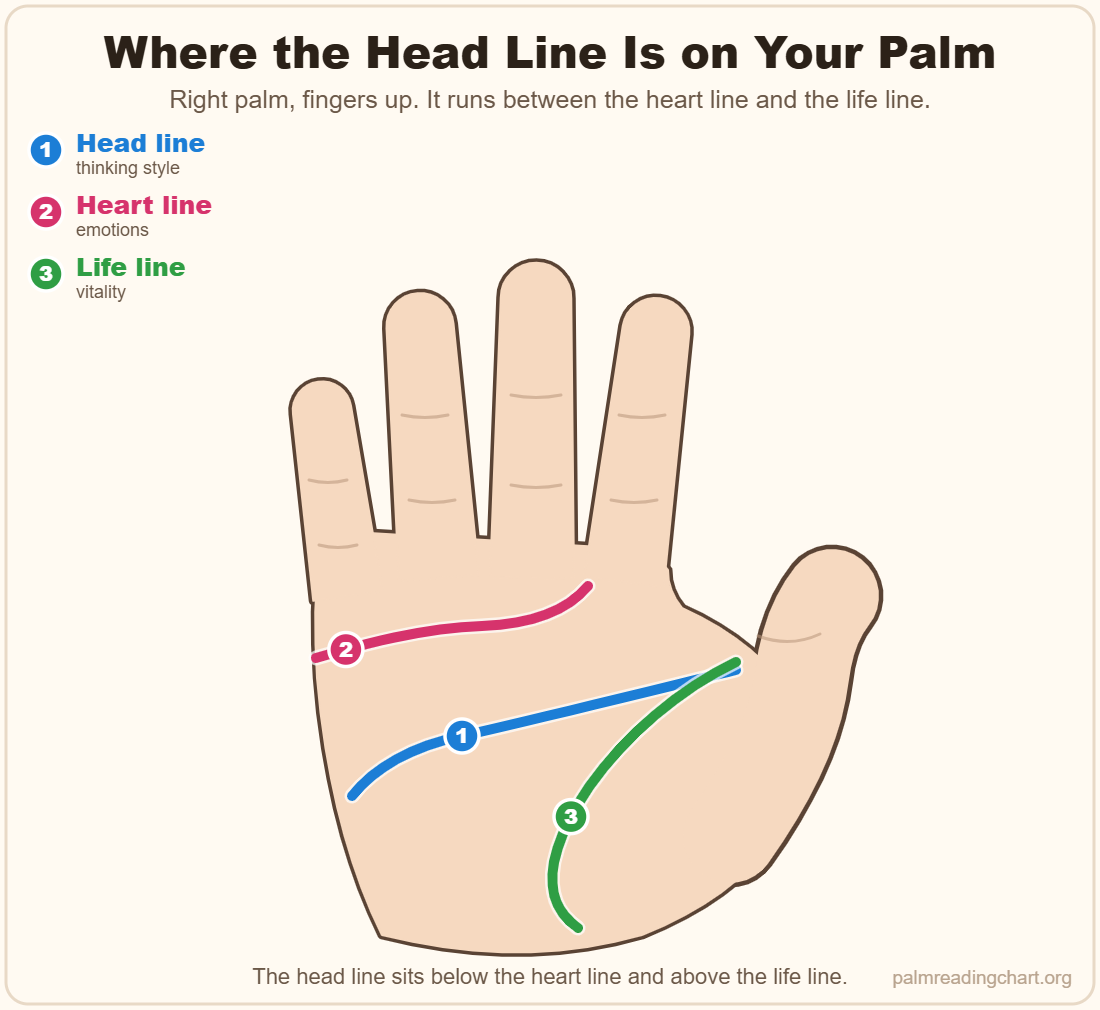
The head line is one of the main lines of the palm. It sits below the heart line and above the life line. Most sites say it starts on the thumb side of the palm, between the thumb and index finger and close to the life line. From there it runs across the middle of the palm toward the outer edge, below the little finger.
Other names for the head line
Besides the wisdom line and the mind line, Western palmistry also uses the line of head and the line of mentality. Indian palmistry calls it the Buddhi Rekha or the Mastishk Rekha. All of these name the same crease.
How to Find Your Head Line in 4 Steps
- Hold your writing hand open under bright light with the palm facing you.
- Find the two lines that frame it: the heart line near the top of the palm and the life line curving around the base of your thumb.
- Trace the crease between them that runs across the middle of the palm, and note where it starts and where it stops.
- Check your other hand the same way before you decide what you see.
To see all the major lines side by side, read palm lines and what they mean.
Head Line Palm Reading: What Length, Shape, Depth and Start Mean
Palmists read several features together: how long the line is, how it bends, how deep it is and where it starts. What follows pulls together the views of several palmistry sites. It is one common version, not a rule.
Long or short head line
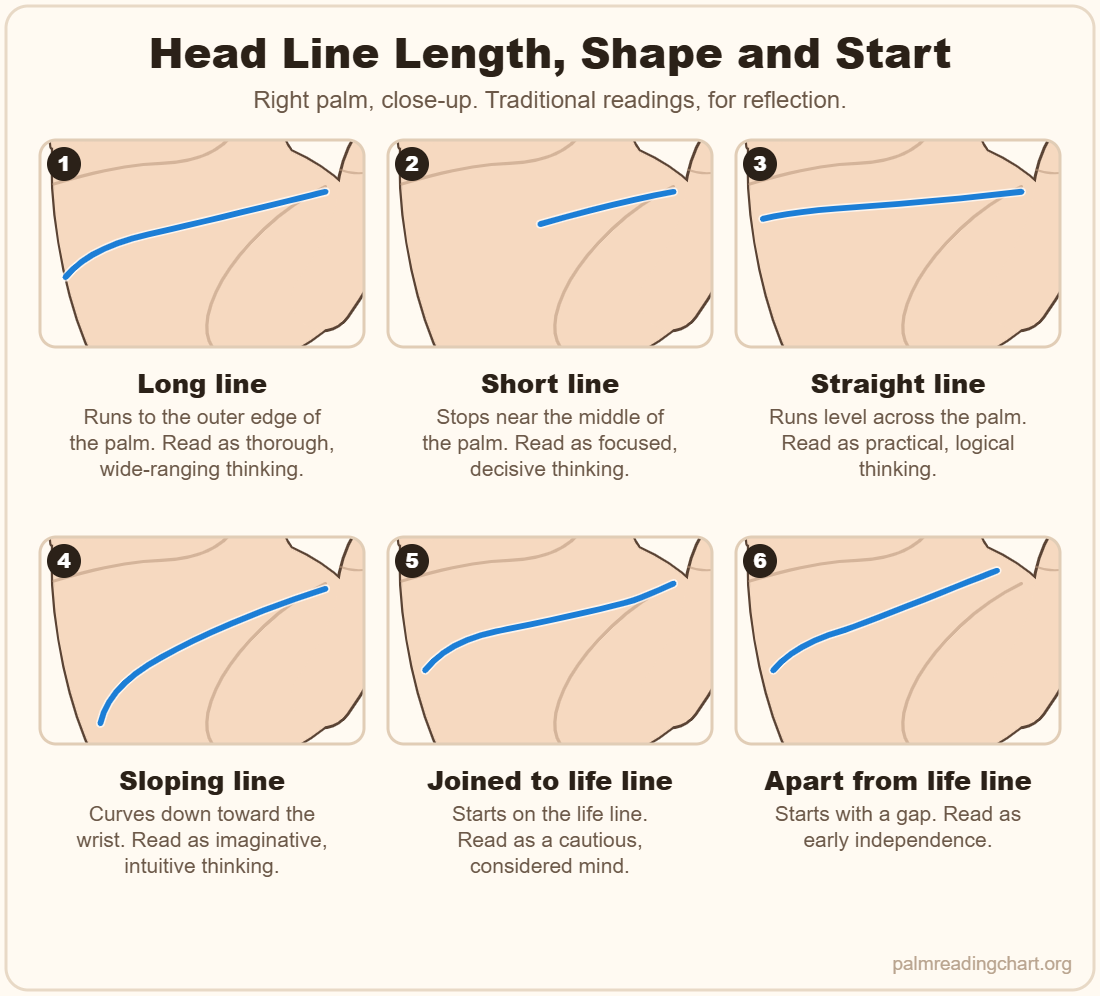
A long line that reaches toward the outer edge of the palm is read as thorough, wide-ranging thinking. Some sites add that it can tip into overthinking. A short line is read as focused, decisive thinking, and several sites stress that short does not mean less intelligent.
Some sites sort length by the finger the line stops under: roughly the middle finger for short, the ring finger for medium and the little finger or beyond for long. Others simply say a short line stops near the middle of the palm.
Straight or sloping head line
A straight line is read as practical, logical thinking. A line that curves down toward the wrist, ending near the Mount of Luna (the fleshy pad at the base of the palm, on the little finger side), is read as imaginative and intuitive thinking, and a steeper slope as stronger imagination. One site reads a gentle curve as a mix of the two.
Deep or faint head line
A deep, clear line is read as strong concentration. Sites read a faint or shallow line in different ways, from scattered focus to a flexible, associative mind, so readings vary.
Joined to or apart from the life line
A head line that starts joined to the life line is read as a cautious, considered mind shaped early by family. A line that starts apart from it is read as early independence, and a very wide gap as boldness that can turn impulsive.
Forks, Breaks, Chains and Islands on the Head Line
Marks on the line are read as changes or phases in how you think, never as a verdict. Most modern sources agree on the broad idea and differ on the details, so we keep to the readings that several sites share.
Writer’s fork
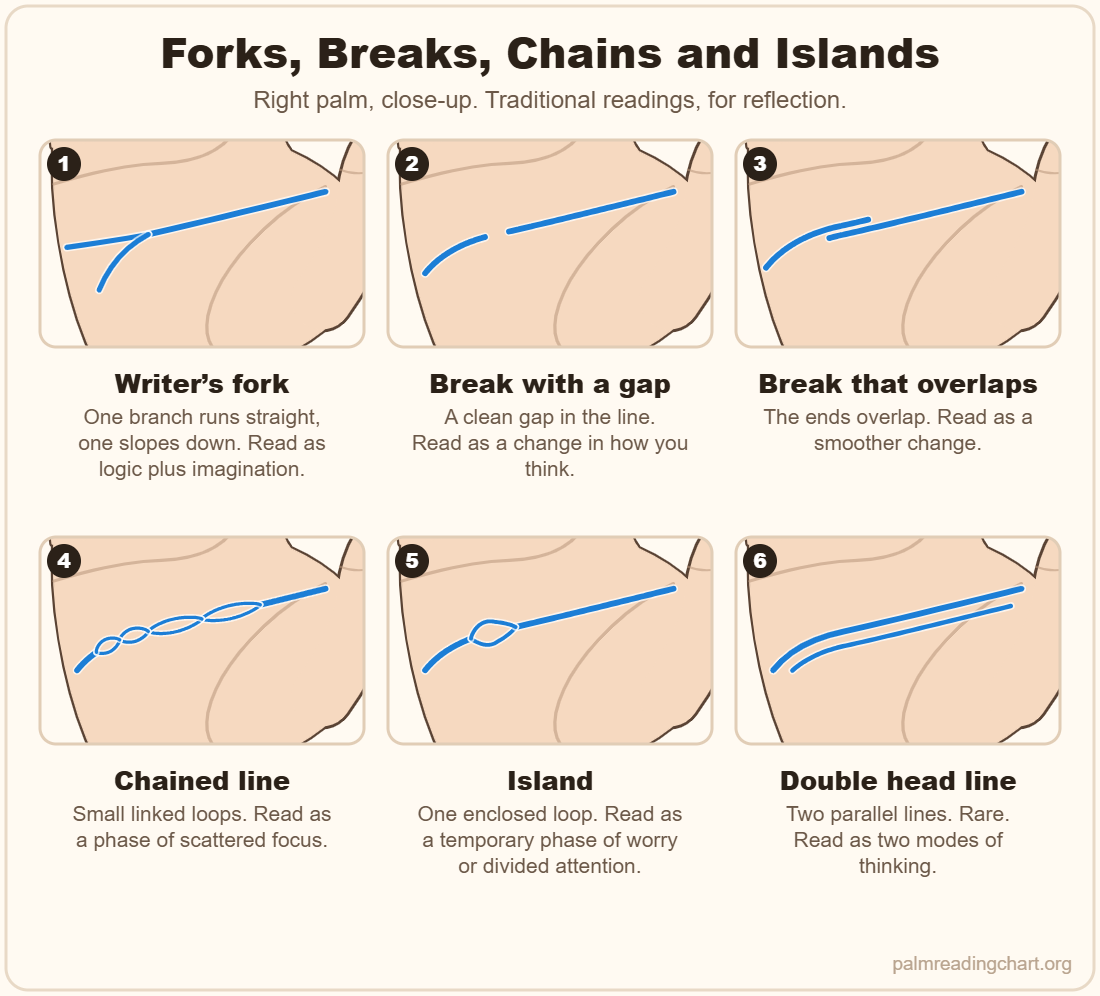
A small Y-shaped split near the end of the line, with one branch running straight and the other sloping down, is called the writer’s fork. Sites read it as a mind that blends logic with imagination and can hold two views at once. Some sites note that it is not limited to writers.
Broken head line
A gap in the line is read as a change in how you think, such as a new direction or a changed view. Where the two ends overlap, sites read the change as smoother, and a wide clean gap as more abrupt. Several sites add that a break is not a sign of illness or injury.
Chains and islands
A run of small links or a small enclosed loop is read as a phase of scattered focus, worry or divided attention. Sites describe these as temporary phases, and one says larger islands mark longer ones.
Double head line
Two parallel lines are rare and are read as two modes of thinking, or a very active mind.
Quick Guide to Head Line Patterns
| Pattern | Traditional reading |
|---|---|
| Long line | Thorough, wide-ranging thinking |
| Short line | Focused, decisive thinking |
| Straight line | Practical, logical thinking |
| Sloping line | Imaginative, intuitive thinking |
| Deep line | Strong concentration |
| Faint line | Scattered or flexible thinking; sources differ |
| Joined to the life line | A cautious, considered mind |
| Apart from the life line | Early independence |
| Writer’s fork | Logic and imagination combined |
| Break with a gap | A change in how you think |
| Break that overlaps | A smoother change |
| Chain or island | A phase of scattered focus, worry or divided attention |
| Double line | Two modes of thinking |
What the Head Line Cannot Tell You
In palmistry the head line describes how you think, not how smart you are. It cannot measure IQ, predict a career, or diagnose a mental or physical condition. Modern sources that comment on this generally agree, though a few older or less careful sites link breaks, chains and islands to illness, and this guide does not. A short line is not a weaker mind, and a long line does not guarantee success.
Breaks, chains and islands are not signs of illness or injury. If something about your health, memory or mood worries you, see a doctor.
Which Hand to Read for the Head Line
Look at both palms. Use the hand you write with for how you think now, and the other hand for the mind you were born with, as palmists describe it. If the two lines differ, one site reads that as a mind that has grown away from its starting style. Conventions vary, so see our guide to which hand to read in palm reading.
Head Line Palm Reading FAQ
Does a short head line mean low intelligence?
No. Palmistry sources say a short line points to focused, decisive thinking and tells you nothing about IQ.
What if my head line and heart line are one line?
A single crease across the palm in place of the two lines is called a simian line. It is uncommon, palmists give it its own readings, and sources describe it as intense focus and feeling. It is not a diagnosis.
Is the head line the same as the mind line?
Yes. The mind line, the wisdom line and the line of head all name the same crease.
Does the head line change over time?
A little. Some sites say lines can deepen, fade or gain small marks over time, and one adds that the major creases keep their basic path. It is fine to look again now and then.
Conclusion
Head line palm reading treats the crease across your palm as a picture of how you think. Length, curve, start and marks each add a detail. Read both hands, keep the readings light and go further with our beginner guide on how to read your palm.




Leave a Reply