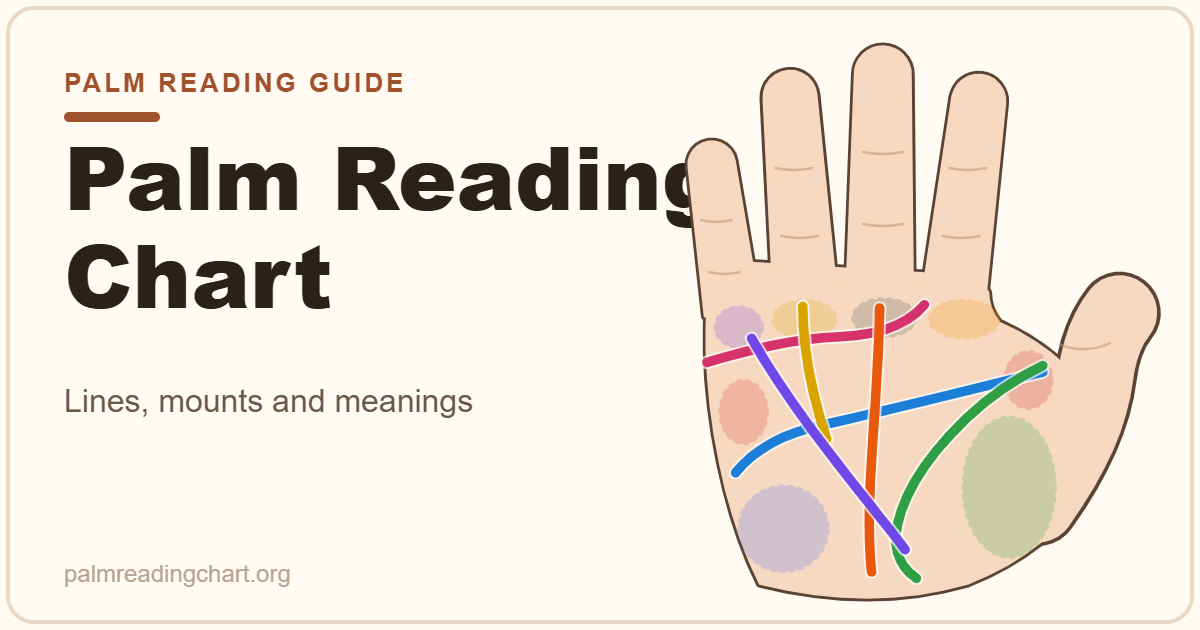
The mounts of the palm are the raised pads of flesh on your hand, and palmistry usually names them after planets. This guide shows where each mount sits, how guides judge a flat or full one and what tradition says about each. The maps show a right palm.
Palmistry is tradition, not science. Wikipedia’s article on palmistry describes it as a pseudoscience and notes a lack of evidence for its predictions. A pad on your palm cannot show your character or your future.
Table of Contents
What Are the Mounts of the Palm?
Guides name seven planetary mounts: Venus, Jupiter, Saturn, Apollo (also called the Sun), Mercury, Luna (also called the Moon) and Mars. Most guides split Mars into an upper pad and a lower pad, which gives eight mounts.
Some guides add the plain of Mars, the hollow at the center of the palm, as a ninth zone. Others call it a hollow instead of a mount, and one site also lists areas named Rahu and Ketu, which come from Indian astrology. Our palm reading chart uses the eight-mount version, and so does this guide.
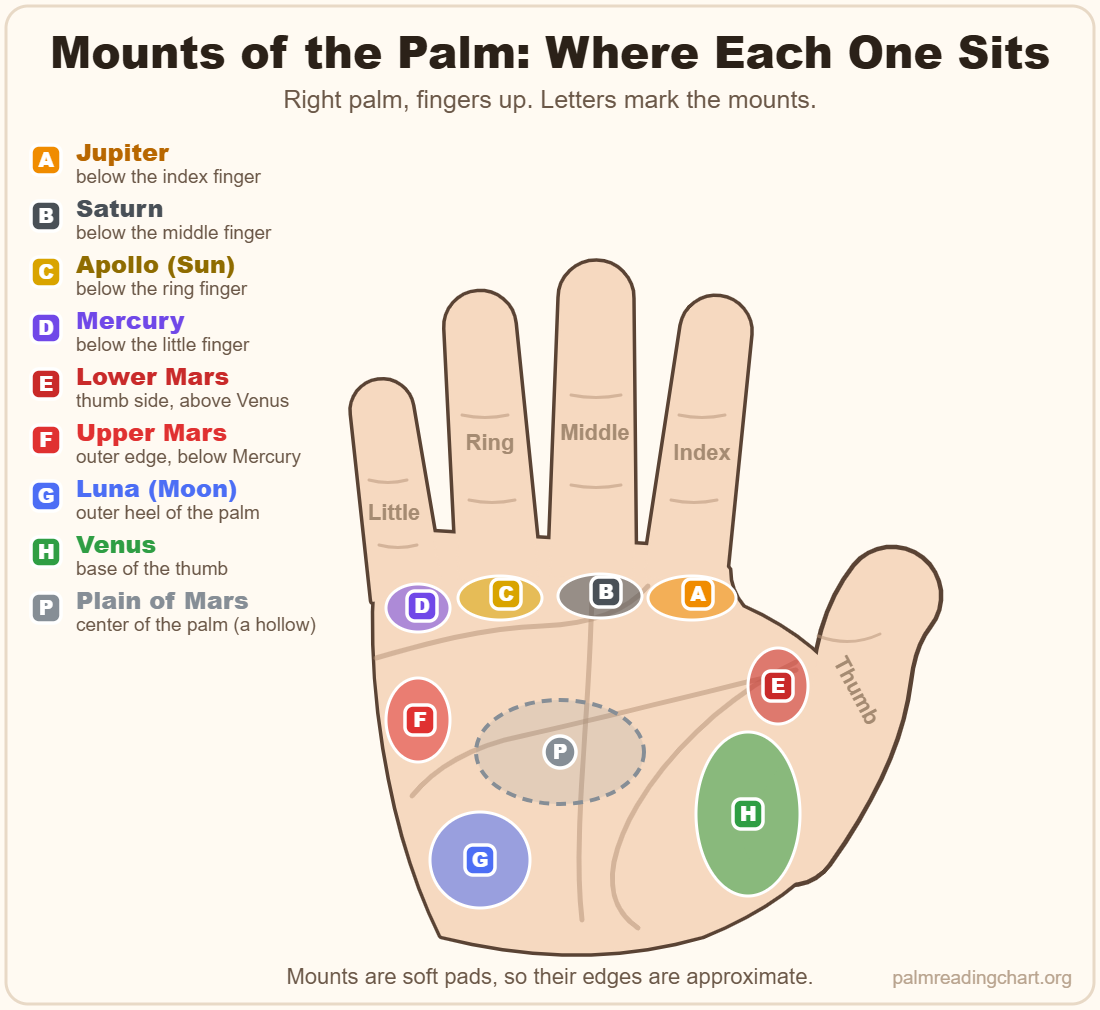
Mounts are soft tissue, so the edges on the map are approximate. Your own pads may sit a little higher or lower than the drawing shows.
Guides read a mount as a theme. A fuller pad stands for a stronger version of that theme, and a flatter pad stands for a quieter one. Several guides add that a bigger mount is not automatically a better one, and that balance across the hand matters more.
Mounts of the Palm Under the Four Fingers
Four mounts sit at the base of the fingers, just above the heart line. Reading from the thumb side, they are Jupiter, Saturn, Apollo and Mercury.
Mount of Jupiter
The Mount of Jupiter sits below the index finger. Guides tie it to ambition, confidence and leadership. A flat mount is read as a quieter drive, and a very full one as pride or a need to take charge.
Mount of Saturn
The Mount of Saturn sits below the middle finger. Guides tie it to seriousness, patience, responsibility and reflection. Some guides read a flat mount as a lighter, more easy-going style, and one site calls a flat Saturn mount normal on most hands. A very full one is read as heaviness, over-caution or a wish to be alone.
Mount of Apollo (the Sun)
The Mount of Apollo sits below the ring finger. Guides tie it to creativity, optimism and a love of beauty, and some add a wish to be recognized. One guide reads a flat mount as quieter, more private creativity, and several read a very full one as vanity or a strong need for attention. Our sun line guide covers the line that rises toward this mount.
Mount of Mercury
The Mount of Mercury sits below the little finger. Guides tie it to communication, quick thinking, adaptability and business sense. A flat mount is read as a more reserved way of speaking, and a very full one as too much talk or restlessness. Several guides use harsher words for a very full mount, and this guide leaves them out.
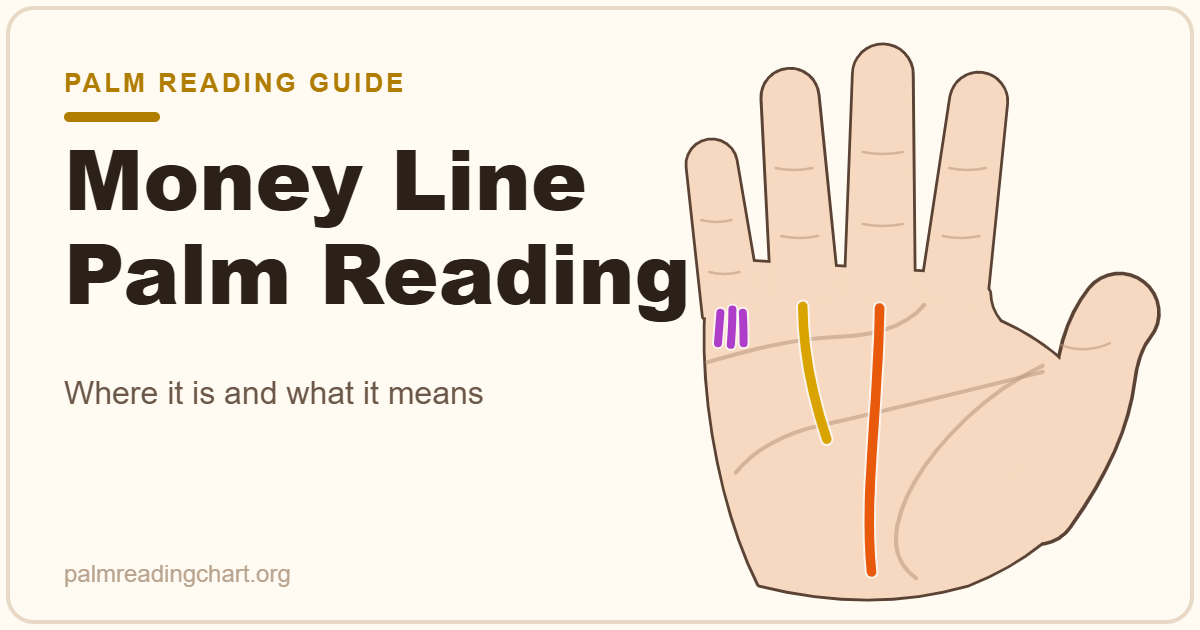
The short upright lines on this mount are what several guides call money lines. Our money line guide sorts out where they sit and what they can and cannot tell you.
Mounts at the Base of the Palm
Two large mounts sit lower on the hand. Venus fills the base of the thumb, and Luna sits on the opposite side.
Mount of Venus
The Mount of Venus is the pad at the base of the thumb, enclosed by the life line. Several guides call it the largest mount, and one adds that it varies the most from hand to hand. Guides tie it to warmth, affection and zest for life. A flat mount is read as cooler or more reserved, and a very full one as indulgence or emotional excess.
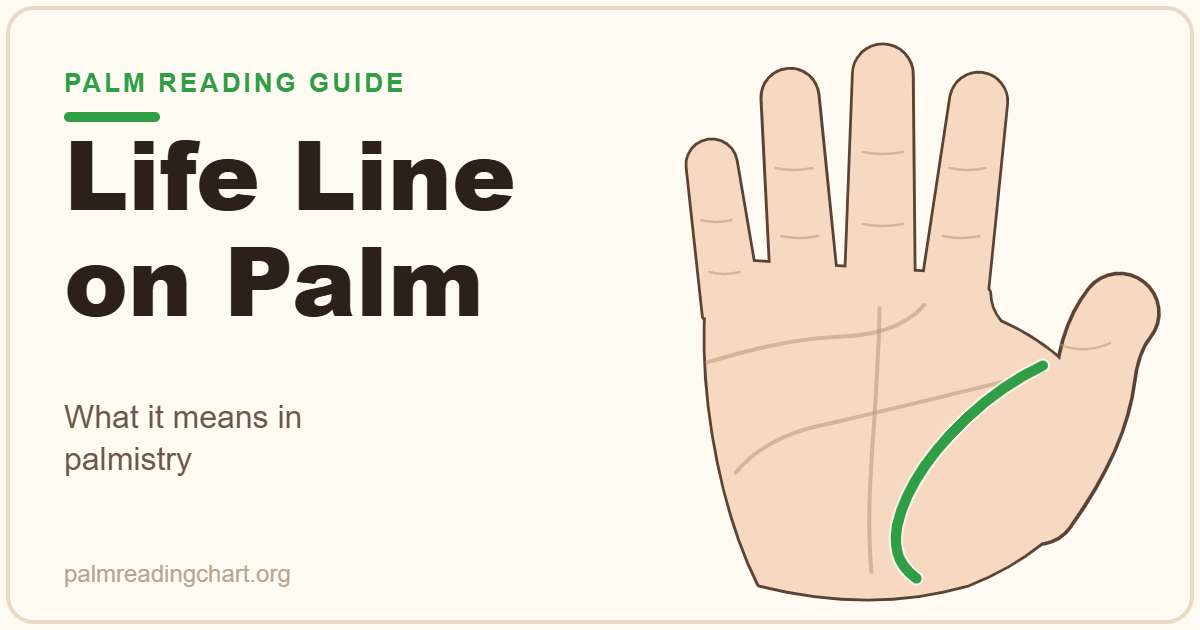
Our life line guide shows the curve that frames this mount. One guide notes that a life line that hugs the thumb narrows this mount.
Mount of Luna (the Moon)
The Mount of Luna sits on the outer edge of the palm near the wrist, opposite the thumb. Guides tie it to imagination, intuition and an inner life. A flat mount is read as a more practical, fact-based outlook, and a very full one as daydreaming or escapism.
A head line that curves down toward the wrist can end near this mount. Our head line guide explains how guides read that curve.
The Mars Mounts and the Plain of Mars
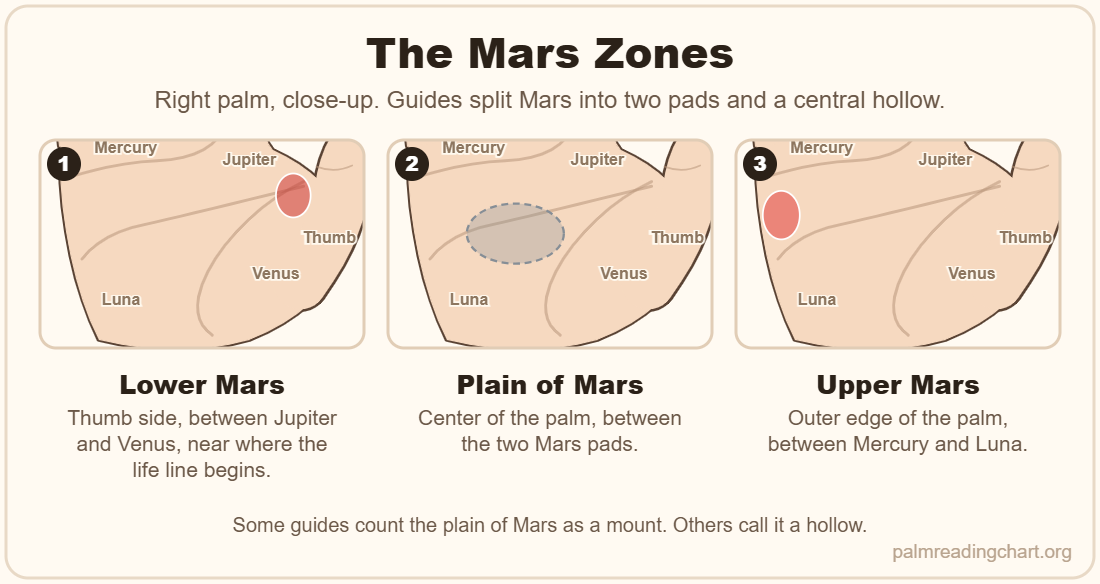
Mars is the confusing one. Instead of a single pad, guides draw two pads and a hollow between them.
Lower Mars
Lower Mars sits on the thumb side of the palm, between Jupiter and Venus, near where the life line begins. Guides tie it to active courage, assertiveness and taking the initiative. A very full pad is read as aggression or impatience, and a flat one as hesitation.
Upper Mars
Upper Mars sits on the outer edge of the palm, between Mercury and Luna. Guides tie it to endurance, patience and calm under pressure, which one guide calls passive courage. Two guides read a flat pad as less endurance, and a very full pad is read as stubbornness or rigidity.
Plain of Mars
The plain of Mars is the hollow in the center of the palm, between the two Mars pads. Guides read it in different ways. One site reads a deep, firm plain as endurance and self-control, and another reads a hollow one as low energy. A third reads a wide, flat plain as a good sign.
Because the readings conflict, treat the plain of Mars as a minor note.
Mounts of the Palm at a Glance
The table gathers the eight mounts in one place. It uses the milder wording. Several guides use harsher words for flat and very full pads, and this guide leaves them out. Where only one or two guides give a reading, the cell says so.
| Mount | Where it sits | Well developed | Flat | Very full |
|---|---|---|---|---|
| Jupiter | Below the index finger | Ambition, confidence, leadership | A quieter drive | Pride, taking charge |
| Saturn | Below the middle finger | Seriousness, patience, reflection | A lighter, easy-going style (some guides) | Heaviness, over-caution |
| Apollo (Sun) | Below the ring finger | Creativity, optimism, charisma | More private expression (one guide) | Vanity, need for attention |
| Mercury | Below the little finger | Communication, quick thinking | More reserved speech | Too much talk, restlessness |
| Venus | Base of the thumb | Warmth, affection, zest for life | Cooler, more reserved | Indulgence, emotional excess |
| Luna (Moon) | Outer heel of the palm | Imagination, intuition | Practical, fact-based | Daydreaming, escapism |
| Lower Mars | Thumb side, above Venus | Active courage, initiative | Hesitation | Aggression, impatience |
| Upper Mars | Outer edge, below Mercury | Endurance, composure | Less endurance (two guides) | Stubbornness, rigidity |
How to Judge a Mount on Your Own Palm
Guides do not share one method, but several list the same checks. They look at height, firmness and texture, and at how each pad compares with the others.
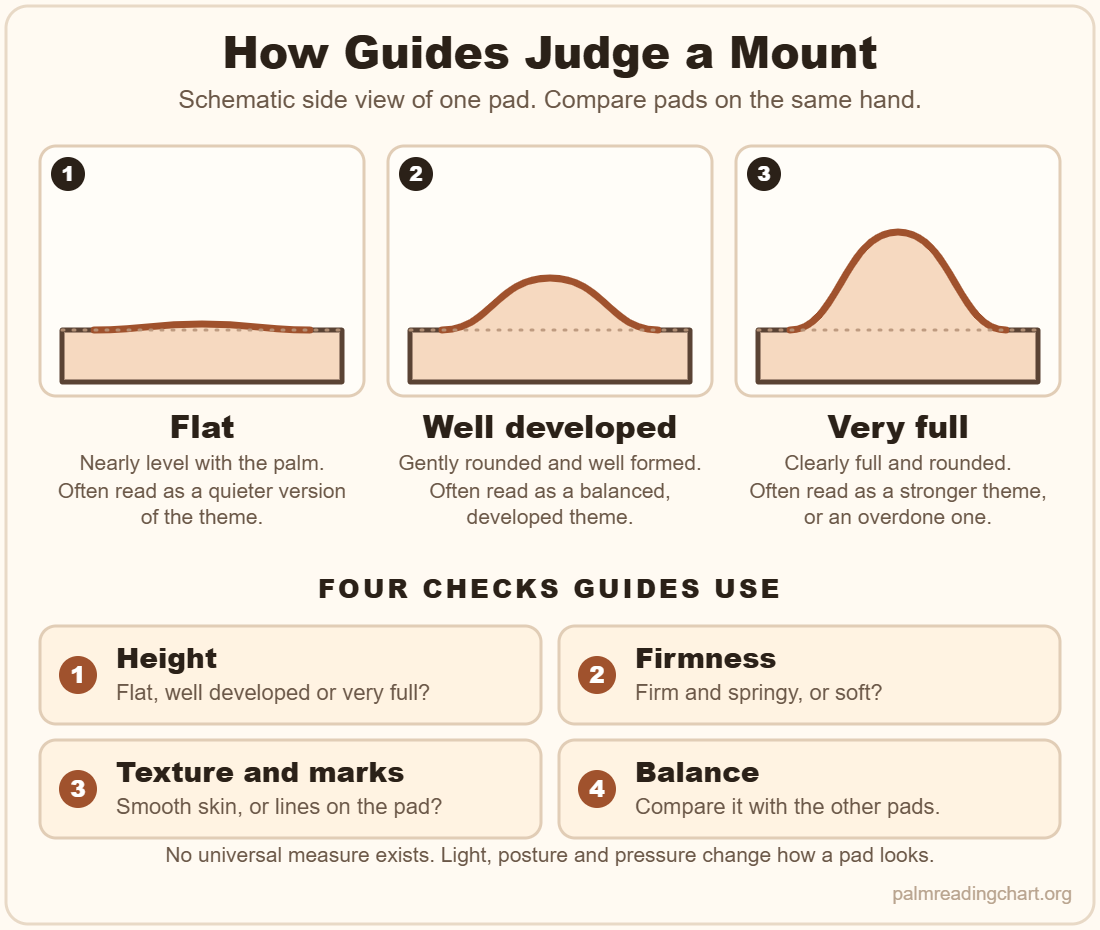
- Rest your hand in bright, even light, relaxed and not stretched flat.
- Look at the palm from the side so each pad catches the light, and note which pads look higher.
- Press each pad gently with the thumb of your other hand. A firm pad pushes back, and a soft one gives way.
- Check the skin on each pad for smooth areas and for small lines or other marks.
- Compare the pads with each other on the same hand, not with a drawing.
- Repeat with your other hand and compare the two.
Guides differ on one detail. One suggests a slight cup of the hand, and another warns that cupping makes several pads look higher. The second guide adds that pressing the whole palm flat against a table spreads the tissue. It also warns that hand size, posture, light and camera angle all change how a pad looks. If you take photos, use the same pose and light each time.
Two guides say the fullest mount sets the keynote of the hand, and several stress balance across all of them. Several also say a flat mount is not a flaw, only a quieter expression.
Which Hand to Read for Mounts
Guides that mention it say to look at both hands. One site calls the passive hand the store of potential and the active hand the sign of how much you use. That is close to the rule in our post on which hand to read, where your writing hand shows the present and your other hand shows what you were born with. See that post for the full comparison.
Can Your Mounts Change?
Several guides say they can. Sites differ on how fast. One says mounts shift more than lines do, because they are soft tissue, and that hand use can firm the Venus pad. Another says they change less than lines. Either way, a flat or full mount today is not a permanent label.
How Guides Combine Mounts With Lines
Guides read mounts together with the lines and the shape of the hand, not alone. Several say a mark on a mount, such as a star or a cross, changes its meaning. Several add that the mount a line ends on colors how it is read. One guide reads a fate line that ends toward Jupiter differently from one that ends toward Saturn.
The step-by-step guide to how to read your palm covers the four main lines first and the mounts after them.
What the Mounts Cannot Tell You
No mount can tell you your personality, your health or your future. The meanings above are tradition. Wikipedia says palmistry’s predictions lack evidence.
One guide warns that older manuals carry medical and social claims that do not suit a modern reading. Please do not use your mounts to make a health, money or relationship decision.
Mounts of the Palm FAQ
How many mounts are on the palm?
Most guides name seven planetary mounts and split Mars into two pads, which gives eight. Some add the plain of Mars as a ninth zone.
What does a flat mount mean in palmistry?
Guides read it as a quieter version of that mount’s theme. Several say it is not a flaw, and one calls a flat Saturn mount normal on most hands.
What does a very full mount mean?
A fuller pad is read as a stronger theme. Some guides read a very full one as an overdone version of the same theme. Several add that a bigger mount is not automatically better.
Which mount is the most important?
Guides do not name one for everyone. Two say the fullest mount on your hand sets its keynote, and several say balance matters more than any single pad.
Where is the Mount of Venus on the hand?
It fills the base of the thumb, within the arc of the life line. Several guides call it the largest mount.
Can the mounts on my palm change?
Several guides say they can change gradually, though they differ on how fast. A flat or full pad today is not a fixed label.
Conclusion
The mounts of the palm are the raised pads under the fingers and around the base of the hand. Find each one on the map, check its height and firmness and compare it with the others on the same hand. Treat every reading as symbolism and keep both hands in view. For the bigger picture, start with palm lines and what they mean.


Leave a Reply