Child line palm reading is the old palmistry practice of looking at the short upright lines on the edge of the palm for hints about children. One of the best-known folk readings says a deep, wide line points to a boy and a fine, narrow line to a girl.
This guide shows where the child lines are, how to find them, what each pattern is said to mean in folklore and why a palm cannot tell the sex of a baby. All the drawings show a right palm with the fingers up. On a left palm the same lines sit in mirror image.
Treat all of it as folklore for fun and reflection. Nothing on a palm can predict a pregnancy or the size of a family, and none of it should guide family planning or medical choices.
Table of Contents
Where Are the Child Lines on Your Palm?
Child lines are short upright creases on the outer edge of the palm, in the space between the base of the little finger and the heart line, the long curved crease across the upper palm. They rise from, or just above, the marriage line, the short horizontal crease that runs in from the edge of the palm. That is why palmists find the marriage line first and then look directly above it. If it is new to you, start with marriage lines in palms.
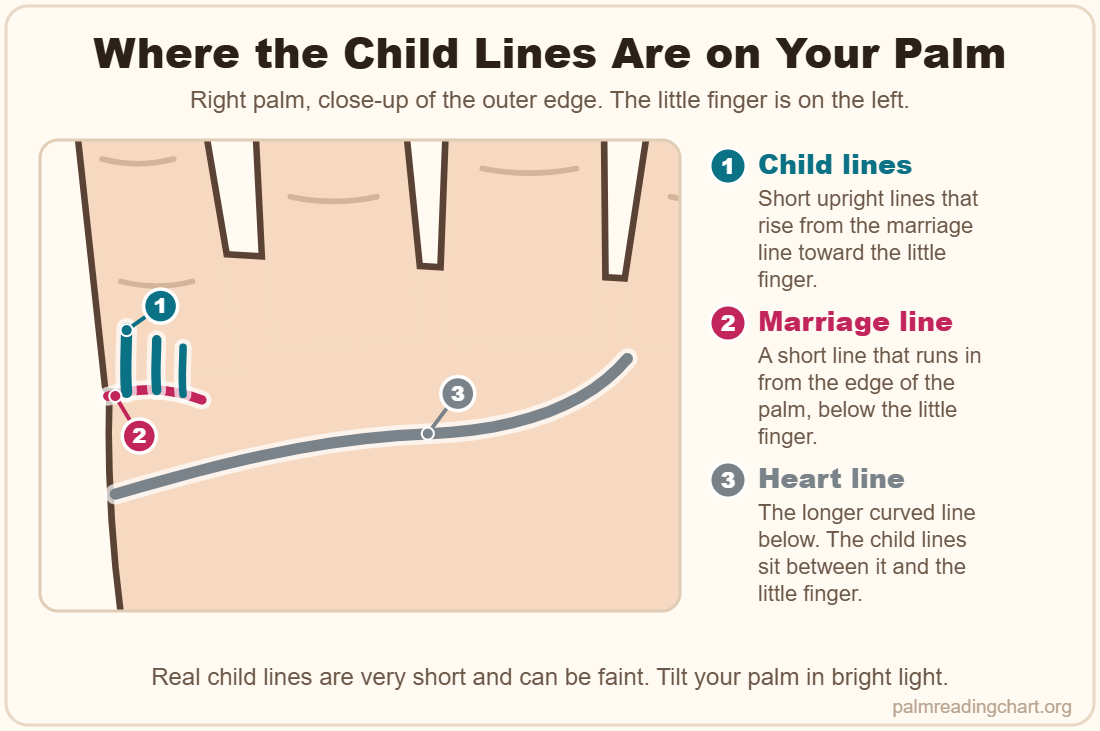
The marks are very short, and you will also see them called children lines. A magnifying glass and good light make them much easier to spot.
How to Find Your Child Lines in 5 Steps
- Hold your writing hand open, palm facing you, in bright light.
- Look along the outer edge below the little finger and find the marriage line.
- Tilt the hand toward the light and gently cup the palm so the edge creases stand out.
- Look just above the marriage line for short upright lines that rise toward the little finger.
- Repeat on your other hand and compare the two before drawing any conclusion.
Boy or Girl? What the Folklore Says
Folk tradition links the look of a child line with the sex of a child. Sources differ, and some call the idea unscientific and outdated, so what follows is one common version, not a rule. Some modern writers skip the boy and girl idea and read the lines symbolically, as bonds with children or with people you care for.
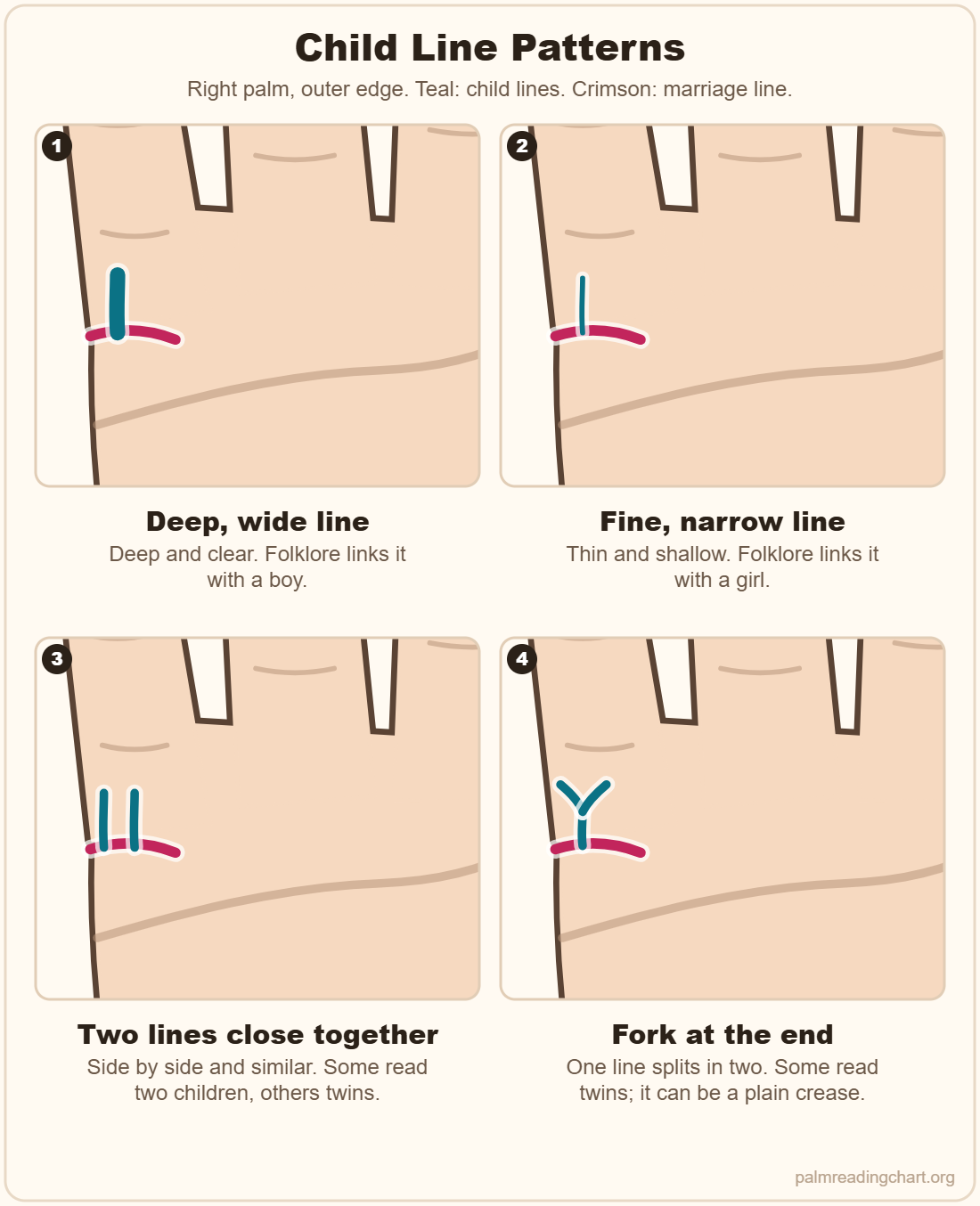
Deep, wide lines
A deep, clear, wide line is traditionally linked with a boy. Many palmistry sites repeat this reading.
Fine, narrow lines
A thin, shallow, narrow line is traditionally linked with a girl. Other palmists leave the gender idea out and give a fine line no special meaning.
Long and short lines
Sources do not agree on length. Some sites fold it into the boy and girl idea, pairing long, deep lines with a boy and short, faint ones with a girl. Others skip that and read length as how lasting a bond is. Because the readings conflict, treat length as the least reliable detail.
Fork, Twin and Other Child Line Patterns
The diagram below shows four patterns that come up on palmistry sites. The first two are the deep and fine lines described above. In the diagram, the teal lines are child lines, the crimson line is the marriage line and the faint line below is the heart line.
Two lines close together
Some palmists read two similar lines side by side as two children close in age, while others read them as twins.
Fork at the end
A line that splits in two at the top is read by some palmists as twins. Others point out that a fork may simply be a natural skin crease, so it is not a forecast.
Faint or missing lines
Many people see only faint lines, or none at all. Sources differ on faint lines. Many modern palmists give them no meaning, and the creases may simply be too fine to spot. They can also change over time.
What the Child Lines Do Not Show
A palm cannot show whether you will have a boy or a girl. A baby’s genetic sex is set at conception, and the reliable ways to find out are medical, such as an ultrasound or a blood test your doctor can explain. The lines on a hand are creases formed by how the hand folds, not records of future events. Palmistry is generally classed as a pseudoscience.
The number of lines is not a headcount either, and having few or none says nothing about whether you want or have children. For how the count is read, see our guide to the children line on palm.
Some older sources give gloomy meanings to broken or marked lines. We do not repeat them. They cannot be supported, the sources contradict one another and they can cause needless worry.
Quick Guide to Child Line Patterns
| Pattern | Traditional reading |
|---|---|
| Deep, wide line | Folklore links it with a boy |
| Fine, narrow line | Folklore links it with a girl |
| Long or short line | Sources differ; the least reliable detail |
| Two lines close together | Some read children close in age, others twins |
| Fork at the end | Some palmists read twins; it may be a plain crease |
| Faint or no lines | Sources differ; many modern palmists give no meaning |
Child Line Palm Reading FAQ
Can the child line tell me if I will have a boy or a girl?
No. The boy and girl reading is a folk belief with no scientific support. Ask your doctor about anything medical.
Is the child line the same as the children line?
Yes, they are the same marks. This guide covers how the lines look and the folklore about them, while our children line guide covers how the count is read.
Which hand should I read?
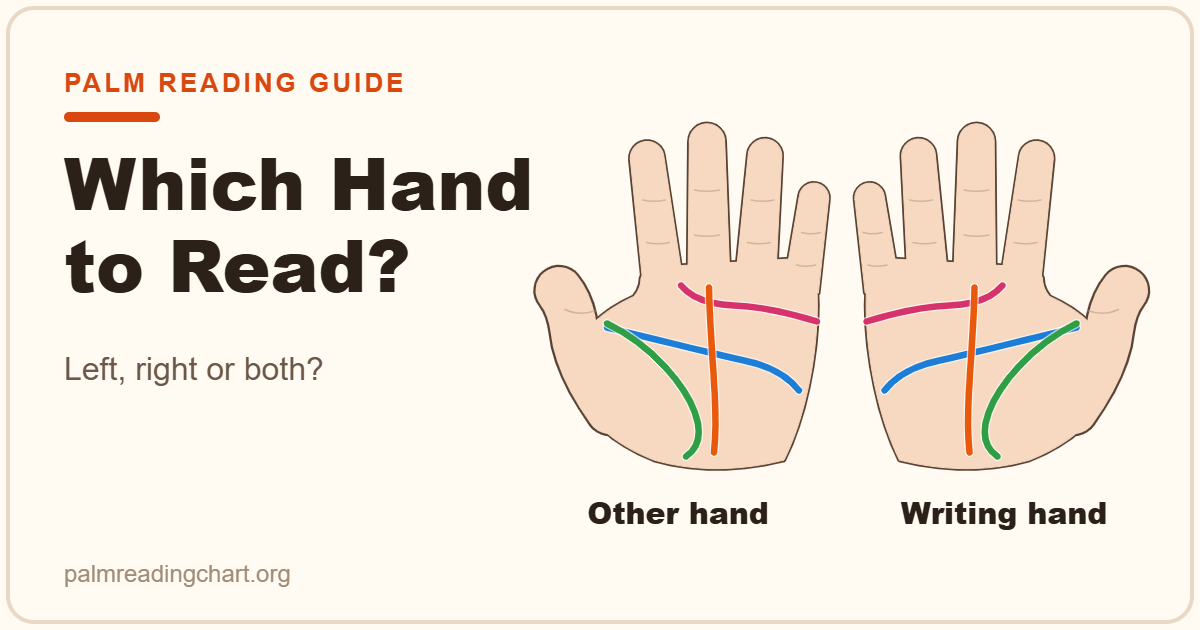
Palmists usually read both hands. Many start with the hand you write with, which they link with the life you are living now, and then compare it with the other hand, which they link with what you were born with. Some sources use other rules, such as assigning a hand by sex. Sources differ, and this guide does not use those rules. For the full rule, see which hand to read in palm reading.
Do men have child lines too?
Yes. Anyone can have these creases, and they appear in the same place on every palm.
What if my child lines are faint?
Try tilting your palm in bright light. Many people have only faint lines or none they can see, and sources differ on whether that means anything.
Can child lines change?
Creases on the hand can deepen, fade or shift as you age, so a line you cannot see today may show up later.
Conclusion
Child line palm reading looks for short upright lines above the marriage line and attaches boy-or-girl folklore to their depth. Palmists disagree on it, so read both hands for fun and use our palm lines guide and how to read your palm to go further.



Leave a Reply