Simian line palm reading is about a single crease that runs straight across your palm where the heart line and head line usually sit. Palmists also call it the simian crease.
This guide covers how to spot it, how it differs from look-alikes such as the Sydney line, and what palmists say it means on one hand or both. Every drawing shows a right palm. For a left hand, picture the same lines in mirror image.
Read it as tradition and symbolism, nothing more. Scientists find no support for palmistry, and a simian line cannot predict your intelligence, your character or your future.
Table of Contents
What Is a Simian Line on the Palm?
Most palms show two main horizontal creases across the upper half. The heart line sits near the base of the fingers and the head line below it, with a band of skin between them. On a simian palm those two creases are replaced by one.
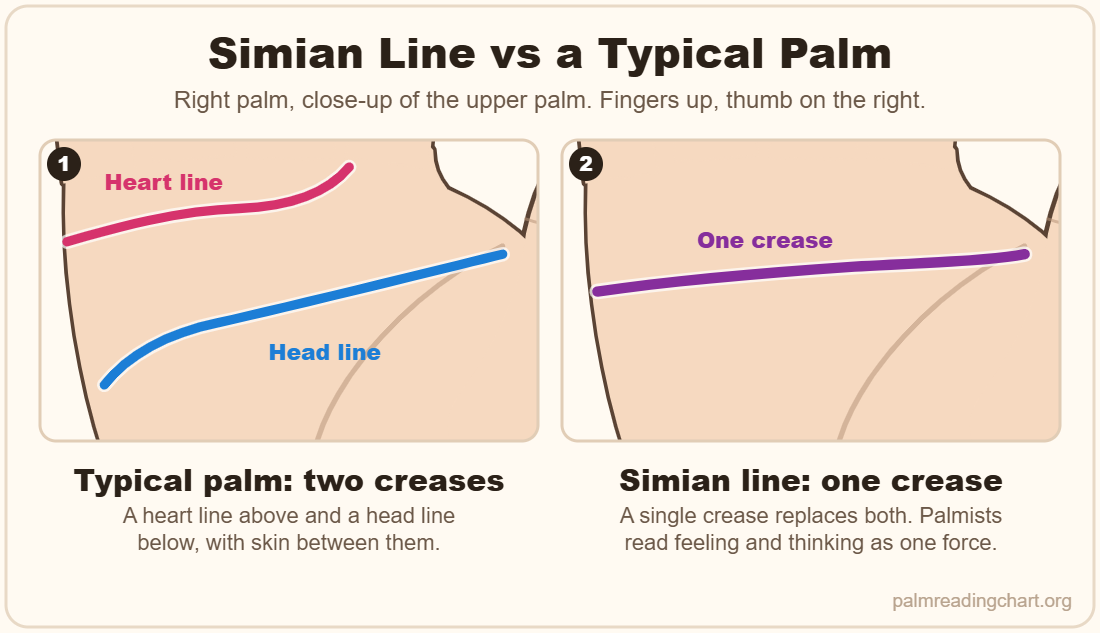
Medical books call this a single transverse palmar crease. The word simian is an older term that medical writers now avoid because it is seen as demeaning. Palmistry sites still use simian, so this guide does too, but it keeps the description plain: one crease across the palm.
It is uncommon. Reference sources such as Wikipedia put it at roughly 1.5 to 3 percent of people and say it is more common in some East Asian populations. Several palmistry sites say it is more common in men. Palmistry sites quote figures anywhere from 1 percent to 10 percent, so treat those loosely. It often appears on one hand only.
Other names for the simian line
You may also see the monkey line in some guides. Some Indian palmistry guides use the name Kapi Rekha, and one uses Bandhan Rekha. Every one of these names describes the same one-crease pattern.
How to Spot a Simian Line in 4 Steps
- Rest your writing hand in good light, palm toward you and fingers relaxed.
- Look across the upper half of the palm, below the bases of the fingers. Most hands show two creases here with skin between them.
- Check whether one crease crosses the whole palm instead, with no separate heart line or head line above or below it.
- Look at your other hand before you decide, since the line often shows on one hand only.
If you can pick out two lines, see our guides to the heart line and the head line. For the other major creases, read palm lines and what they mean.
Simian Line Types, Sydney Line and Look-Alikes
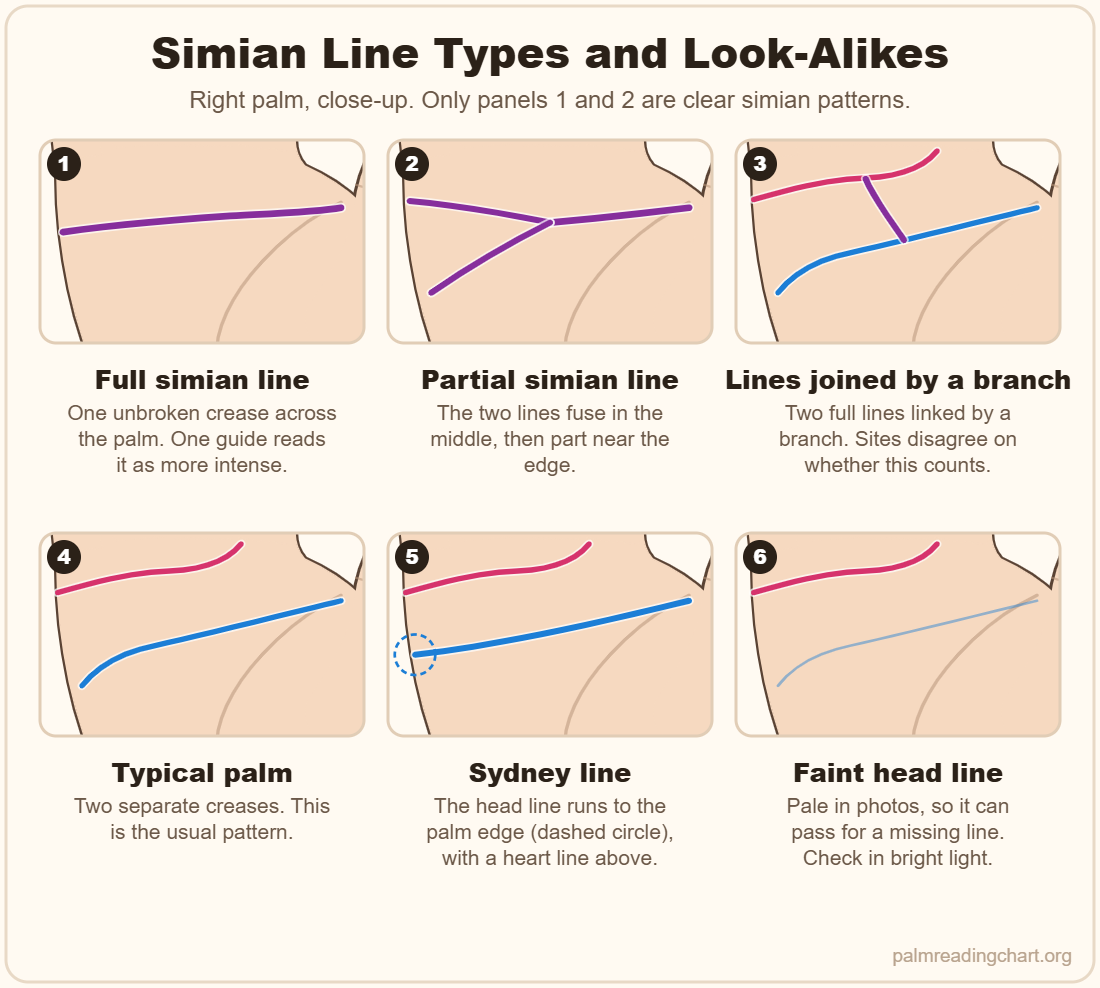
Sites describe a few forms of the simian line and a few palms that only look similar. Sorting them first keeps the readings below from getting mixed up.
Full simian line
One unbroken crease crosses the whole palm, and no separate heart or head line shows. One guide reads this as the more intense form of the pattern.
Partial simian line
Here the heart line and head line share a route for part of their length and then separate. For example, they may fuse in the middle of the palm and part again toward the outer edge. Sites read this as a softer blend of intensity and balance, and one site says to read it more tentatively.
Lines joined by a branch
Sites disagree about two full lines linked by a short branch. One counts a strong branch as a partial simian line. Another calls them ordinary heart and head lines that touch, and tells readers to focus on the branch.
Sydney line
Several guides treat the Sydney line as a separate pattern, and one calls it a milder variation of the simian line. The head line runs the full width of the palm to the outer edge, and a separate heart line still sits above it. Palmists read it as persistent, thorough thinking.
Look-alikes to rule out
A faint head line can pass for a missing one, especially in a photo. Chance crossings can also look like a bridge between two lines. Check the real hand in bright light before you decide that a palm has only one crease.
Simian Line Palm Reading: What It Means
Where most hands run feeling and thinking along two separate creases, a simian hand runs them along one. Palmists read that as an intense, all-or-nothing nature in which emotion and reason work together as one force.
Palmists list focus, determination, loyalty and commitment as the positive readings. The challenges they name are stubbornness, difficulty switching off and black-and-white thinking. Most sites do not rate the line as lucky or unlucky, and one stresses that rarity alone does not make it good or bad.
Higher or lower crease
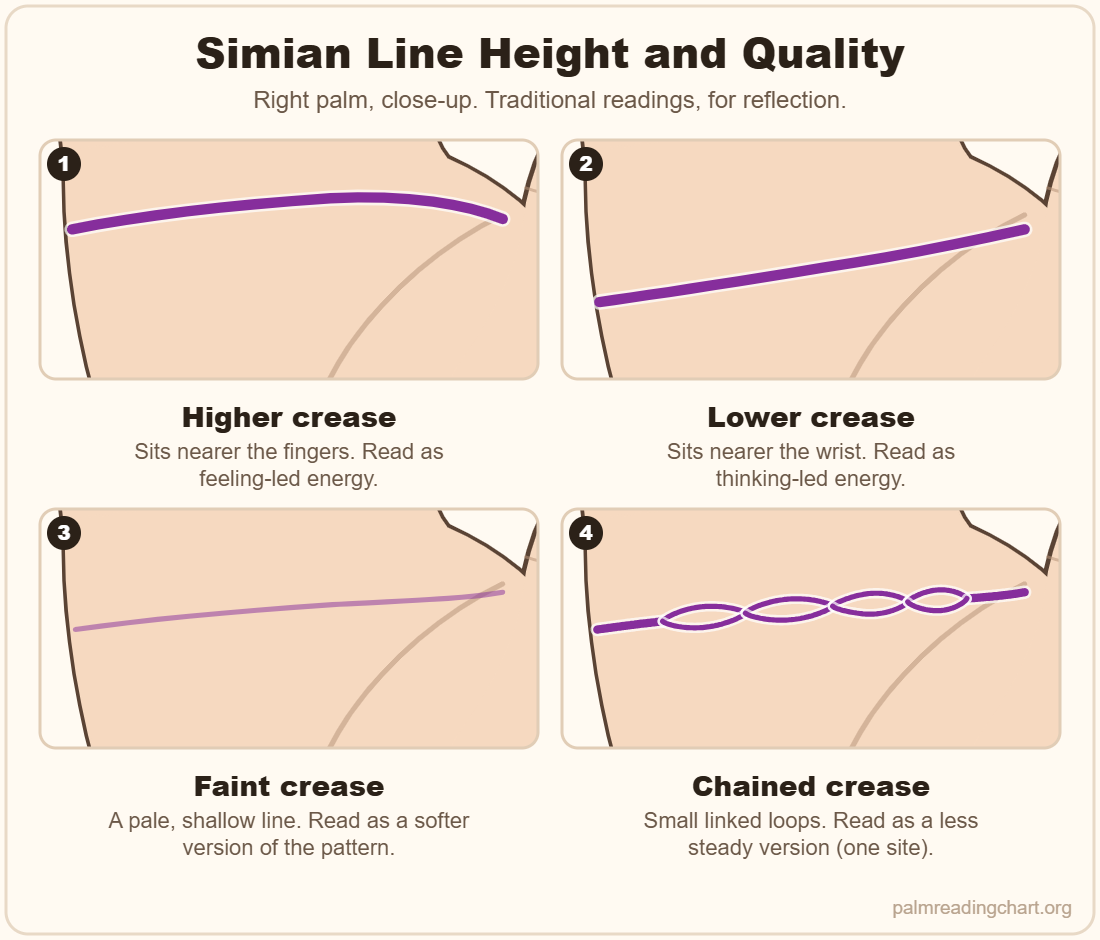
Some sites read the height of the crease. A crease that sits higher, nearer the finger bases, is read as feeling-led energy. A lower crease is read as thinking-led energy. One site warns against calling a high line emotional or a low line analytical on height alone.
Clear, faint or chained crease
A clear, unbroken crease is read as a steady pattern. Two sites read a faint crease as a softer blend, and one site reads a chained crease as a less steady version. Few sources go into detail here, so keep these readings loose.
Simian Line on One Hand or Both Hands
Palmists compare the hands, and the pattern changes the reading. On the hand you write with, a simian line is read as how you act now, in work and public life. On your other hand it is read as an inborn, inner tendency that may be quieter on the surface.
A line on both hands is rarer and is read as a deeply rooted, consistent style. If it shows on one hand only, some sites call the difference between your hands especially informative. One reading says a line on the inborn hand alone points to a pattern your active hand has partly moved away from.
Conventions differ on which hand counts as which, and a few traditions choose by gender. One site says the line does not depend on gender and hands should not be assigned that way. Our guide to choosing which hand to read compares the options.
Quick Guide to Simian Line Patterns
The table below gathers the readings above in one place.
| Pattern | Traditional reading |
|---|---|
| Full simian line | The more intense form (one guide) |
| Partial simian line | A softer blend of intensity and balance |
| Two full lines joined by a branch | Sites disagree on whether it counts |
| Sydney line | Usually a separate pattern: persistent, thorough thinking |
| Higher crease | Feeling-led energy |
| Lower crease | Thinking-led energy |
| Clear, unbroken crease | A steady pattern |
| Faint crease | A softer blend (two sites) |
| Chained crease | A less steady version (one site) |
| On the writing hand | How you act now |
| On the other hand | An inborn, inner tendency |
| On both hands | A deeply rooted, consistent style; the rarest pattern |
What a Simian Line Cannot Tell You
A simian line does not measure intelligence or moral character, and it cannot show how a relationship will go. Some older Western palmistry linked the crease to intellectual disability, and modern palmists reject that as stigmatizing. There is no evidence for it, and this guide leaves such claims out.
It is not a medical sign either. In most people who have it, the crease is a normal variation. Medical sources note that it turns up more often in some genetic conditions, such as Down syndrome. Most people who have it are healthy, though, and the crease alone is not a test for anything. A doctor diagnoses conditions, not a palm line. If a health or development question worries you, ask a doctor.
Palmists themselves do not agree on the line. One site says they split on whether it reflects a personality tendency or only a different way of processing information. Another site adds that modern psychology has found no verified link between palm creases and personality.
Simian Line Palm Reading FAQ
Is a simian line rare?
Somewhat. Reference sources estimate that about 1.5 to 3 percent of people have a single palmar crease. Having it on both hands is rarer still.
Does a simian line mean a health problem?
Not by itself. Doctors treat it as a minor variation, and any real concern belongs with a doctor.
Is a simian line lucky or unlucky?
Neither, say most palmistry sites. They read it as a sign of intensity that can show up as strong focus or as stubbornness, and some folklore calls it a blessing.
Does a simian line mean high intelligence?
No. Palmistry sources say the line does not measure intelligence. It describes how feeling and thinking combine, not how much of either you have.
Can a simian line change over time?
The main crease forms before birth, so a true simian line is not expected to split into two lines later. Fine creases around it may fade or deepen with age, and a partial line can look different with the angle and the light.
What is the difference between a simian line and a Sydney line?
A simian line replaces both the heart line and the head line with one crease. A Sydney line keeps the heart line and stretches the head line across the whole palm. If a separate heart line still shows above the long crease, it is a Sydney line.
Conclusion
Simian line palm reading treats one crease across the palm as a sign of intense, single-minded feeling and thought. Work out which type you have, compare both hands and keep the readings light. To place it among the other lines, see our palm reading chart and meanings and our beginner tutorial on how to read your palm.




Leave a Reply