Which hand to read in palm reading comes down to two answers: both, and the writing hand first. Palmistry sites tie the writing hand to your present life and the other hand to what you were born with, and many treat the comparison between the two as the most useful part.
Treat the rules below as conventions found on palmistry sites, not as facts about the body. Palmistry is generally classed as a pseudoscience, so use it for reflection and fun, not to predict your future.
Table of Contents
Which Hand to Read in Palm Reading: The Short Answer
Read both. Start with the hand you write with, then look at the same features on your other hand and note what matches and what differs. If you can look at only one hand, this guide suggests using the one you write with.
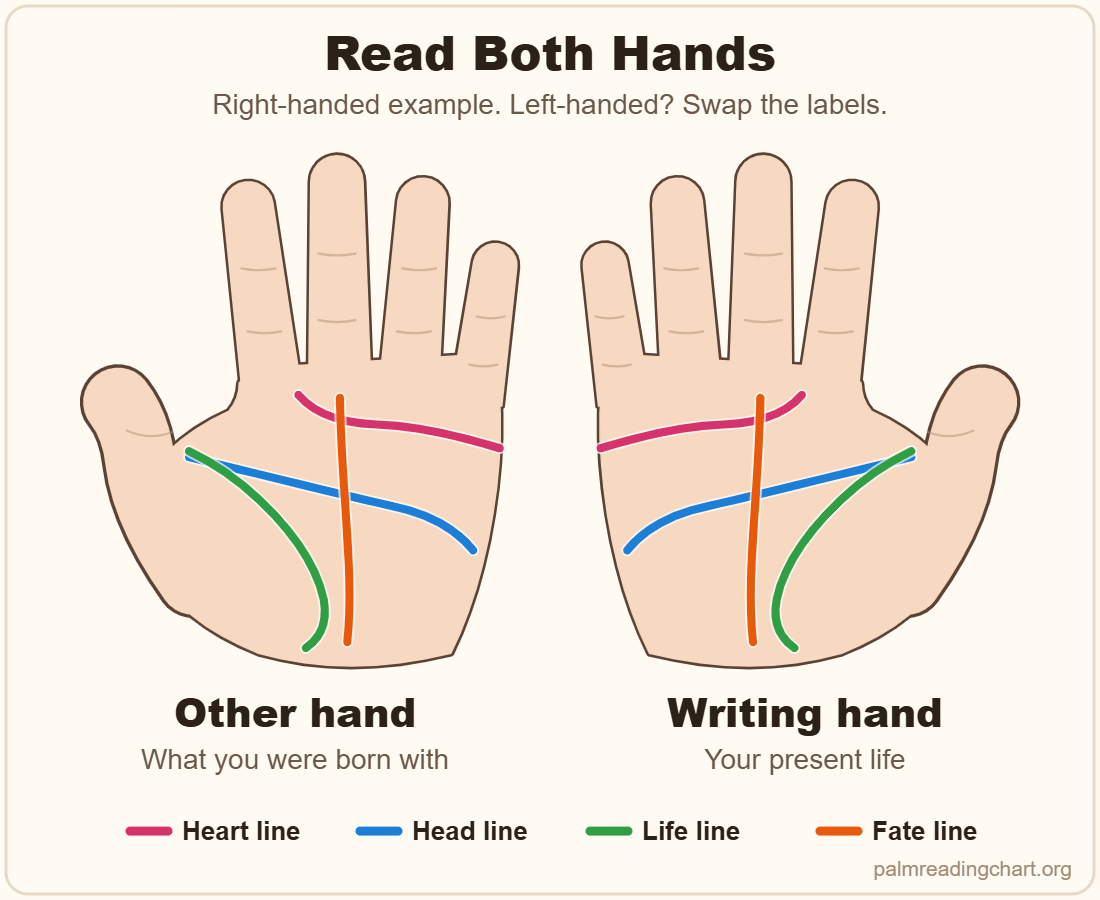
The drawing below is a right-handed example. If you write with your right hand, your right hand is linked with your present life and your left hand with what you were born with. If you write with your left hand, the roles swap.
What Each Hand Is Said to Show
The writing hand
Also called the dominant or active hand. Palmists link it with your present life: your choices, your experience and the traits you have built so far.
The other hand
Also called the non-dominant or passive hand. Palmists link it with what you were born with: natural tendencies, a starting point and unused potential.
If You Are Left-Handed or Use Both Hands
The rule follows handedness, not the side of the body, so a left-handed person reads the left hand first and treats the right hand as the other hand.
For people who use both hands, sources differ. One suggests the hand you favor for fine tasks such as writing, another says the right hand is the default by convention, and a third reads both hands equally. If you are unsure, use the hand you write with, as in the main rule.
If you were taught as a child to switch your writing hand, one source says to use the hand you write with now.
How to Compare Your Two Hands in 4 Steps
- Hold both palms open in bright, even light with the fingers relaxed.
- Read your writing hand first and note the main lines: heart, head, life and, if you have one, fate.
- Look for the same lines on your other hand.
- Note anything that is clearer, fainter or present on only one hand.
If the lines are new to you, start with our guide to palm lines and what they mean.
What It Means When Your Hands Differ
Palmists describe four patterns when they compare hands. Take the readings below as one common version.
The hands match
Matching hands are read as a life that has stayed close to your natural temperament.
The writing hand looks more developed
Lines that are clearer, longer or deeper on the writing hand are read as growth beyond your starting point.
The other hand looks more developed
Clearer, longer or deeper lines on the other hand are read as potential you may not be using yet.
A line on only one hand
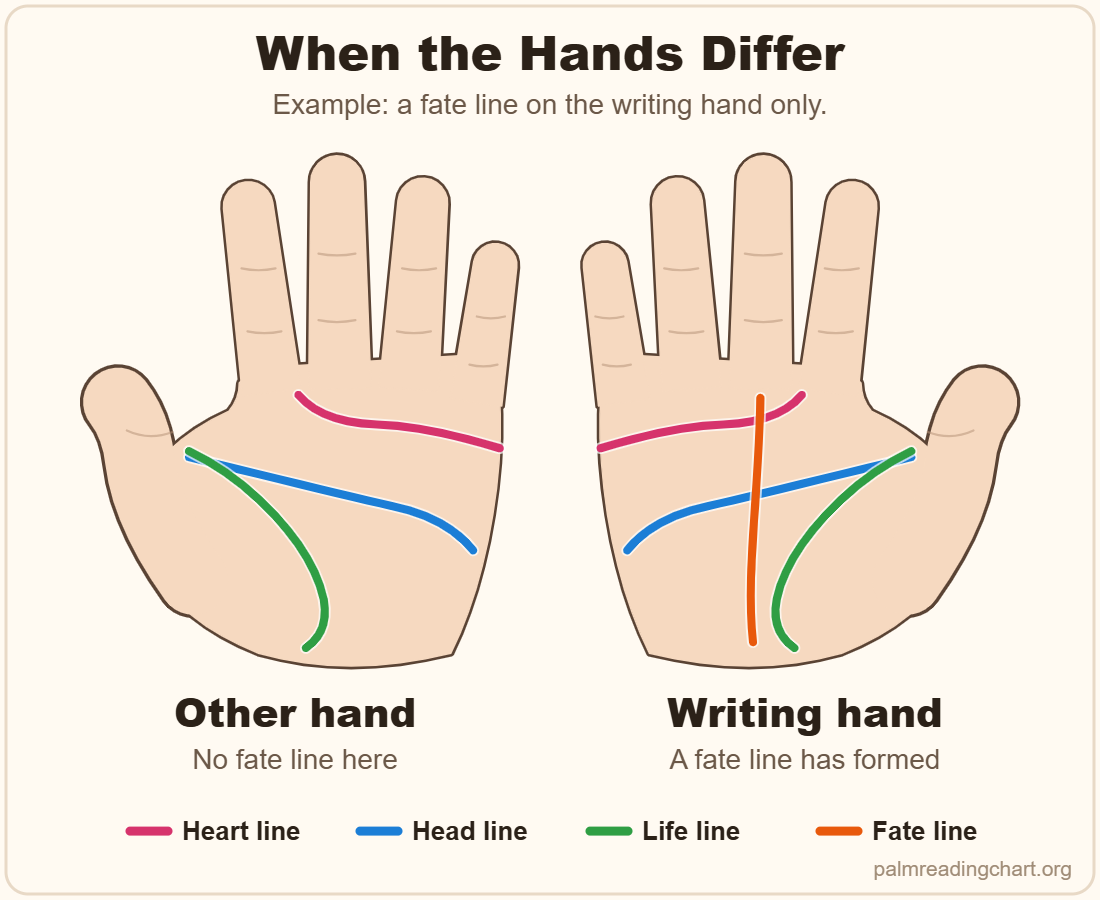
A line on the writing hand only is read as something built through experience, while a line on the other hand only is read as untapped potential. The drawing below shows a fate line on the writing hand only. One source says the fate line differs between hands more than any other line.
One source says lines on the writing hand change more visibly over a lifetime, while the other hand changes little. Palmistry offers this as part of the tradition, not as tested science.
Men Right, Women Left? What the Gender-Based Rule Says
Some traditions choose the hand by whether the reader is a man or a woman instead of by handedness, and the descriptions of that rule contradict each other. One site says Chinese palmistry reads the right hand for men, while others say the left. One site says classical Indian texts give men the right hand and some lineages reverse this for women. Several sites add that contemporary palmists in those traditions read both hands or follow the writing-hand rule, and Western palmistry mostly uses the writing hand for everyone.
This guide does not use a gender-based rule. The writing hand is the starting point for everyone, and because the descriptions disagree, this guide does not pick one of them.
Quick Guide: Which Hand to Start With
| Your situation | Start with |
|---|---|
| You write with your right hand | Your right hand, then your left |
| You write with your left hand | Your left hand, then your right |
| You use both hands | Sources differ: the hand you favor for fine tasks, the right hand by convention, or both equally |
| You switched your writing hand as a child | The hand you write with now, says one source |
| You follow a gender-based rule | Sources contradict each other; this guide uses your writing hand |
Which Hand to Read: FAQ
Is the left hand the past and the right hand the future?
Not literally. Some sources describe the other hand as the raw material you were born with rather than the past, and the writing hand as your present life. Neither hand predicts the future.
Do both hands show the same lines?
They are usually similar, but few people have two identical palms. Small differences in length, depth and branching are normal.
Which hand do I use for a particular line?
The sources we checked give no separate rule for individual lines, so use the same approach for each one: writing hand first, then compare the other. For the lines themselves, see our palm reading chart and our guide to the heart line.
Can I use a photo instead of looking at my palms?
Yes. Two of the sources we checked suggest photographing both palms in even light so you can compare them side by side.
Conclusion
Which hand to read in palm reading is simple to remember: read both, start with the hand you write with and compare the two. Treat the comparison as something to reflect on, and to go further, read our beginner guide on how to read your palm.


Leave a Reply