Bracelet lines in palmistry are the horizontal creases across the wrist, just below the base of the palm. Traditional readers treat them as themes of vitality, comfort and prosperity, and every one of the thirteen guides we read uses the word bracelet for them.
Below you will see where the lines sit, how to find and count them, and how the guides read clear, faint, wavy, chained and broken ones. We also look at lines that rise from the wrist into the palm, and at the places where the thirteen guides part ways. Wikipedia describes palmistry as a pseudoscience rooted in folk tradition, so take every reading as food for thought, not a forecast. The drawings show a right hand with the palm toward you and the fingers up. Flip them to picture a left hand.
Table of Contents
What Are Bracelet Lines in Palmistry?
Bracelet lines are minor lines, smaller than the heart, head and life lines. If palm lines are new to you, start with our overview of palm lines first.
The name varies from page to page. All thirteen guides say bracelet. Nearly all also say rascette, and two add the Indian name Manibandh Rekha. Several say wrist lines. None of the guides explains where any of these names comes from.
Where Bracelet Lines Sit on the Wrist
Most guides place the lines where the palm meets the wrist. They run across the wrist as horizontal or gently curved creases, often one below another like stacked rings. Figure 1 draws three of them on a right hand.
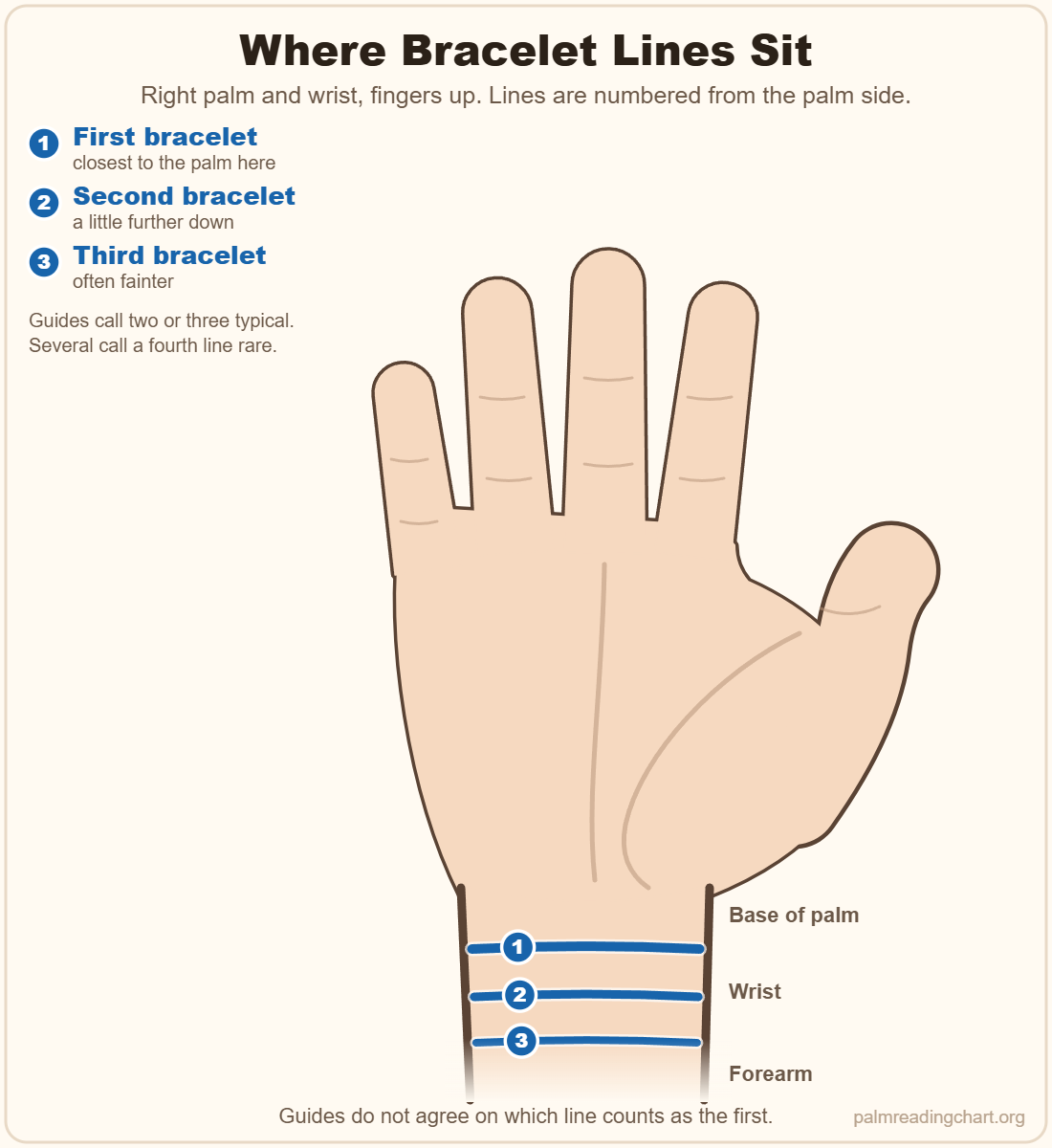
Guides usually number the lines first, second and third, and many add a fourth. Most do not say which line counts as the first. Two say it is the line nearest the palm, though one of those contradicts itself, and a few use wording that does not settle the question. Figure 1 numbers from the palm side for convenience only, so check which way a page counts before comparing two sources.
How to Find and Count Your Bracelet Lines
Wrist creases are easy to see and easy to over-read. These steps keep the count steady.
- Sit in even daylight and rest the forearm on a table with the palm facing up.
- Let the wrist relax in a neutral position. A note of our own: bending it deepens the creases and can add temporary ones.
- Look straight down at the wrist, then tilt it slightly so the light skims across the skin.
- Count only creases that run across most of the wrist’s width. Short wrinkles and fine skin texture do not count.
- Note which creases are clear and which are faint, since guides treat the two differently.
- Check the other wrist and compare the two.
How Many Bracelet Lines Do People Have?
Most guides that state a typical count say two or three. A few name three as the most common figure, and several call a fourth line rare or uncommon. One guide reads a hand with no bracelets as a sign of spiritual interests. The counts do not match from page to page, since one page calls two lines rare while others call two lines common.
What Each Bracelet Is Said to Mean
Traditional readings treat each bracelet as its own theme and then read the set together. Three themes recur across the guides: vitality, prosperity and contentment, with respect or recognition on most pages. Every guide mentions health in some form, and every guide mentions wealth or finances. We keep to the general idea of vitality here.
The First Line
Most guides tie the first line to youth and the early years, and they read a clear, deep one as a sign of vitality. One guide calls the first line the most important and says the others are read alongside it, while another ranks the third highest. Our life line guide covers the line that is read for energy across the whole hand.
The Second Line
Many guides link the second line to the middle years and to wealth or steady finances. A clear, deep, unbroken second line is read as comfort and gradual gains. For hands with just two lines the guides split. Some read steady, gradual success, while two read a modest or limited result.
The Third Line
Many guides tie the third line to later life. They read a clear one as one of the most fortunate signs, with respect, influence or good works around it. One guide calls a fainter third line usual, and that is a useful reminder not to read faintness as a flaw.
The Fourth Line
Several guides call a fourth line rare. Where they describe it, they read it as recognition, a lasting legacy or good luck.
Most guides also pin ages or life stages to the lines. Their schemes differ, so this article gives no ages. Nearly every page attaches heavier health and life-span claims to the lines as well. We leave those out, because a crease cannot support them.
Bracelet Line Patterns and What Guides Say
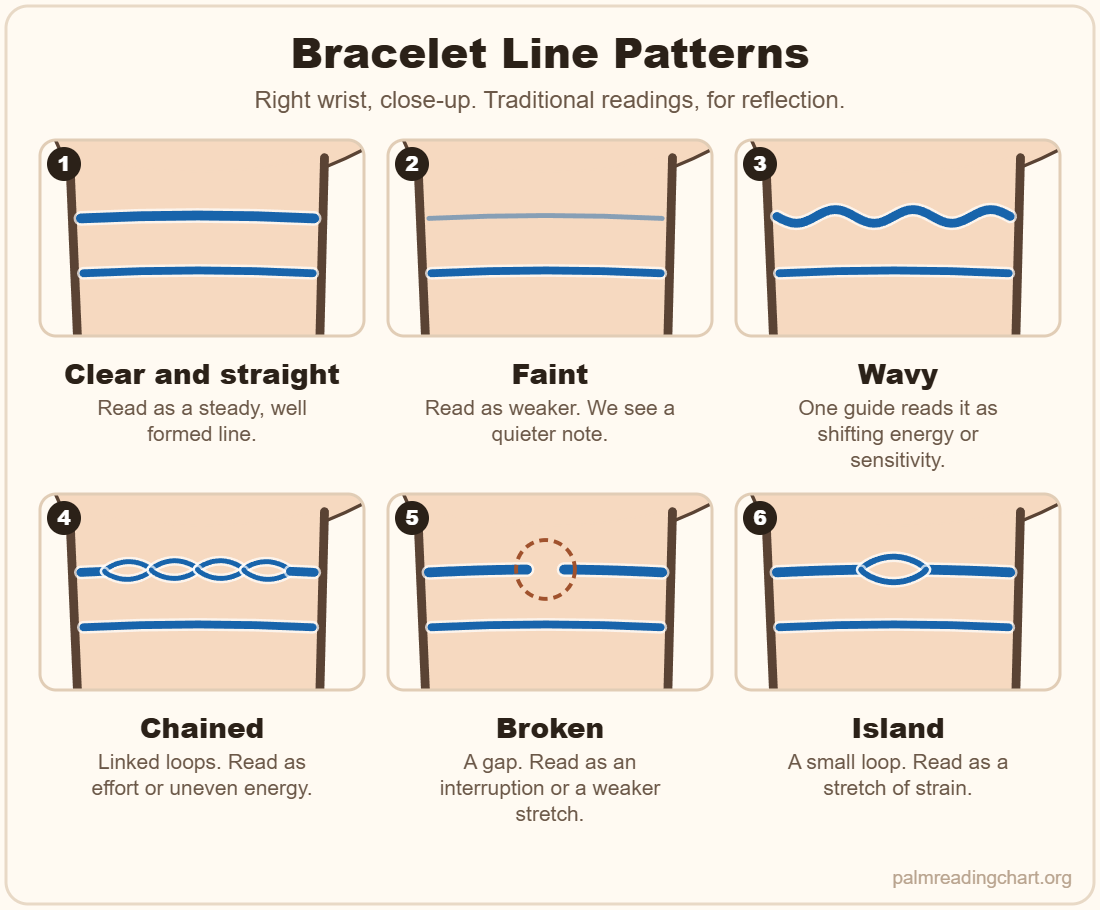
Beyond the count, guides look at how clear, straight and unbroken each line is. Figure 2 pictures six patterns on a right wrist, each with a second line below for comparison.
Clear, Deep and Straight
Almost every guide reads a clear, deep or unbroken bracelet as a favorable sign. Several add that a straight line is the favorable shape. Guides tie this combination to steady vitality.
Faint Lines
Most guides read a thin or faint line as the weaker version of a clear one. We prefer the gentler view that a faint line is a quieter note, not a flaw. Because the wrist bends, how faint a line looks can also change with how you hold the hand.
Wavy and Chained Lines
A couple of guides mention wavy lines, and one reads them as shifting energy or sensitivity. About half of the guides name chained lines, made of small linked loops. Some read a chained first line as effort followed by success, while others read it as uneven energy.
Breaks, Islands and Stars
Most guides treat a break in a bracelet as an interruption or a weaker stretch. One reads a fragmented second line as changing finances. Several read an island, a small enclosed loop, as scattered or drained energy or as a stretch of stress. A couple of guides read a star on a bracelet as a lucky sign, such as a sudden opportunity. Our palm marks guide covers islands, stars and crosses across the whole hand.
Lines That Rise From the Wrist
A separate group of marks is the set of lines that start at a bracelet and climb into the palm. Only three of the thirteen guides describe them. An old book text and a newspaper article both talk about travel and recognition, and a third page adds one reading for the Apollo mount. Figure 3 pictures four of the five destinations the first two share. We skip the fifth, which carries a gloomy reading.
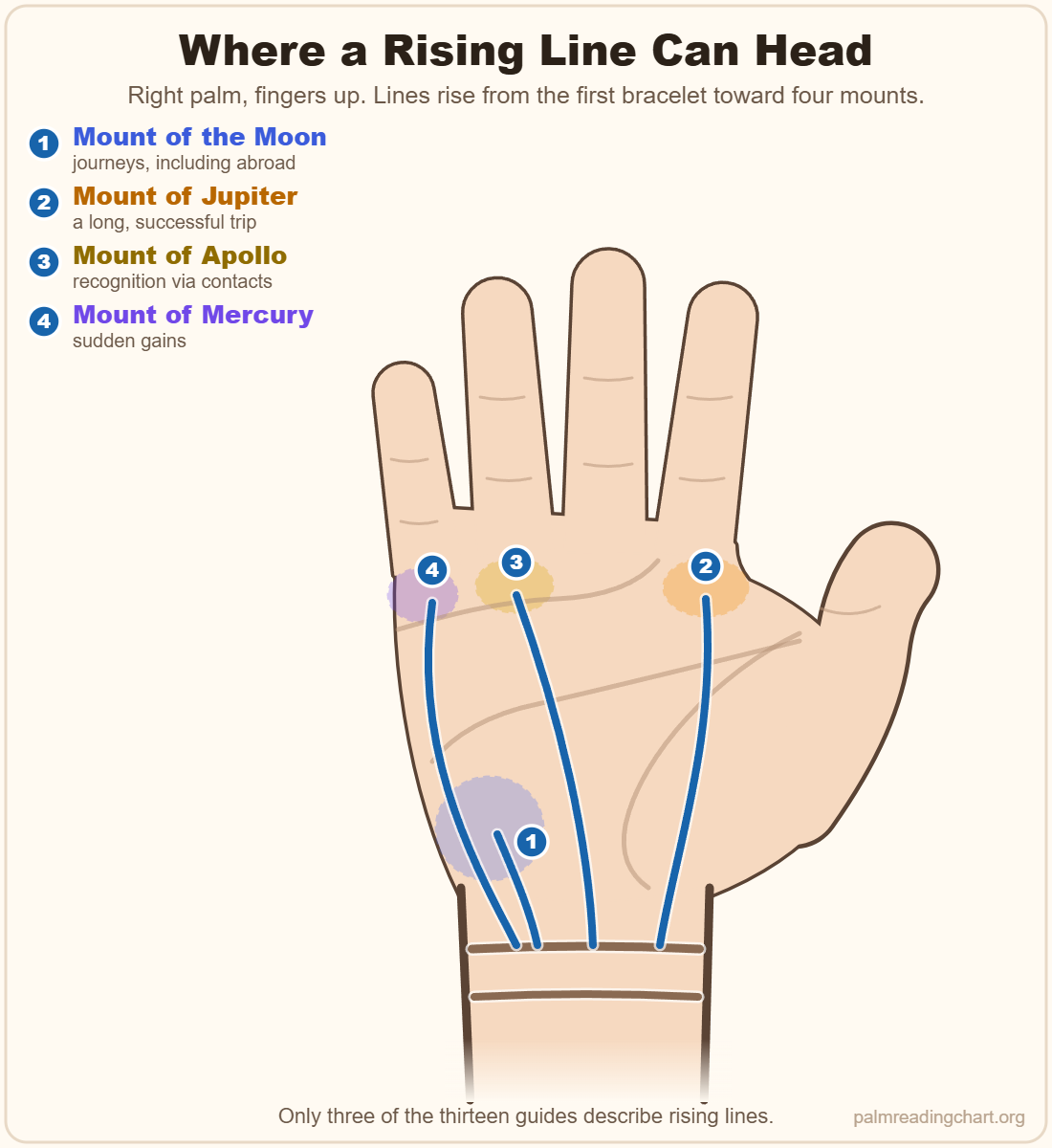
- Toward the Mount of the Moon. Read as journeys, including trips abroad.
- Toward the Mount of Jupiter. Read as a long, successful journey.
- Toward the Mount of Apollo, the sun mount. Read as recognition through contacts made while traveling.
- Toward the Mount of Mercury. Read as a sudden gain.
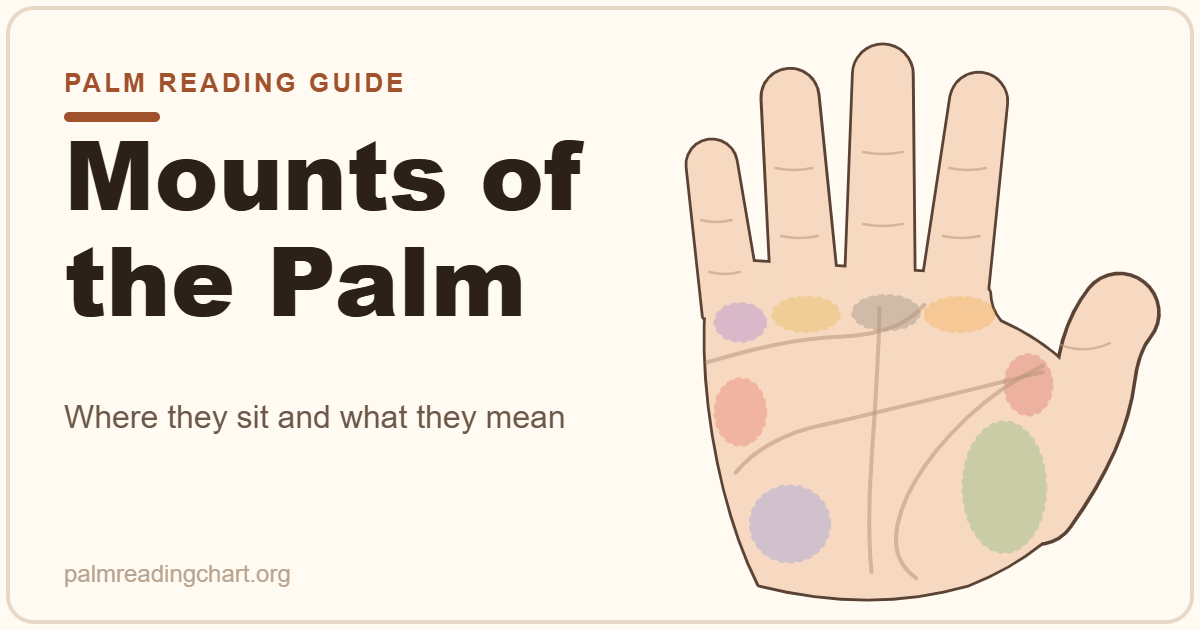
The old text adds that lines rising from the rascette point to an ennobling tendency. The newspaper piece adds that any rising line points to wishes being fulfilled. A mounts of the palm guide names each pad. Because these claims come from so few pages, treat them as one tradition’s view, not a broad agreement.
Bracelet Line or Look-Alike?
Several things near the wrist can pass for bracelet lines. The list below covers three.
- Bending creases. The wrist folds where it bends, so tilting the hand back adds temporary creases. Read the wrist at rest.
- Travel lines. One old text warns against mixing up the first bracelet with a voyage line. Our travel lines guide covers the short creases on the outer edge of the hand.
- The fate line. A few guides look at where a major line meets a bracelet. A line running up the center of the palm from the wrist may be a fate line instead. Our fate line guide shows its usual route.
Do Bracelet Lines Change Over Time?
Several guides say the lines can change with age, health or lifestyle. One says the third and fourth lines are acquired and can shift with mindset and habits. Two guides mention skin wrinkles or creases as a limit on how reliably the lines can be read. Treat the lines you see today as one moment, and look again after a while.
Which Hand Shows Bracelet Lines?
Guides do not agree on this. A few suggest starting with the dominant hand, and others follow older rules that split the hands in different ways and contradict each other. Our which hand to read guide explains the rule this site uses, including for left-handers. Both wrists carry bracelets, so compare them and read any difference as a detail worth noting, not a verdict.
Bracelet Lines at a Glance
| Mark | Traditional reading | Worth checking |
|---|---|---|
| Clear, deep line | A favorable sign of vitality (almost every guide) | That it crosses most of the wrist at rest |
| Straight line | The favorable shape (several guides) | That the wrist is relaxed, not bent |
| Faint or thin line | A weaker or quieter theme (most guides) | The light angle, and whether the other wrist matches |
| Wavy line | Shifting energy or sensitivity (a couple of guides) | That it is one wave, not stacked creases |
| Chained line | Effort before success, or uneven energy (about half the guides) | Small linked loops along a single line |
| Broken line | An interruption or weaker stretch (most guides) | Whether a bending crease makes the gap |
| Island | Scattered energy or a stretch of stress (several guides) | A true loop, not two creases that meet |
| Star | A lucky sign or sudden opportunity (a couple of guides) | A true star, not crossing creases |
| Two or three lines | The typical count (most guides that state one) | Which line your source counts as first |
| Fourth line | Rare, with recognition or legacy (several guides) | Whether it is a crease or a wrinkle |
| Rising line | Journeys, recognition or a sudden gain (three guides) | Where it ends, and whether it is a fate line |
Where the Thirteen Guides Differ
The sources agree on the name and the basic location. All thirteen say bracelet, and most place the lines where the palm meets the wrist. They split on which line is first, on whether two lines are common or rare, on how to read a chain and on the age schemes. The rising-line readings rest on just three pages, and a few pages closely resemble one another, so they are not independent confirmations.
Nearly every page also attaches heavy health and life-span claims to the lines. We drop those claims because no wrist crease can bear them. What stays are the milder readings of vitality, prosperity and contentment that several guides share.
What Bracelet Lines Cannot Tell You
None of the thirteen guides says palmistry is entertainment, and none calls it unscientific. Four add softer caveats. One calls the readings traditional and not clearly demonstrated, and one says they show tendencies and not fixed outcomes. One says they offer no medical or financial promises, and one labels its page educational and not medical advice. A wrist crease cannot show your future, your wealth or your health. For real decisions, rely on facts, qualified professionals and people you trust. If you enjoy them, let bracelet lines nudge you to think about vitality and contentment in your own life, and nothing beyond that.
Bracelet Lines in Palmistry FAQ
What are bracelet lines in palmistry?
They are the horizontal creases across the wrist, below the palm, also called rascette lines. Guides read them as themes of vitality, prosperity and contentment, and they disagree on many details.
How many bracelet lines should I have?
Most guides that state a typical count say two or three. Several call a fourth line rare, and a few discuss hands with a single line.
Which bracelet line is the first?
Guides do not agree. Most do not say, two start from the palm side, and a few use wording that does not settle it. Check which way your source counts.
Which wrist should I read?
Guides do not settle this. A few suggest starting with the dominant hand, and our which hand guide explains the rule this site uses. Comparing both wrists is the safest habit.
Can bracelet lines change?
Several guides say they can, with age, health or lifestyle, and two mention wrinkles as a limit on reading them. Look again after some time.
Conclusion
Bracelet lines in palmistry are the creases across the wrist, read as themes of vitality, prosperity and contentment. Find them with the wrist at rest in even light, count only creases that cross most of the width and compare both hands. Guides tie clarity and straightness to a favorable reading, and they disagree on counting, ages and chains. For a full reading from start to finish, follow our walkthrough for reading your palm. Then see where the wrist fits on the labeled chart of palm lines and mounts.

Leave a Reply