A palm reading chart is a labeled map of the hand. It shows where each line and mount sits and what palmistry traditionally says about it.
This chart covers six lines, eight mounts, line features and the four hand shapes. The labeled chart shows a right palm, and the tables gather the traditional readings in one place.
This chart reflects tradition, so use it for curiosity and self-reflection. The palmistry article on Wikipedia notes that scientific literature treats it as pseudoscience and points to a lack of evidence for its predictions. Nothing here is medical, legal or financial advice.
Table of Contents
Palm Reading Chart: Lines and Mounts on One Hand
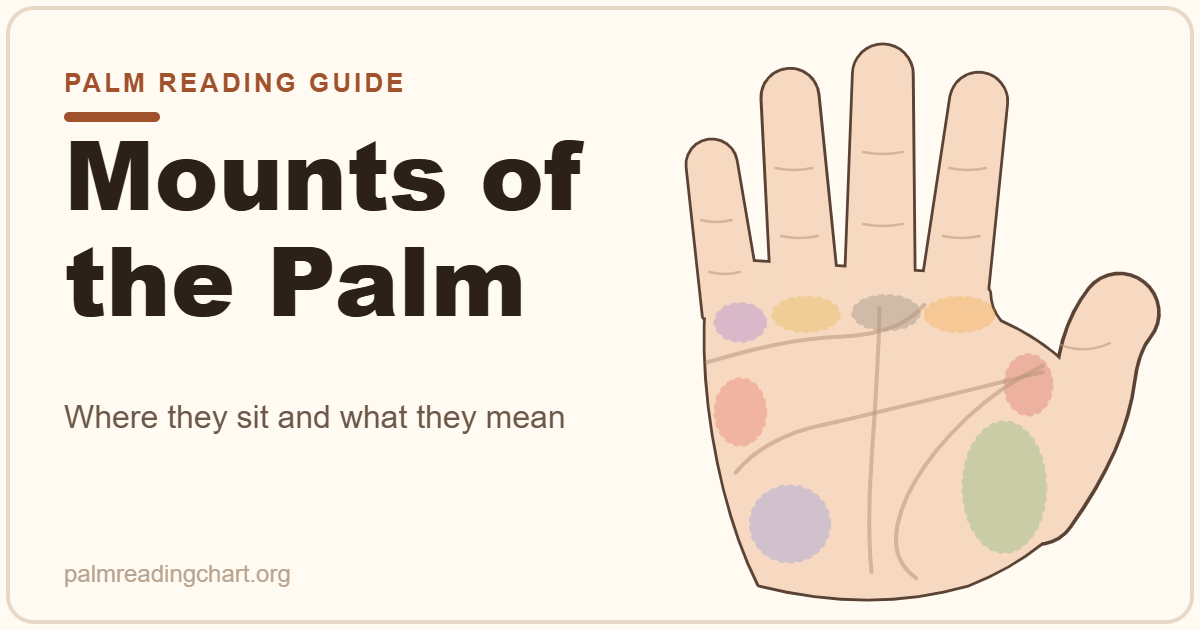
The chart below puts the lines and mounts on a single right palm. Numbers mark the six lines, and letters mark the eight mounts.
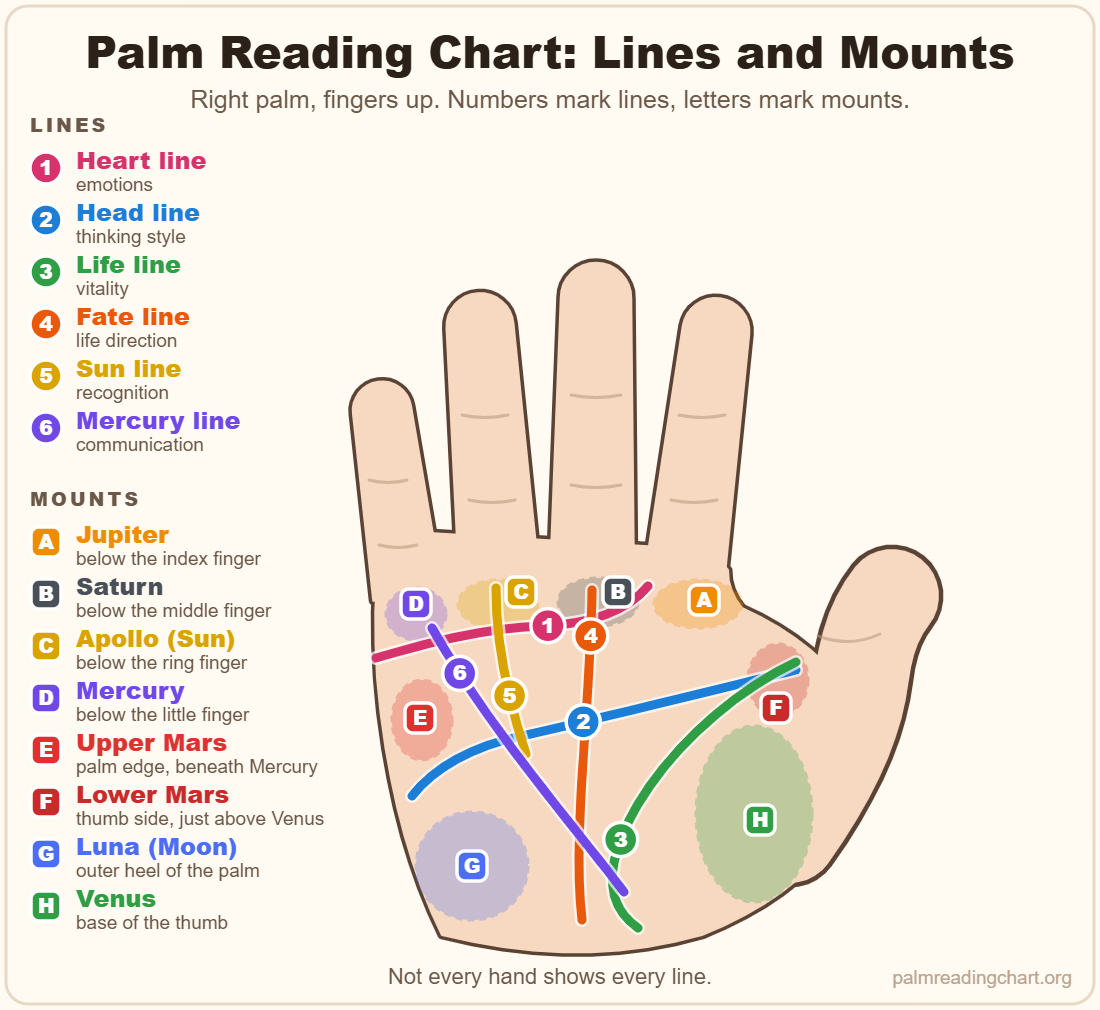
Guides do not agree on the list of mounts. Most name six or seven. Wikipedia and some guides add the plain of Mars, and Wikipedia also lists a mount of Neptune. This chart draws the six that most guides name plus the two Mars mounts, which makes eight.
Want a copy? Save the chart image and print it at full page width to keep beside you while you read.
Palm Reading Chart and Meanings: The Lines
Most charts start with the heart, head, life and fate lines. One chart treats the fate line as a minor line, so the count of major lines differs. Most guides add the sun line, and some add the Mercury line or marriage lines. The table lists traditional readings only.
| Line | Where it sits | Traditional reading |
|---|---|---|
| 1. Heart line | Across the upper palm, below the fingers | Emotions, love and relationship style |
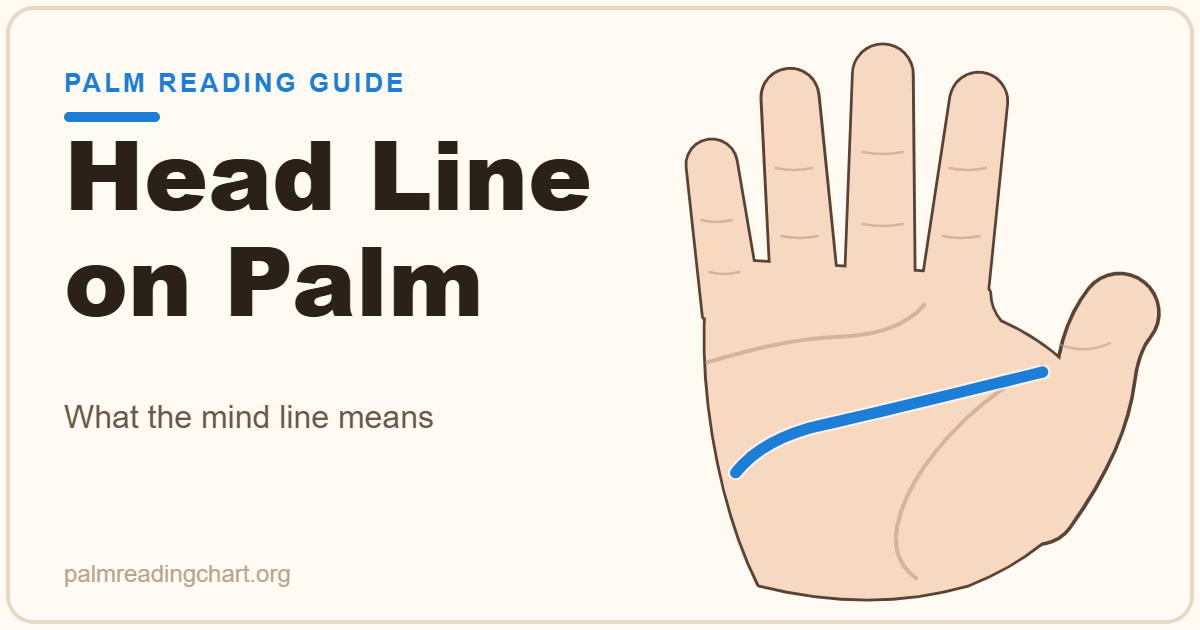
| 2. Head line | Starts between the thumb and index finger and crosses the middle of the palm | Thinking, learning and decision-making |
| 3. Life line | Arcs around the ball of the thumb | Vitality and major life changes, not lifespan |
| 4. Fate line | Rises through the middle of the palm; not everyone has one | Career direction and life path |
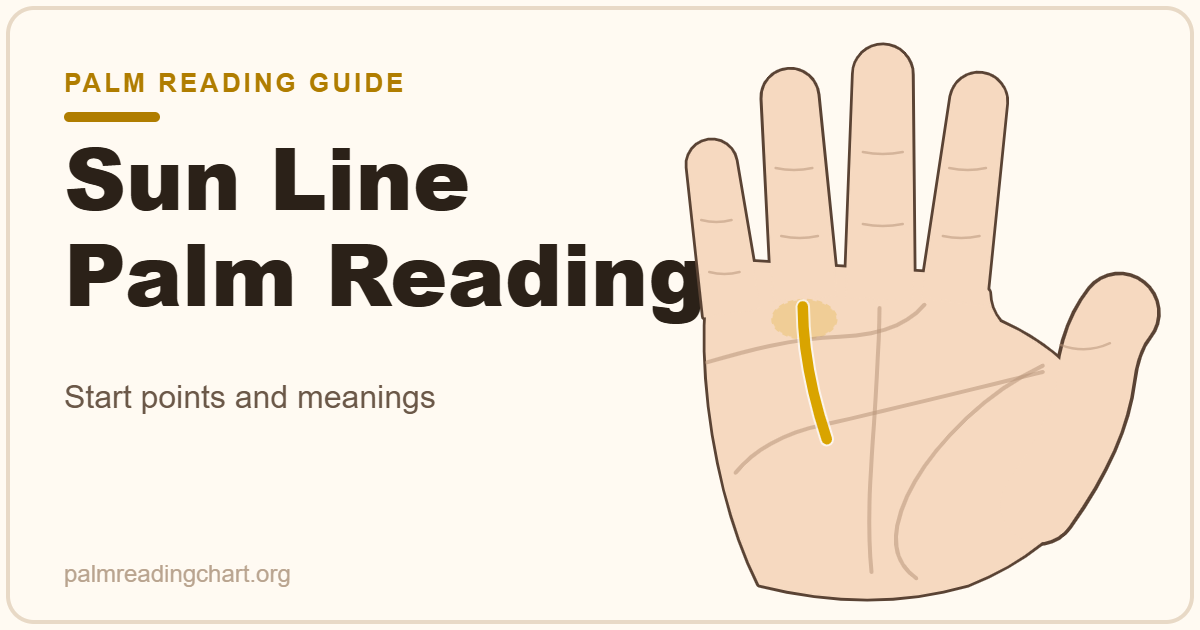
| 5. Sun line | Runs toward the ring finger, beside the fate line; often faint or absent | Recognition and creative success |
| 6. Mercury line | Slants up from the wrist area; many hands lack it | Communication and business sense; some guides add health (not a medical sign) |
Most guides stress that the life line does not measure how long you will live. They read it as vitality and major life changes instead. Our guides to the life line, heart line, head line and fate line go deeper on each one.
The Mercury line goes by more than one name. Guides also know it as the health line, and our health line guide covers it under that name.
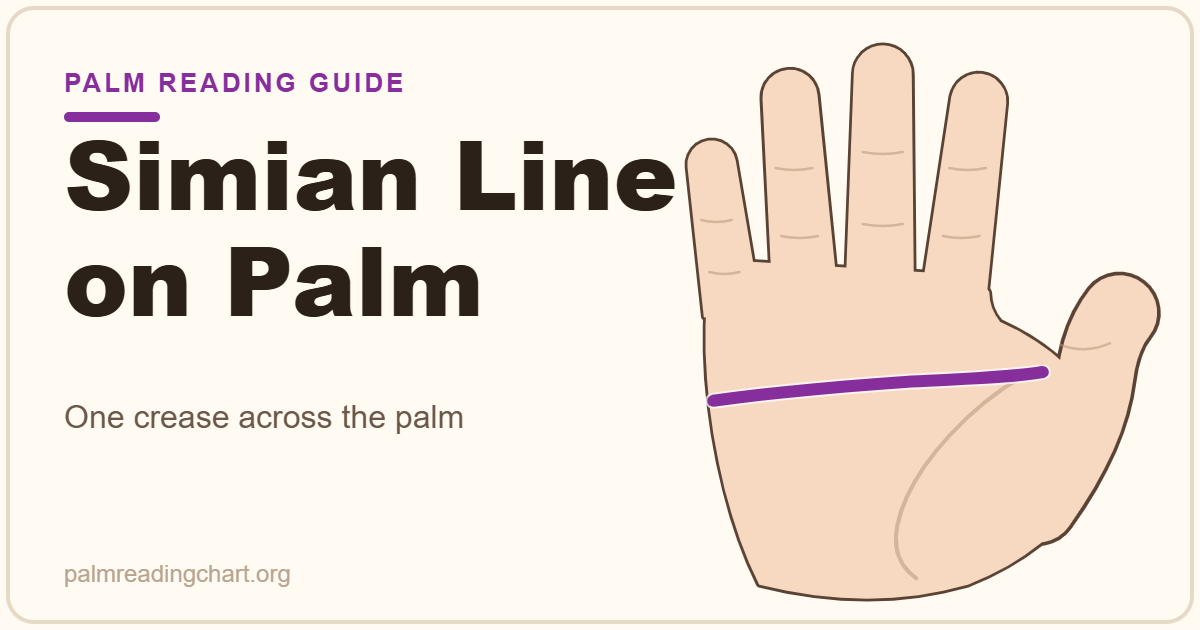
Some charts also mark the marriage lines, which are short lines on the edge of the palm below the little finger. A heart line and head line that merge into one is called the simian line. Our posts on marriage lines and the simian line cover those marks. Bracelet lines at the wrist and the girdle of Venus appear on fewer charts.
Palm Reading Chart and Meanings: The Mounts
Mounts are the raised pads of the palm. Guides usually give them planet names such as Jupiter and Venus, and some read a fuller pad as a stronger trait.
| Mount | Where it sits | Traditional theme |
|---|---|---|
| A. Jupiter | Below the index finger | Ambition and leadership |
| B. Saturn | Below the middle finger | Duty and self-discipline |
| C. Apollo (Sun) | Below the ring finger | Creativity and recognition |
| D. Mercury | Below the little finger | Communication and commerce |
| E. Upper Mars | Palm edge, beneath Mercury | Courage and stamina (guides vary) |
| F. Lower Mars | Thumb side, just above Venus | Courage and stamina (guides vary) |
| G. Luna (Moon) | Outer heel of the palm | Imagination and intuition |
| H. Venus | Base of the thumb | Warmth, love and energy |
Some guides call the two Mars areas inner and outer Mars. Inner (lower) Mars is the thumb-side area, and outer (upper) Mars is the one on the palm edge. At least one guide swaps the upper and lower labels. Guides also describe their themes in different words, from courage to physical strength and tenacity.
Hand Shapes on a Palm Reading Chart
Some guides start with the shape of the hand, before they look at any line. They sort hands into four types named after the elements, using palm shape and finger length.
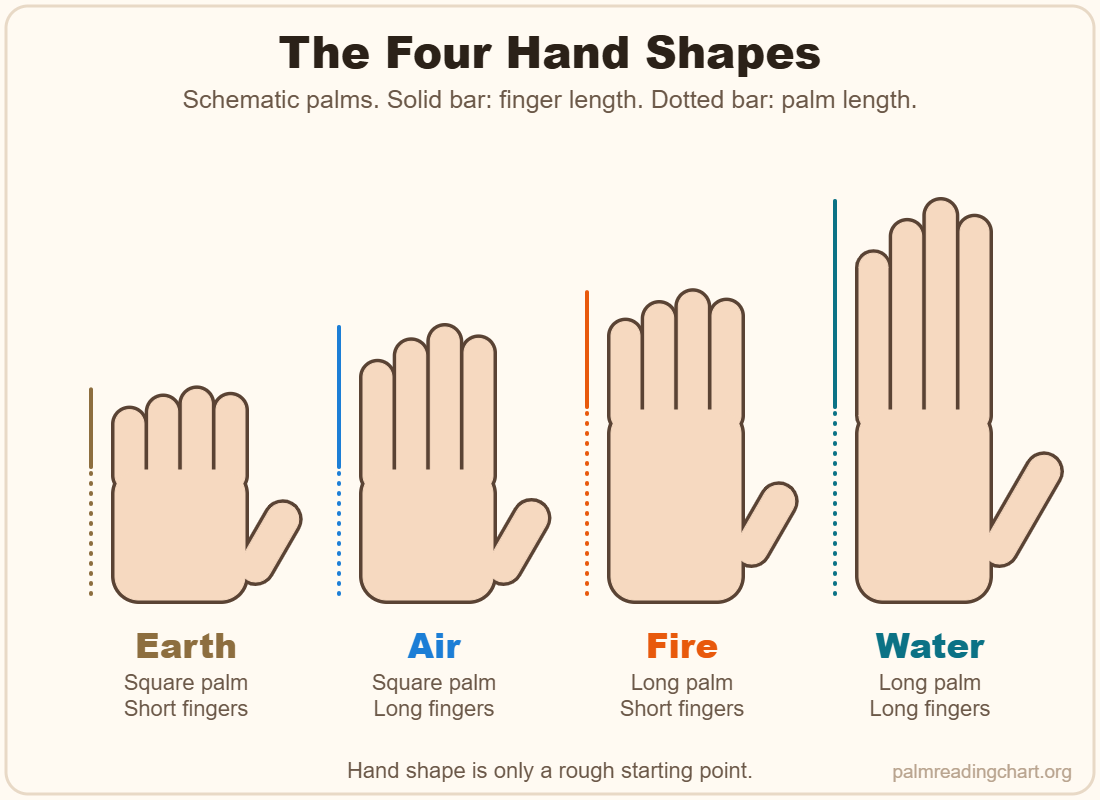
| Type | Palm | Fingers | Traditional theme |
|---|---|---|---|
| Earth | Square | Short | Practical and grounded |
| Air | Square | Long | Analytical and curious |
| Fire | Long | Short | Bold and passionate |
| Water | Long | Long | Intuitive and sensitive |
Guides compare the length of the fingers with the length of the palm. They define the palms for Fire and Water in slightly different words, and one guide gives Fire a square palm. One guide also notes that most real hands blend types, so the label is only a rough starting point.
What Line Features Mean on a Palm Reading Chart
Guides also read how a line looks, not only where it sits. These readings are traditional, and they change with the line the feature appears on.
| Feature | What it looks like | Traditional reading |
|---|---|---|
| Deep and clear | A well-marked crease | A steady, well-established theme in that area of life |
| Faint or thin | A shallow crease | A quieter or still-developing theme, not a missing one |
| Break | The line stops and starts again | A change or transition in that area of life, not an ending |
| Chain | A run of small linked loops | One site reads it as a complicated or unsettled period while the line continues |
| Fork | The line splits into two arms at its end | Depends on the line; one guide reads a forked head line as seeing several sides of an issue |
| Island | The line splits, encloses a small space and rejoins | A difficult or low-energy period in that area; one site rejects fixed meanings and reads islands by context |
Several sources agree that no single feature settles a reading, and that lines can change over time. Read each feature in context, and compare both hands.
How to Use a Palm Reading Diagram in 6 Steps
Follow this order to match your own palm to the chart.
- Open your writing hand under soft daylight with the fingers relaxed.
- Compare palm length with finger length to find the closest hand shape.
- Find the heart, head and life lines, then the fate line if you have one.
- Note where each line starts and ends, plus its length, depth, breaks and forks.
- Look for fuller or flatter mounts, and check for the sun and Mercury lines.
- Do the same on your other hand, then compare both palms.
Weigh the features together instead of judging one mark alone. A faint or missing line is common.
Which Hand to Read on the Chart
Many guides assign the writing hand to your present and the other hand to your birth traits. Reading both is the usual advice. The which hand to read post compares the views in full.
What a Palm Reading Chart Cannot Tell You
A chart is a map of tradition, not a measurement. Wikipedia says palmistry has many interpretations of lines and features, and they often conflict with one another. That helps explain why the mount list and the line count change from guide to guide.
Most guides say a short life line does not mean a short life, and several add that fine lines can change over the years. Wikipedia adds that palmistry’s predictions lack evidence. Please do not use a chart to guess at your health, your money or a relationship decision.
Palm Reading Chart FAQ
What is a palm reading chart?
It is a labeled diagram of the hand. It shows where the lines, mounts and sometimes the hand shapes sit, along with the traditional meaning of each one.
Which lines are on a palm reading chart?
Most charts show the heart, head, life and fate lines. Most also add the sun line, and some add the Mercury line or marriage lines.
How many mounts are on a palm reading chart?
It depends on the guide. Most guides list six or seven, and Wikipedia’s list is longer because it adds the plain of Mars and Neptune. This chart shows eight.
Are palm reading charts accurate?
A chart can show where each line sits, but the meanings are traditional, and Wikipedia notes a lack of evidence for palmistry’s predictions. Guides also disagree on points such as the mount count and which lines are major.
Does the chart work for a left hand?
The lines keep the same names and positions on a left hand, but the drawing flips. Your thumb sits on the left when you look at your own left palm. Guides often read the two hands for different things, as the hand section above explains.
Is palm reading real?
It is a long-standing tradition, but Wikipedia says it is widely viewed as a pseudoscience. Use it for fun or reflection, and not for decisions about your life.
Where does palmistry come from?
Wikipedia says palmistry is common across the Eurasian landmass. It adds that medieval Sanskrit texts placed it within Samudrika Shastra, and that it also developed on its own in Greece.
Conclusion
A palm reading chart brings the lines, mounts and hand shapes together on one hand. Use the tables to find each mark, compare both hands and treat every meaning as tradition. For a plain-language overview of the same marks, read palm lines and what they mean.


Leave a Reply